All species › Caryophyllales › Sundew family › Drosera helodes
Drosera helodes
A pygmy sundew of the coastal plain around Perth, and one of the many species separated only in the 1980s and 1990s from the huge variety of south-west Australian miniature sundews. The name helodes is Greek and means 'of the marsh': the plant grows in hollows that fill with water in winter. Neville Marchant and Allen Lowrie described it in 1992.

Identification
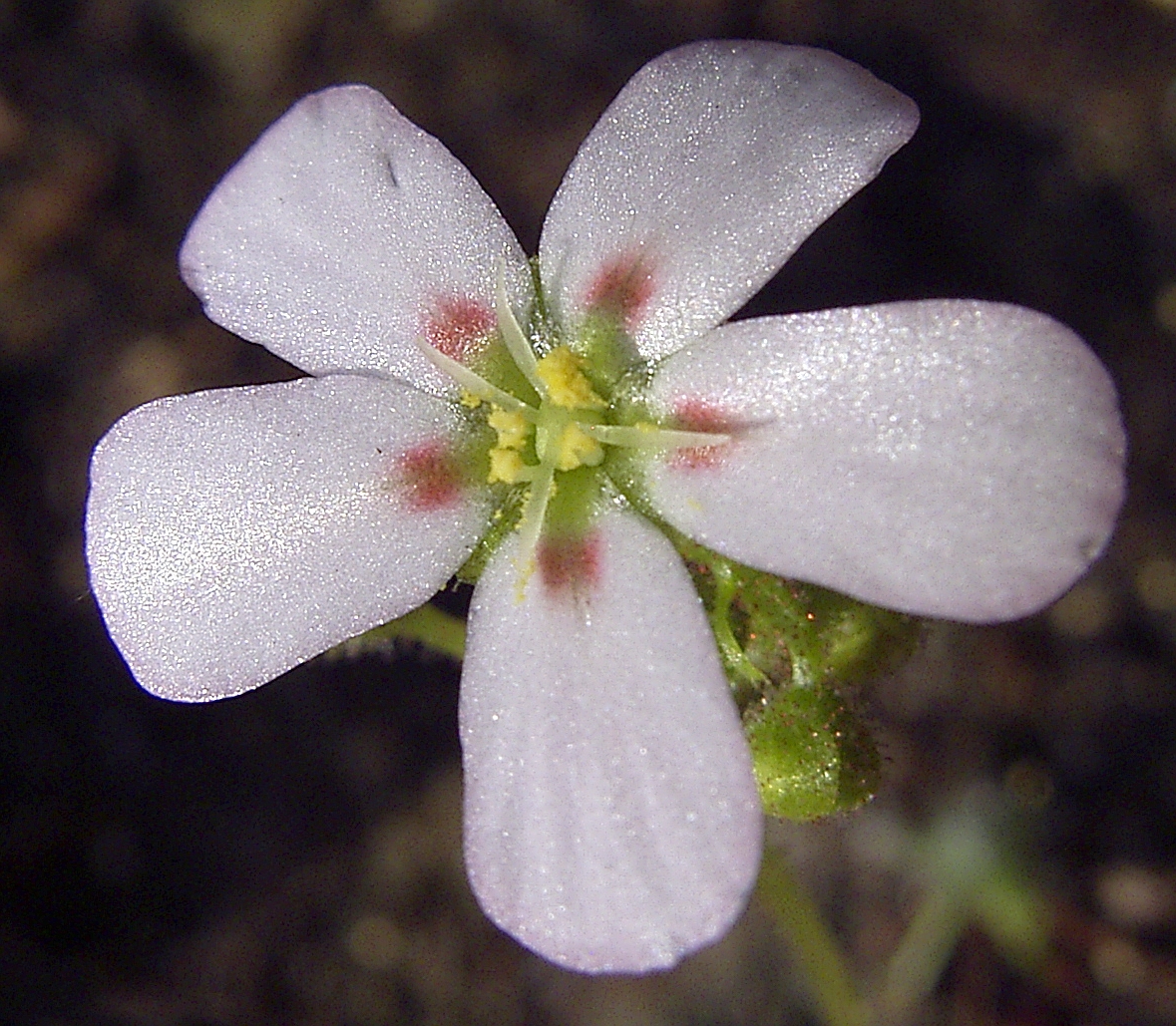
A small, fibrous-rooted, perennial rosette reaching about 8 cm tall; as in many pygmy sundews the rosette can rise over the years on a short stem. At the heart of the rosette sits a tuft of shiny, whitish stipules, the hallmark of the whole pygmy group. The flowers are pink and appear in October and November. We did not find precise measurements of leaf and flower in any source consulted.
Similar species
South-west Australia holds dozens of pygmy sundews, and many cannot be named without flowers. From the orange-flowered species, such as Drosera hyperostigma and D. leucoblasta, D. helodes is told apart by its pink flowers. Among the pink- and white-flowered species the differences often lie in details of styles, stigmas and the hairiness of scape and sepals, visible with a hand lens. The wet coastal-plain habitat is a clue, not proof.
The trap and how it works
An active flypaper trap in miniature. The leaf blades carry stalked glands each with a sticky droplet; the outer, longer tentacles catch the prey and then bend towards the centre of the leaf, where shorter glands take over the digestion. The prey is the very smallest: springtails, mites, tiny midges. For so small a plant every catch is a real contribution to its nitrogen supply.
Habitat and ecology
Sandy soils with laterite in hollows that are wet in winter and dry out in the long, dry summer (W7, D3, D1). The plant grows through the wet winter and spring months, flowers in spring and withdraws in summer to a resting bud protected by the stipules.
Distribution and elevation
Endemic to south-west Australia. FloraBase records the species for the Swan Coastal Plain bioregion, in the Dandaragan Plateau and Perth subregions: the coastal plain around and north of Perth.
- Recorded (one-degree cells)
Forms and variation
No subspecies or varieties have been described. As in nearly all pygmy sundews, the plant reproduces not only by seed but also asexually: at the end of the growing season it forms gemmae in the heart of the rosette, small modified leaves that are flung away by splashing raindrops and grow into new plants. That is why they often stand in dense little groups.
Where and when to see it
Go in October, when the flowers are open; they only open in sunshine, so choose a bright day around midday. Search the edges of wet hollows on the coastal plain and kneel down: a rosette a few centimetres across only shows up when you are right above it. Much of the remaining bushland on the coastal plain is hemmed in by suburbs; keep to the paths.
Conservation status
On the global IUCN Red List the species is listed as Least Concern (LC), and in Western Australia it is also regarded as not threatened. It is not listed in CITES. Its habitat does lie in one of the most urbanised parts of south-west Australia, where wet hollows are drained and built over. Uncertainty: the available sources are thin; we could not consult the original description or the detailed treatment in Lowrie's Carnivorous Plants of Australia Magnum Opus (2013).
Scientific name
Drosera helodes | Marchant & Lowrie, 1992
Described by N.G. Marchant & Lowrie in 1992, in Kew Bulletin, volume 47, no. 2, p. 324 (29 June 1992). On Great Northern Highway, about 3 km north of Bullsbrook, Central Rural District of Western Australia. Collected by A. Lowrie on 22 November 1983 (field no. 83/045); holotype PERTH 4179226. Probably from the Greek helōdēs ("of marshes, marsh-loving") — consistent with the species' habitat in winter-wet depressions, though this is not literally confirmed in a source.
World Checklist of Vascular Plants (WCVP), via Plants of the World Online (POWO), Royal Botanic Gardens, Kew.