All species › Caryophyllales › Sundew family › Drosera heterophylla
Drosera heterophylla
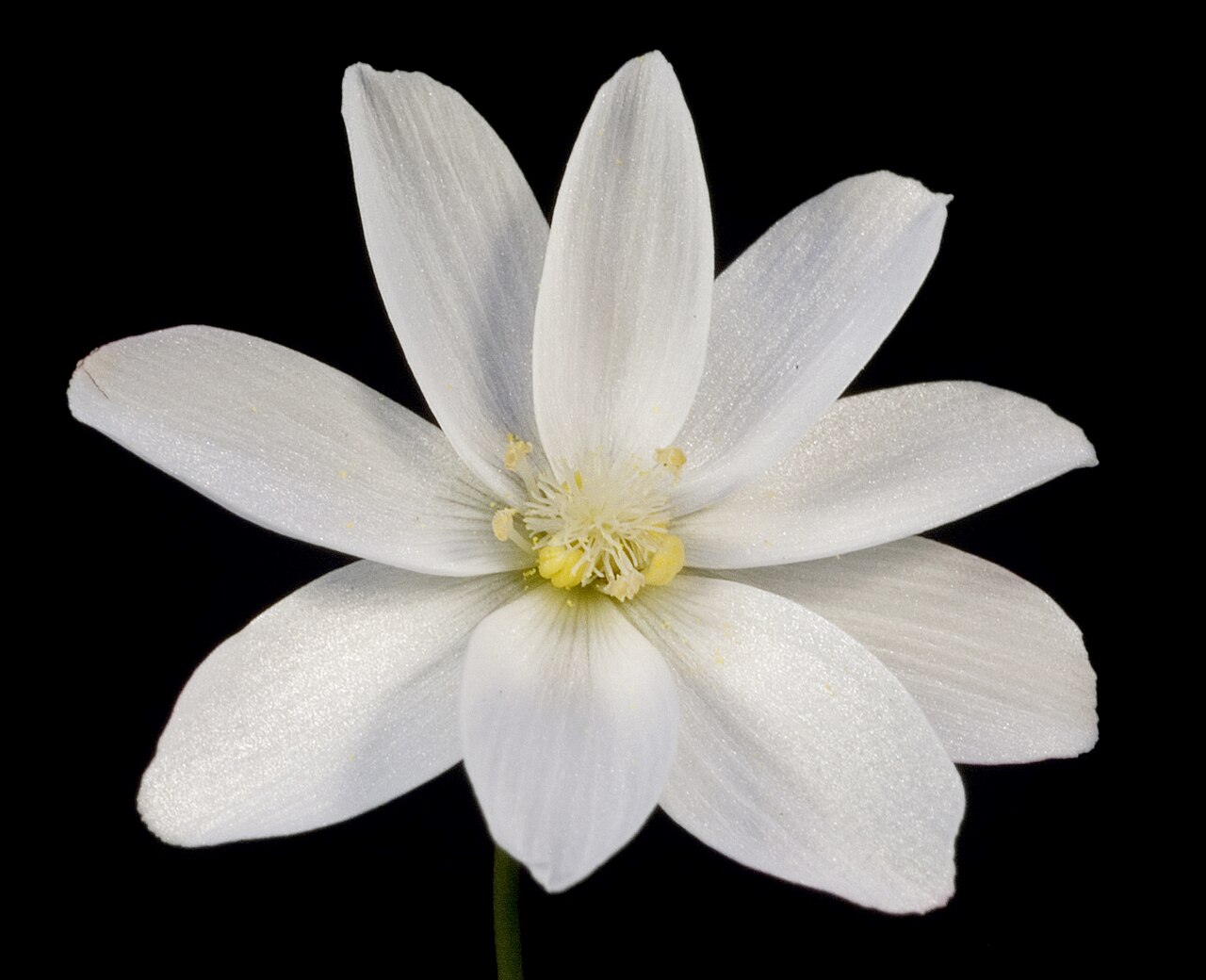
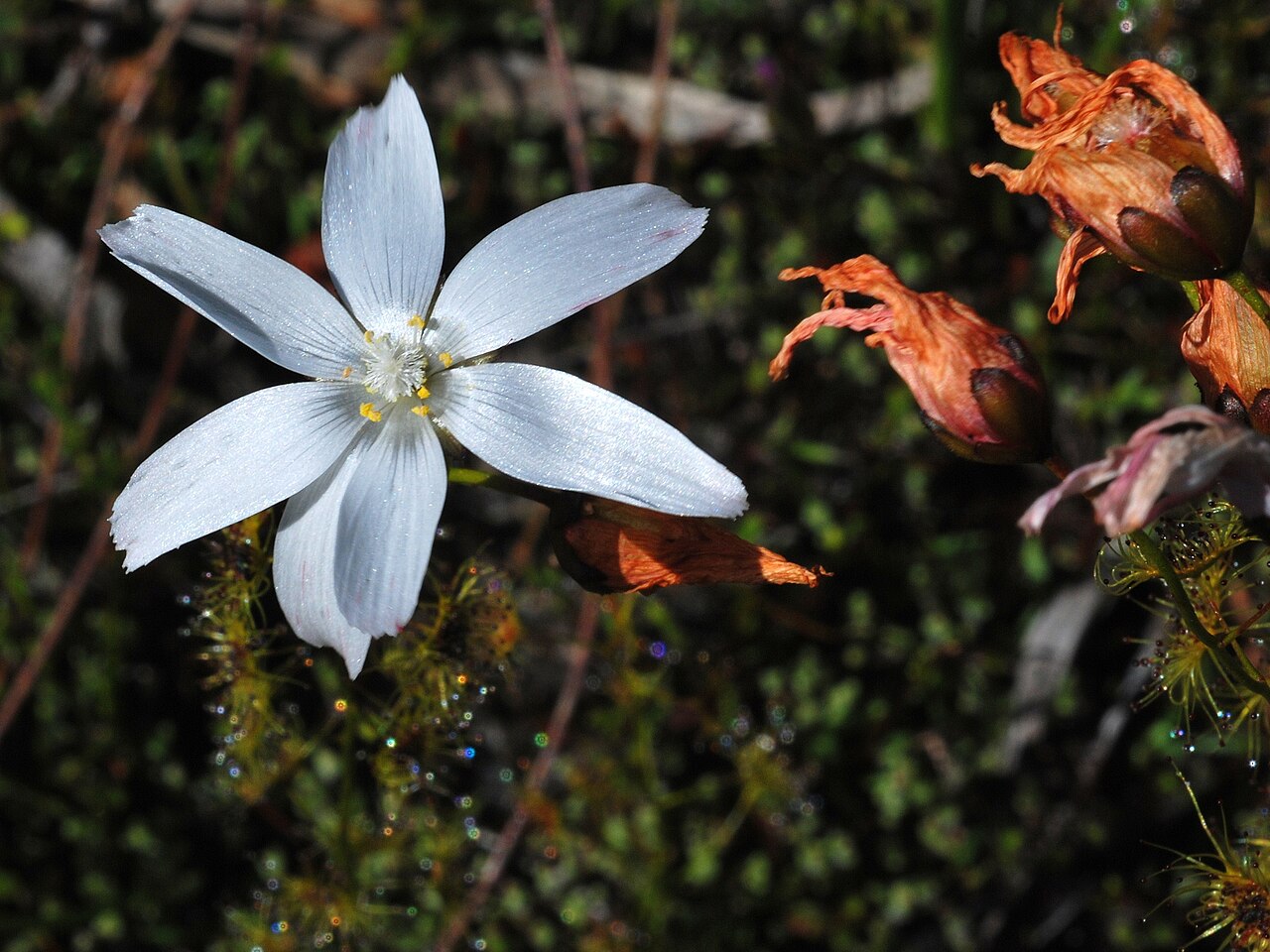
A tuberous sundew that stands alone in the entire genus through one feature: its flowers have not four or five petals but a whole ring of them. Seen from a distance, Drosera heterophylla looks more like a small white anemone than a sundew. In Western Australia it is called Swamp Rainbow. John Lindley described it as early as 1839, in his sketch of the vegetation of the newly founded Swan River Colony.
Identification
A perennial that comes up each year from a tuber lying deep in the soil, with a straight, unbranched stem 10 to 30 cm tall. Small trapping leaves are set along that stem. From June to September white flowers open at the top with far more than the usual five petals — a feature unique within Drosera that makes the plant unmistakable in flower. The epithet means 'with unequal leaves'. We did not find precise measurements of leaf and flower in any source consulted.
Similar species
Out of flower the plant resembles other erect tuberous sundews of the same region, such as Drosera huegelii, which also grows in wet hollows, and D. microphylla. In flower no confusion is possible: no other sundew has such a many-petalled flower. Anyone finding the plant outside flowering time would do well not to name it.
The trap and how it works
An active flypaper trap. The leaves along the stem carry stalked glands with a sticky droplet that catch small flies, gnats and other small insects. Touched tentacles bend towards the centre of the leaf and the glands secrete digestive enzymes. In tuberous sundews catching prey is a supplement: much of the reserve sits in the tuber, which is formed anew every year.
Habitat and ecology
Swamps, often in shallow water, wet clay flats and the wet edges of granite outcrops (W7, W4, R3). These are places that flood in the south-west Australian winter and dry out completely in summer. The plant follows that rhythm: it shoots with the autumn rains, flowers in the wet months and dies back above ground in spring, after which only the tuber survives the dry, hot summer.
Distribution and elevation
Endemic to south-west Australia, from around Mingenew in the north to Perth, and inland to Wongan Hills. FloraBase lists the Avon Wheatbelt, Geraldton Sandplains, Jarrah Forest and Swan Coastal Plain bioregions.
- Recorded (quarter-degree cells)
Forms and variation
No subspecies or varieties are recognised. The species belongs to section Ergaleium, the erect and climbing tuberous sundews, a group almost entirely confined to south-west Australia where it numbers dozens of species. Within that section D. heterophylla is a clear loner because of its flower structure.
Where and when to see it
Go in July or August, in the middle of the wet season, and search the edges of shallow swamps and wet clay flats north and north-east of Perth. Expect wet feet: the plant regularly stands literally in the water. The white flowers show best in sunny weather. Never dig for the tuber; it lies deep and the plant does not survive being dug up.
Conservation status
On the global IUCN Red List the species is listed as Least Concern (LC); in Western Australia it is also regarded as not threatened. It is not listed in CITES. Part of the range lies in the Wheatbelt, where most of the original vegetation has been cleared for cropping and where salinisation of the low ground is a growing problem; there the species is confined to remnant bushland.
Scientific name
Drosera heterophylla | Lindley, 1839
Described by John Lindley in 1839, in "A Sketch of the Vegetation of the Swan River Colony". The precise type locality could not be confirmed. The species occurs around and north of Perth, Western Australia, in shallow swamps or wet clay flats near granite outcrops. From the Greek heteros ("different") and phyllon ("leaf") — "differently leaved", referring to the plant's variable leaf forms.
World Checklist of Vascular Plants (WCVP), via Plants of the World Online (POWO), Royal Botanic Gardens, Kew.