All species › Caryophyllales › Sundew family › Drosera hilaris
Drosera hilaris
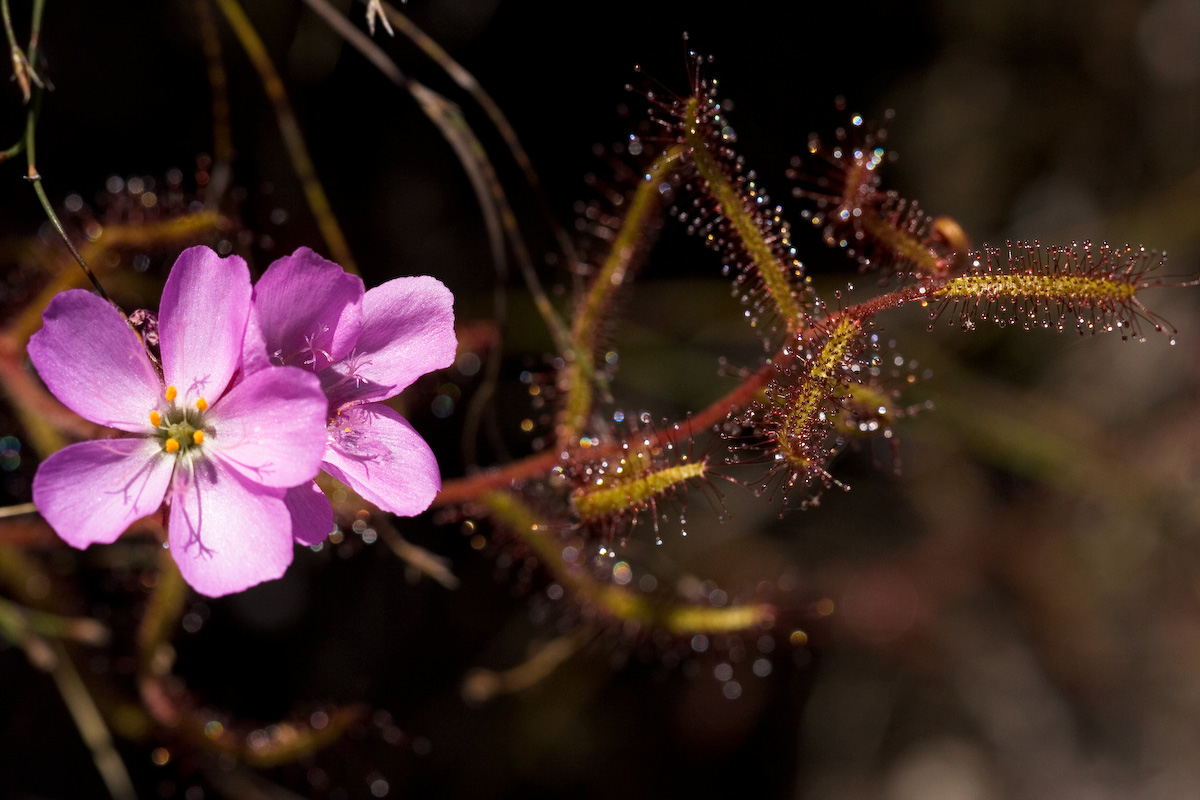
One of the largest rosetted sundews of the Cape, described in 1826 by Chamisso and Schlechtendal. The name hilaris means 'cheerful' — presumably a reference to the conspicuous pink flowers. The species grows in the mountains of the south-western Cape, often in cooler, somewhat shaded wet places where other sundews give up.


Identification
A robust rosette of erect to obliquely spreading, oblong-spatulate leaves, with long red tentacles on the upper surface and a hairy underside. The scape carries large pink to purplish-pink flowers. Published measurements from a flora were not available for this text; the measurement fields are left empty.
Similar species
Drosera capensis has longer, narrower, strap-shaped leaves without a clear division between petiole and blade. Drosera cuneifolia and D. aliciae form flatter, smaller rosettes. Drosera ramentacea and D. glabripes form stems with the leaves scattered along them.
The trap and how it works
An active flypaper trap. The erect leaves catch insects flying through the low vegetation; after contact the tentacles bend towards the prey and the glands secrete digestive enzymes.
Habitat and ecology
Permanently moist seeps, stream banks and wet slopes in mountain fynbos, often on south-facing slopes or among rocks where it is cooler and shadier (R1, W4, B5).
Distribution and elevation
Endemic to the south-western Cape of South Africa, in the mountains of the Cape Peninsula and adjacent ranges. Altitudinal limits were not found.
- Recorded (quarter-degree cells)
Forms and variation
No varieties are recognised. The species is maintained as distinct in the overviews of Cape rosetted sundews, including that of Fleischmann (2018).
Where and when to see it
Search in the wet months on shaded seeps along mountain trails, for example on Table Mountain. The large erect rosettes stand out fairly well among the low vegetation.
Conservation status
Not assessed for the global IUCN Red List and not listed in CITES. Much of its habitat lies in protected areas; local threats are drying out, alien trees and overly frequent fires.
Scientific name
Drosera hilaris | Chamisso & Schlechtendal, 1826
Described by Adelbert von Chamisso & Diederich Franz Leonhard von Schlechtendal in 1826, in Linnaea, volume 1, no. 4, p. 548. The precise type locality could not be established; only "southern Africa" is stated. The species occurs on the Cape Peninsula, South Africa, with Hermanus as the easternmost point of its range. From the Latin hilaris ("cheerful, merry") — the exact reason for this name could not be confirmed.
World Checklist of Vascular Plants (WCVP), via Plants of the World Online (POWO), Royal Botanic Gardens, Kew.