All species › Caryophyllales › Sundew family › Drosera indica
Drosera indica
Drosera indica, the Indian sundew, is not a rosette plant but a slender, erect or scrambling herb with long, thread-like leaves — one of the sundews least like the classic image. It long counted among the most widespread species of the genus, from Africa through Asia to Australia. Since the revisions around 2000 that picture has changed profoundly: the Australian plants turn out to belong to a series of separate species, and true D. indica is now regarded as absent from Australia.

Identification
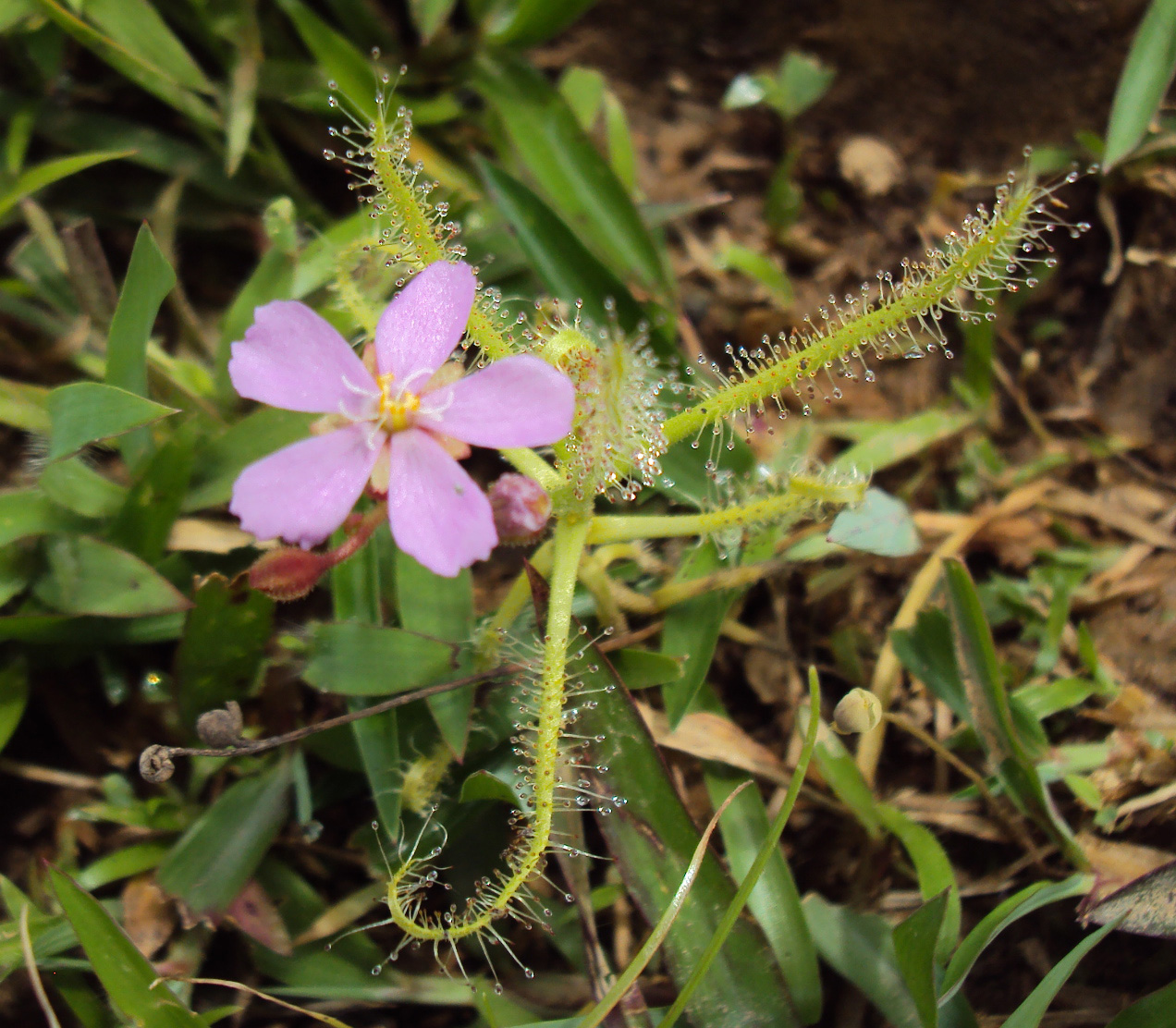
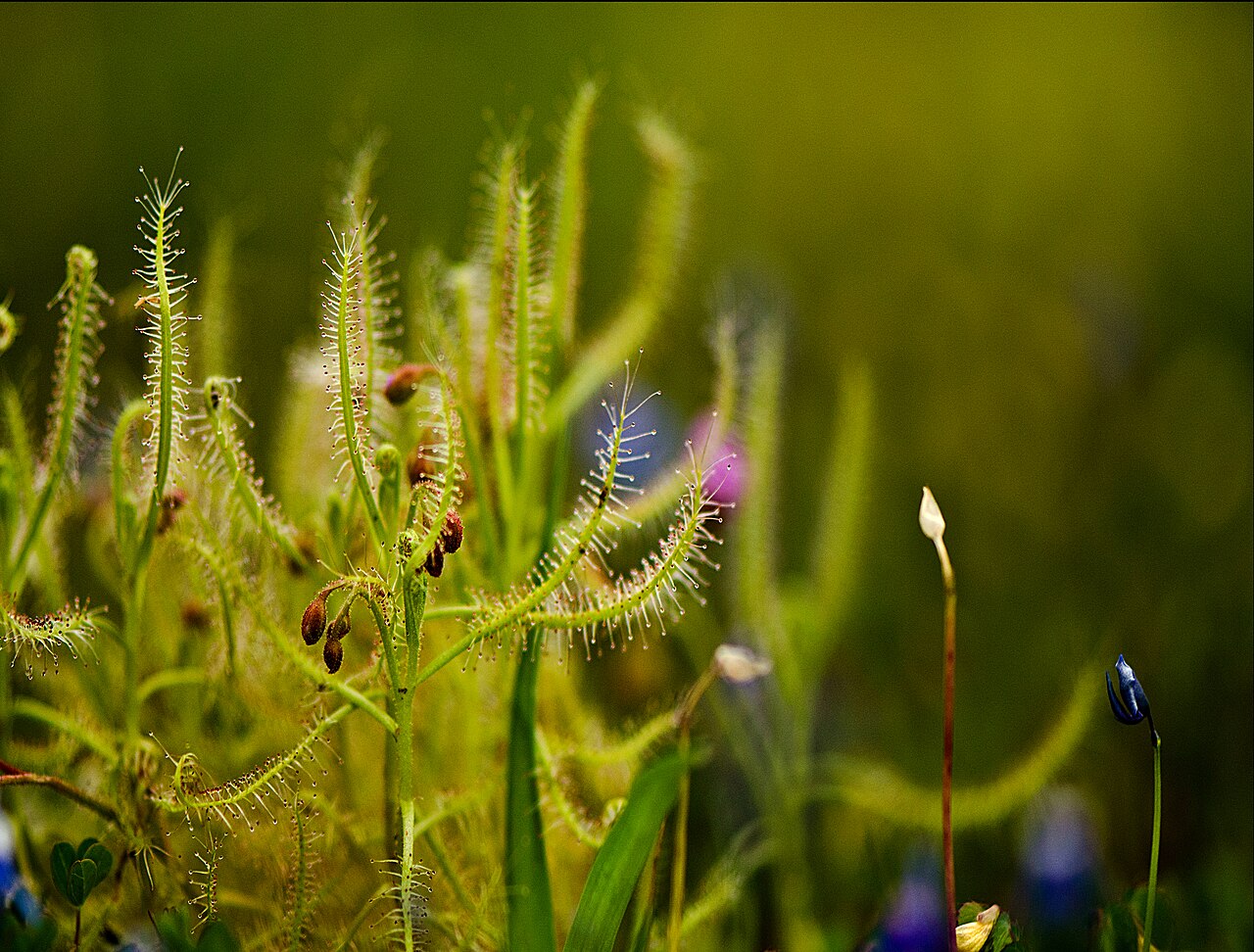
An annual, unbranched herb 5 to 50 cm tall with a fibrous root system. Young plants stand upright; older ones become lax and lie down or clamber through the surrounding vegetation, with only the youngest growth still pointing up. The leaves are narrowly linear, up to 10 cm long, yellow-green to maroon, scattered along the stem and often coiled at the tip like a fern crozier. Sticky tentacles cover their whole length. Opposite the leaves appear the racemes of five-parted flowers in white, pink, orange or purple. The chromosome number is 2n = 28.
Similar species
The confusion lies mainly within its own section Arachnopus, the so-called D. indica group. In Australia this concerns species such as D. finlaysoniana, D. hartmeyerorum, D. serpens, D. aquatica, D. glabriscapa and D. fragrans, which differ in the distribution of glandular tentacles and simple hairs, the structure of the anthers and the shape and sculpture of the seed. D. finlaysoniana, which also occurs in South-East Asia, for instance has normal rather than hooded anthers and small, reticulate seeds. Field identification is often reliable only with a hand lens and ripe seed.
The trap and how it works
An active flypaper trap along the whole length of the leaf. The long tentacles mainly catch flying insects that blunder into the leaves or land on them. The leaf bends slowly towards the prey and can curl around it; with larger prey several leaves work together because the scrambling stems grow through one another. The length of the leaves lets the plant hold relatively large flying insects.
Habitat and ecology
Open, sunny places that are wet in the rainy season: seasonal swamps, rice-field margins and wet hollows (W7), open savanna and woodland (B6), and disturbed wet ground such as ditches and verges (H2). As an annual it survives the dry period as seed.
Distribution and elevation
Tropical and southern Africa, Madagascar and tropical and subtropical Asia. Until about 2000 the species was also recorded for Australia, but after the separation of the many Australian species it is no longer regarded as native there under the current view. The range description 'Africa to Australia' therefore reflects the old, broad species concept. Flowering times and altitudinal limits vary by region and are not published consistently; those fields are left empty.
- Recorded (quarter-degree cells)
Forms and variation
The species is highly variable in size, leaf and flower colour and growth habit. Because of the split of the old concept, many older records and images of 'D. indica' from Australia refer to other species, such as D. finlaysoniana (reinstated as a species by Barrett and Lowrie in 2013) or D. hartmeyerorum. In Africa and Asia too the delimitation has not been studied everywhere, so further splitting cannot be ruled out.
Where and when to see it
Search in the rainy season in open, wet hollows, along the margins of rice fields and in wet verges. The plant is less conspicuous than rosette sundews because it grows among grasses and sedges; look into the light and the droplets on the long leaves give it away. In Australia it is almost always worth recording exactly which species of the group is involved, and when in doubt to photograph the flower and capsule.
Conservation status
On the IUCN Red List the species is Least Concern (LC); it is not listed in CITES. The range is very large and the plant benefits from temporarily wet, disturbed ground. Locally it disappears with drainage, agricultural intensification and herbicide use. Because of the taxonomic split, the separated Australian species, some with small ranges, deserve particular attention.
Scientific name
Drosera indica | Linnaeus, 1753
Described by Carl Linnaeus in 1753, in "Species Plantarum", volume 1, p. 282. The precise type locality could not be established — Linnaeus only stated "tropical" without a more specific place. From the Latin indica ("of India") — the region Linnaeus associated with this widespread, tropical Old World species.
World Checklist of Vascular Plants (WCVP), via Plants of the World Online (POWO), Royal Botanic Gardens, Kew.