All species › Caryophyllales › Sundew family › Drosera arcturi
Drosera arcturi
The alpine sundew is a plant of snow and bog moss. Drosera arcturi grows in the high mountains of south-eastern Australia, in Tasmania and along almost the entire length of New Zealand, and spends the winter under snow as a sturdy, horn-shaped winter bud. With only two other species it forms its own distinctive group within the genus.
Identification
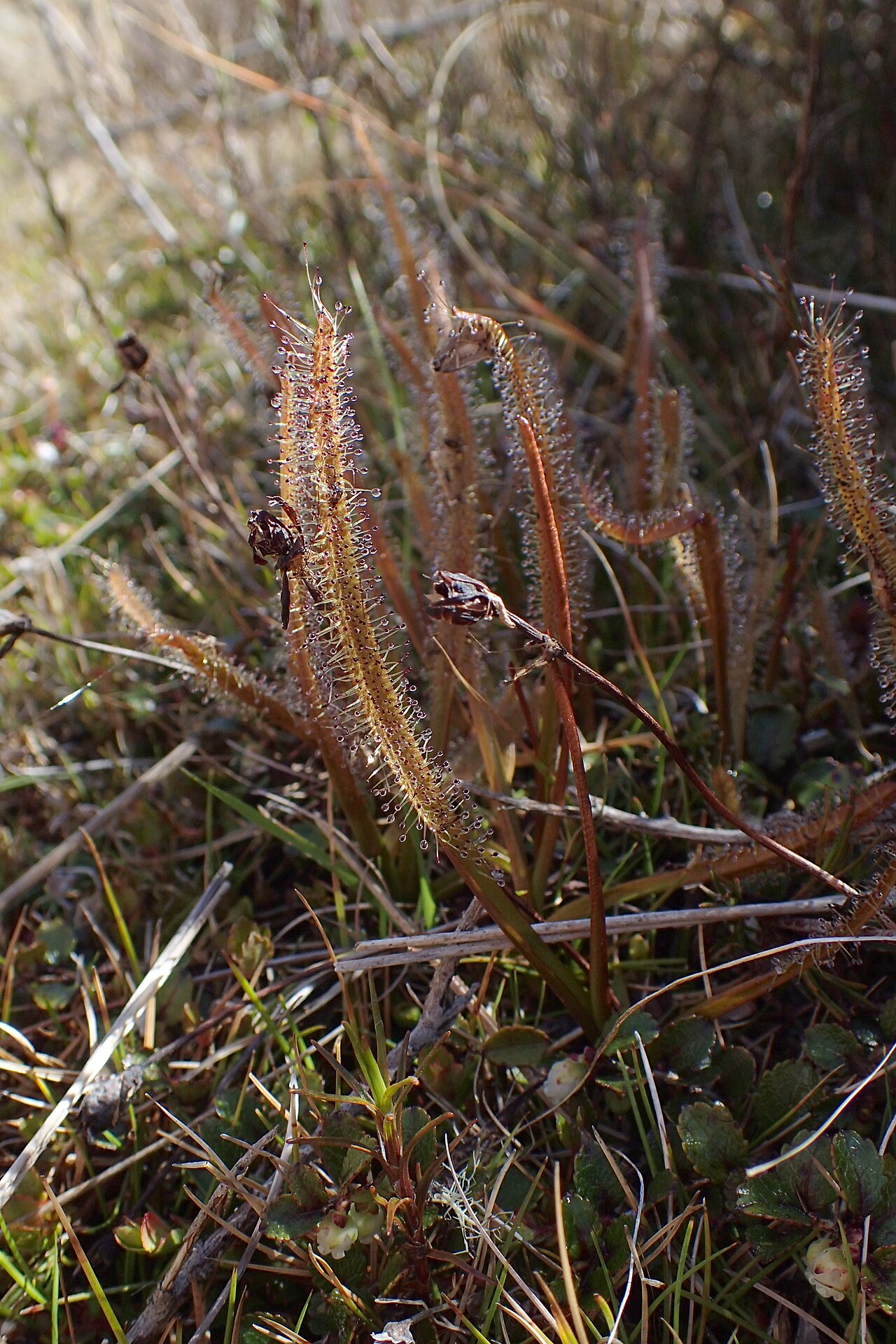
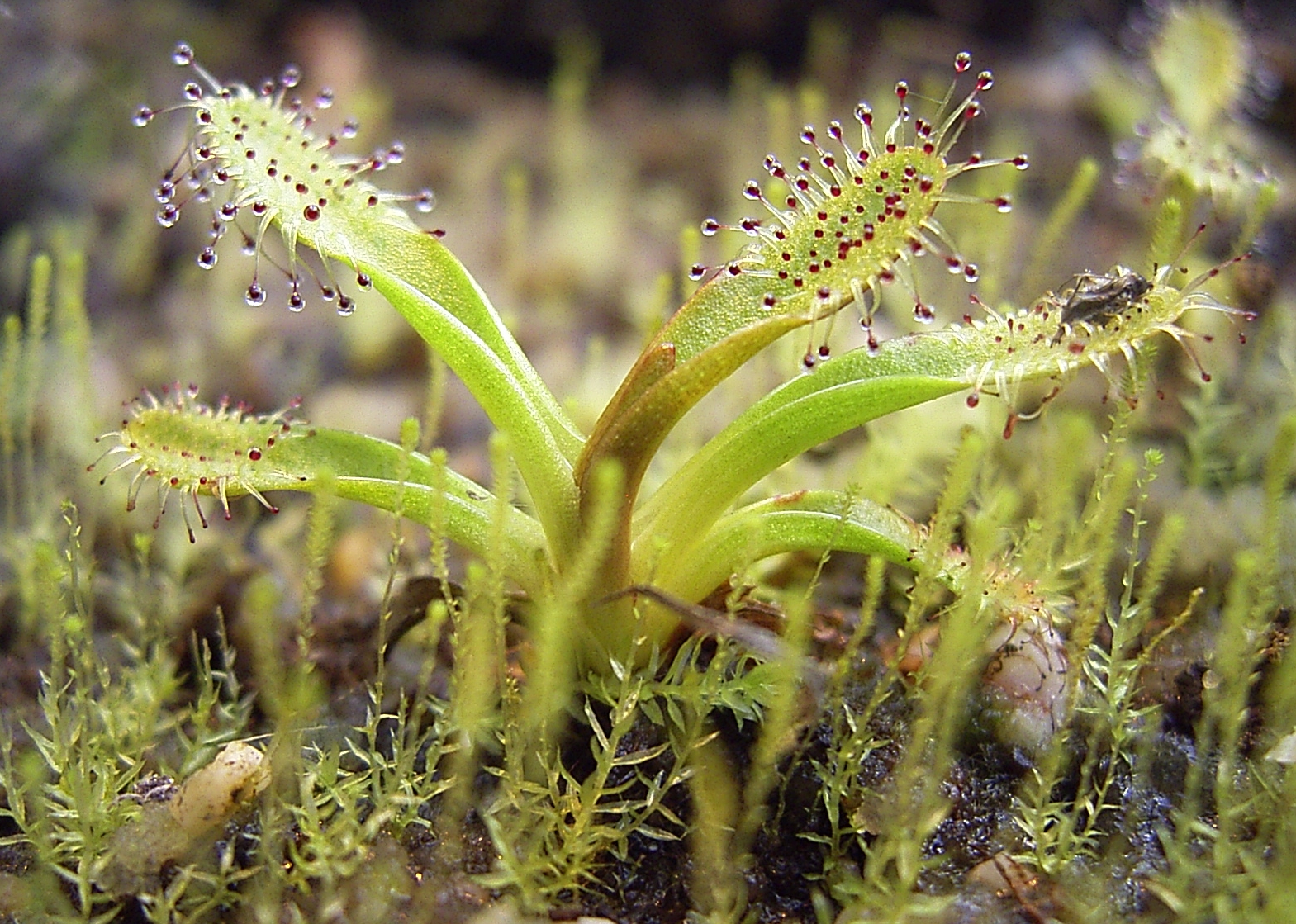
A loose rosette of erect to spreading, linear to strap-shaped leaves 2 to 8 cm long and 3 to 5 mm wide, with no clear division between stalk and blade. The leaves are pale green in shade and turn maroon in full sun; the tentacles are strikingly red. The plant has an underground rhizome with fibrous roots. Usually a single white flower about 13 mm across appears on a stalk of some 12 cm; lowland forms can carry one to five flowers on stalks up to 25 cm. The petals are 5 to 11 mm long. After flowering the plant forms a horn-shaped overwintering bud.
Similar species
In New Zealand the only real look-alike is Drosera stenopetala, which shares its habitat: it has a distinct petiole with a narrow, spatulate blade and white flowers with strikingly narrow, sometimes split petals. Tasmania also has Drosera murfetii, the third species of the same group, with its own distribution. Other sundews in alpine country have round or crescent-shaped blades.
The trap and how it works
An active flypaper trap along the whole leaf. The tentacles secrete a sticky mucilage in which small flies, gnats and other insects of the mountain grassland are caught. The leaf can slowly bend around the prey. In the short alpine growing season this extra source of nitrogen is especially valuable, because the wet peat supplies almost no nutrients.
Habitat and ecology
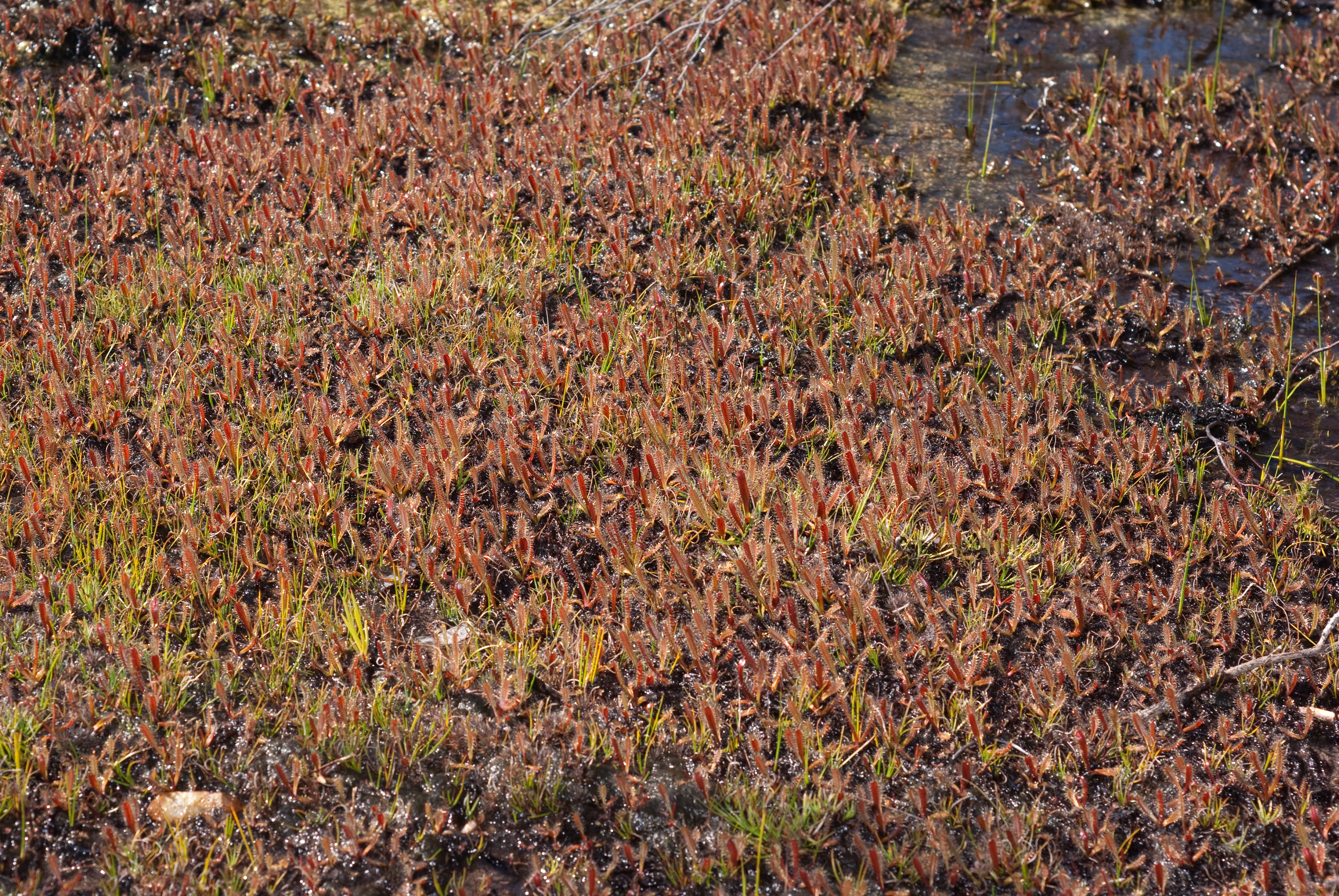
Wet alpine and subalpine Sphagnum bogs (W1), wet heath, herbfields and swampy places (W4), often along small streams and pools and in seepages, including over rock (R1). The sites lie under snow in winter. In New Zealand the species occurs only above about 1500 m on the North Island, but further south and in parts of Tasmania it descends to sea level.
Distribution and elevation
South-eastern Australia — the high mountains of New South Wales (including Kosciuszko National Park) and Victoria — and Tasmania, and New Zealand, from East Cape on the North Island south to Stewart Island. In Victoria it is uncommon and confined to the highest mountain areas. The altitudinal range given is a rough approximation: from sea level in the south to above 1500 m on New Zealand's North Island and in the Australian high country.
- Recorded (quarter-degree cells)
Forms and variation
No formal varieties are recognised, but there is a clear contrast between the usual alpine form with one flower on a short stalk and larger lowland forms with up to five flowers on stalks up to 25 cm. With D. stenopetala and D. murfetii the species forms subgenus Arcturia, an old southern branch of the genus distinguished among other things by flower structure and winter dormancy in a bud.
Where and when to see it
The best time is the Australian and New Zealand summer, December and January, when the snow has gone and the plants are in flower. Search open Sphagnum bogs and seepages above the treeline, along small streams and pool margins. The red tentacles on the long, upright leaves stand out against the green moss. Many sites lie in national parks with fragile vegetation: keep to paths and boardwalks, because bog moss and alpine herbs recover extremely slowly from trampling.
Conservation status
On the IUCN Red List the species is Least Concern (LC); it is not listed in CITES. In Victoria it is uncommon; the flora of south-eastern New South Wales notes that it is listed as endangered in that state. The main threats in Australia are climate change, which shrinks the alpine zone and shortens snow cover, and trampling by livestock and feral horses in high-country bogs. In New Zealand the species is widespread and not threatened.
Scientific name
Drosera arcturi | W.J. Hooker, 1834
Described by William Jackson Hooker in 1834, in Journal of Botany (Hooker's Botanical Miscellany, second series), volume 1, p. 247. Mount Arthur, north-eastern Tasmania — explicitly stated as the type locality. No elevation, collector or date known. From the Latin genitive "arcturi" ("of Arthur") — refers directly to Mount Arthur in Tasmania, the type locality; it is thus a toponym, not a dedication to a person named Arthur.
World Checklist of Vascular Plants (WCVP), via Plants of the World Online (POWO), Royal Botanic Gardens, Kew.