All species › Caryophyllales › Sundew family › Drosera kenneallyi
Drosera kenneallyi
A tropical sundew from the Kimberley, the rugged north-west of Australia, and one of the few species in this guide whose wet season falls in summer rather than winter. Drosera kenneallyi was first collected in 1982 by the botanist Kevin Kenneally, after whom it is named, and described by Allen Lowrie in 1996 in the journal Nuytsia.
Identification
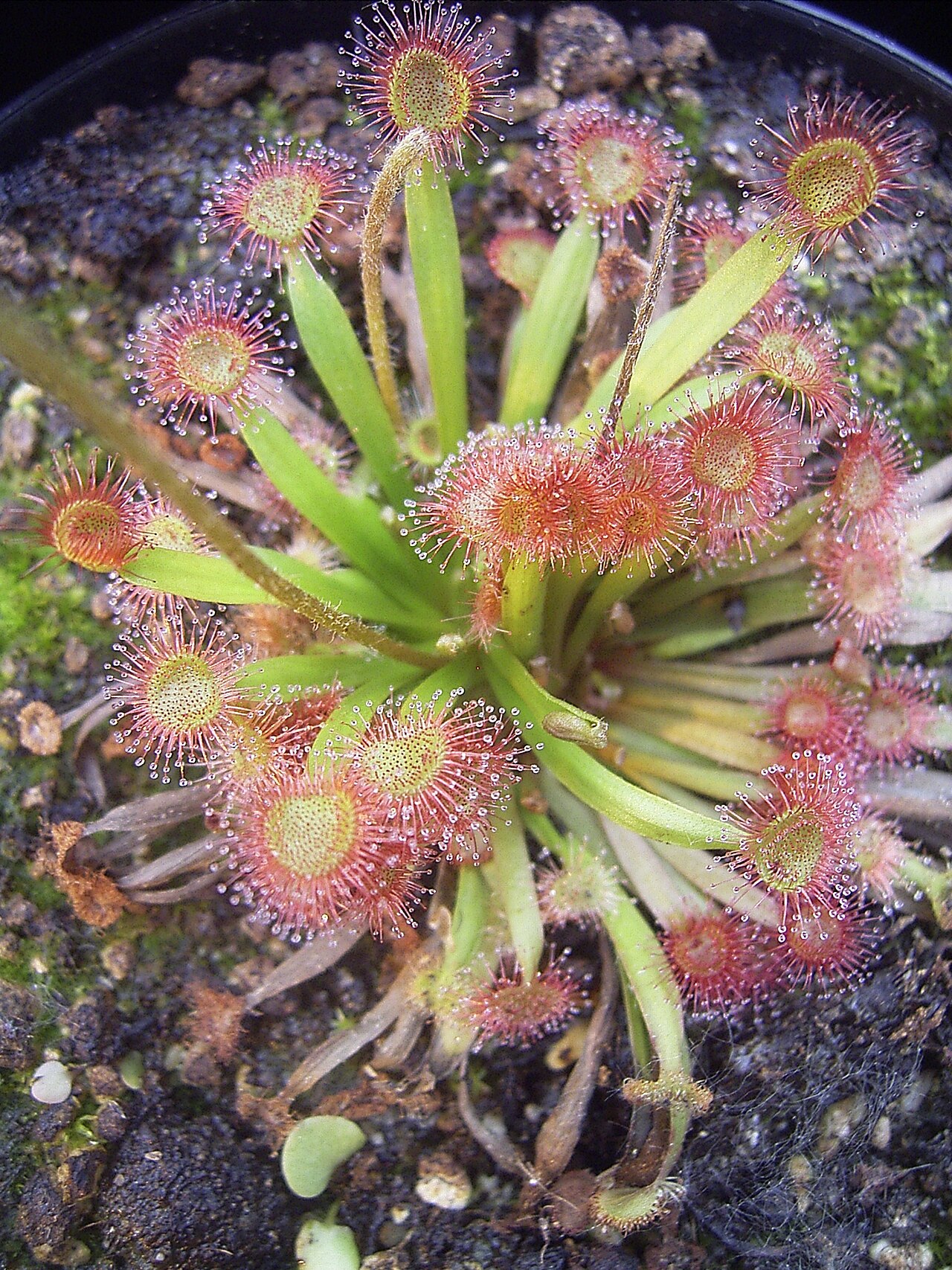
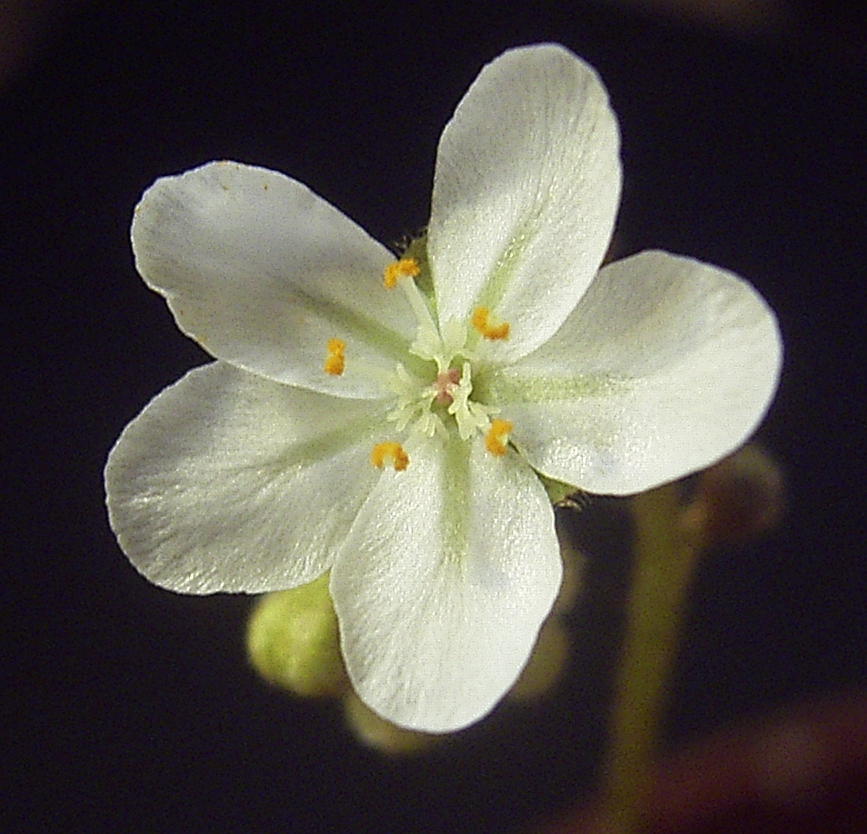
A compact rosette lying flat against the ground. The petioles are 1.5 to 2.2 mm wide at their widest; at their end sits a small, elliptic to broadly ovate trapping blade only 2 to 3 mm across, coloured red. In November and December inflorescences 12.5 to 20.5 cm long appear, racemes carrying ten to twenty white flowers. The combination of tiny red blades on relatively broad petioles and a tall, many-flowered raceme is characteristic.
Similar species
The closest relative is Drosera falconeri, also from the tropical north, which has larger, flat-lying leaves. D. kenneallyi differs in its clearly smaller blades and shorter inflorescence. Other tropical rosette sundews of the same alliance, the group around D. petiolaris, often have hairy petioles or a different leaf shape; identification needs attention to the details of leaf and inflorescence.
The trap and how it works
An active flypaper trap. The red blades carry stalked glands with sticky droplets to which small insects stick. The tentacles then bend towards the prey and the glands absorb the nutrients. Because the blade is so small, the prey is the very smallest: gnats, springtails and ants walking across the rosette.
Habitat and ecology
Sandy loam on the margin of a swamp, in the shade of eucalypts (Eucalyptus latifolia) in open woodland (W4, W7, B6). In January and February, in the middle of the wet season, the site regularly floods with warm water. The plant responds by adjusting the angle of its petioles so that the trapping leaves stay above the water.
Distribution and elevation
The original description and later overviews give the species as endemic to the Mitchell Plateau in the Kimberley, in the north of Western Australia, where it is common around the swamp. We found no confirmation in a source of records from the Northern Territory; the range may be smaller than 'northern Australia' suggests.
- Recorded (one-degree cells)
Forms and variation
No subspecies or varieties have been described. Allen Lowrie brought the species into cultivation in 1993, three years before he formally described it.
Where and when to see it
The Mitchell Plateau is reachable by road only in the dry season, while the plant is at its best early and in the middle of the wet; a visit therefore takes planning and often a plane or helicopter. Search the open woodland edge of swamps, not the swamp itself, and look low: the rosettes are small and red against red soil.
Conservation status
The species has not been assessed for the global IUCN Red List (NE) and is not listed in CITES. The Mitchell Plateau is remote and largely protected, which gives the species some security despite its small range; changes in fire regime and hydrology remain risks. Uncertainty: the occurrence in the Northern Territory is not confirmed.
Scientific name
Drosera kenneallyi | Lowrie, 1996
Described by Allen Lowrie in 1996, in Nuytsia (journal of the Western Australian Herbarium). Sandy loam soils on the margin of "Airfield Swamp", Mitchell Plateau, Kimberley region, northern Western Australia; the type material was collected beneath a Eucalyptus latifolia tree. Named in honour of Kevin F. Kenneally, who first collected the plant in 1982.
World Checklist of Vascular Plants (WCVP), via Plants of the World Online (POWO), Royal Botanic Gardens, Kew.