All species › Caryophyllales › Sundew family › Drosera intricata
Drosera intricata
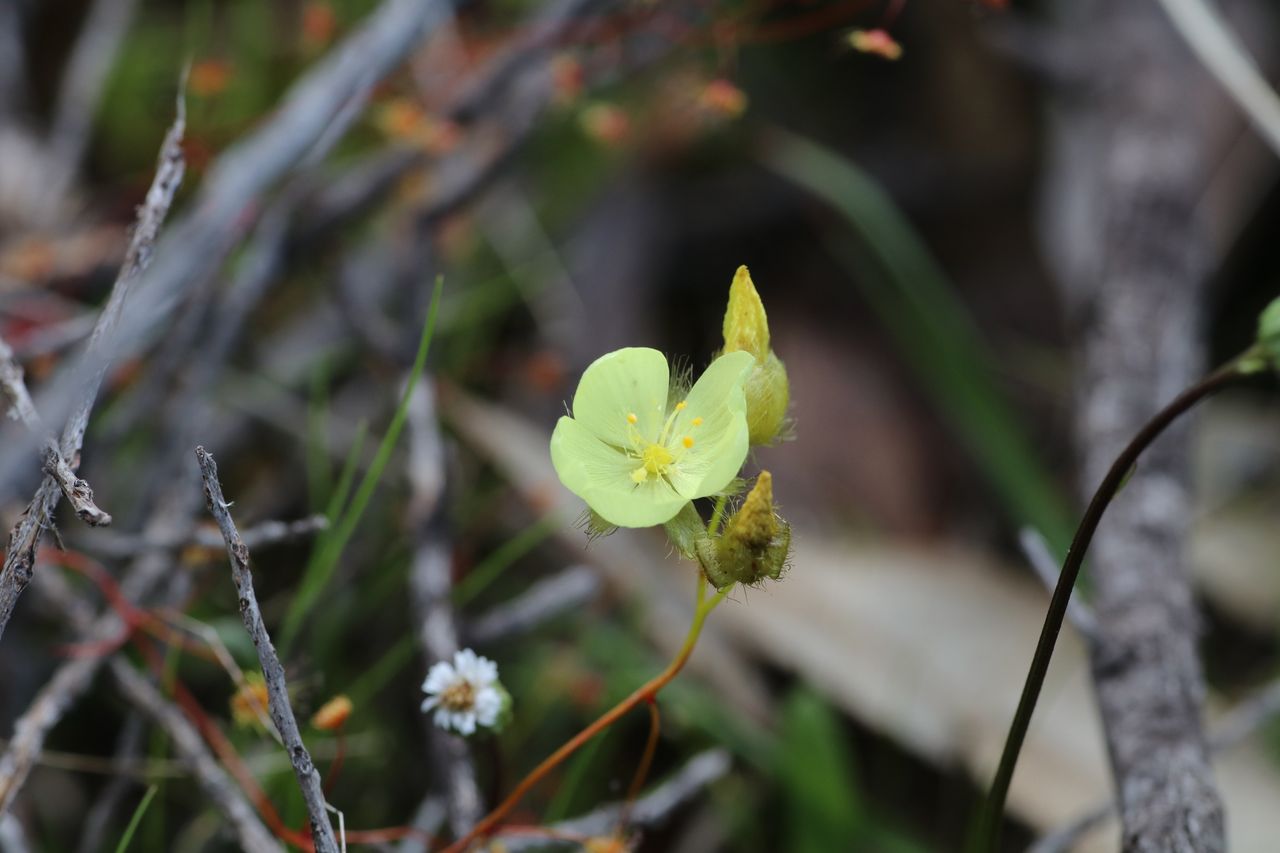
A climbing tuberous sundew with yellow flowers. The name intricata — 'entangled' — describes how the thin, glabrous stems wind through the surrounding vegetation. Jules Émile Planchon described the species in 1848, at the time when the first collections from the young Swan River Colony were being worked up in Europe.
Identification
A perennial that comes up each year from an underground tuber with a thin, glabrous stem 25 to 40 cm long that twines or holds on to other plants with its leaves. Small trapping leaves are set along the stem. The inflorescence bears three to twelve yellow flowers that open in September and October. Yellow flowers are the exception among the climbing tuberous sundews and so a good field character. We did not find precise leaf and flower measurements in any source consulted.
Similar species
Yellow flowers occur in only a handful of climbing tuberous sundews. Drosera moorei, also climbing and yellow-flowered, grows by granite outcrops inland between Southern Cross and Ravensthorpe, not in the wet hollows of D. intricata. The glabrous stem in particular is a useful character against related species with hairy stems. When in doubt, the combination of stem hairiness, flower colour and habitat decides.
The trap and how it works
An active flypaper trap. The small, shield-shaped leaf blades carry tentacles with a sticky droplet. Because the plant winds through shrubs and grasses, the trapping leaves hang scattered through the vegetation and catch mainly small flying insects. The leaves double as climbing organs: with their sticky tentacles they hook on to surrounding stems.
Habitat and ecology
Clay-sand soils on swamp margins and in other seasonally wet places (W7, W4), often among low shrubs (B5) the plant can climb into. Like all tuberous sundews it grows in the wet winter and survives the dry summer as a tuber.
Distribution and elevation
Endemic to south-west Australia. We could not obtain a precise distribution from FloraBase; the species occurs scattered through the south-west of the state.
- Recorded (quarter-degree cells)
Forms and variation
No subspecies or varieties have been described. The species belongs to section Ergaleium, the erect and climbing tuberous sundews.
Where and when to see it
September is the best month: the plants are then in flower and the yellow flowers betray where the thin stems run through the vegetation. Search the edges of seasonal swamps and follow the stem down with your eyes rather than pulling on it; the connection to the tuber breaks easily.
Conservation status
On the global IUCN Red List the species is listed as Least Concern (LC). It is not listed in CITES. As for all species of seasonal swamps in the south-west, drainage, clearing and changes to the fire regime are the main risks. Uncertainty: we could not check the distribution within south-west Australia in detail.
Scientific name
Drosera intricata | Planchon, 1848
Described by Jules Émile Planchon in 1848, in Annales des Sciences Naturelles, Botanique, series 3, volume 9, p. 293. The precise type locality could not be established. From the Latin intricatus ("tangled, intertwined") — refers to the plant's twining, intertwined growth habit.
World Checklist of Vascular Plants (WCVP), via Plants of the World Online (POWO), Royal Botanic Gardens, Kew.