All species › Caryophyllales › Sundew family › Drosera margaritacea
Drosera margaritacea
One of Australia's youngest sundews, described in 2021 by Thilo Krueger and Andreas Fleischmann. Drosera margaritacea is an annual of the Drosera indica alliance from the western Kimberley in the tropical north of Western Australia. The name means 'pearly' and refers to the milky-white glands that sit like pearls on the petioles.
Identification
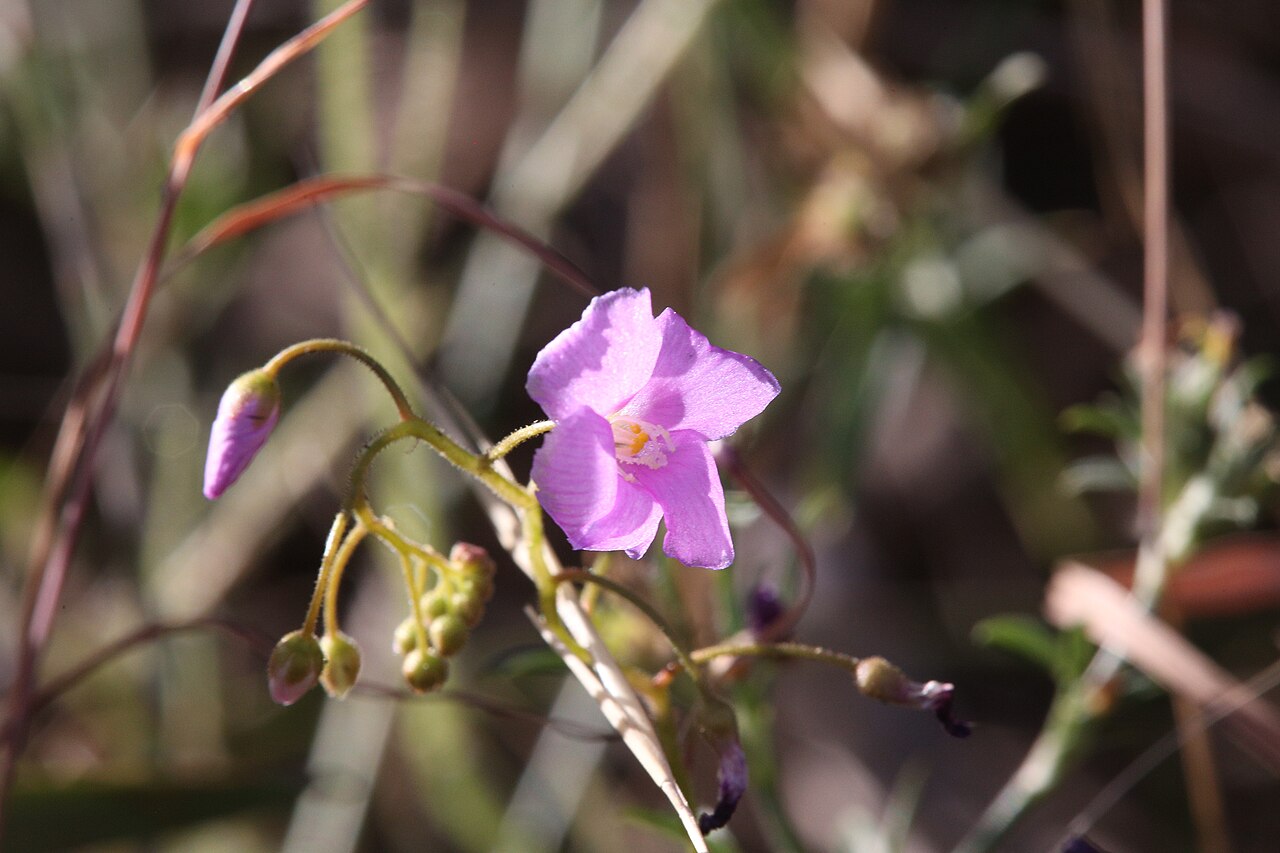
An annual with a stem bearing long, narrow trapping leaves, as in all members of section Arachnopus. The feature that gives the species its name is on the short petiole: it is covered with stalked, milky-white mucilage glands that look like small pearls in the light. In the flower the stamens stand out through a rounded yellow swelling at the tip of the connective, around which the anther thecae protrude. The inflorescences are strikingly tall and many-flowered. We were unable to take measurements from the original description.
Similar species
The closest relative is Drosera finlaysoniana, whose range and circumscription were amended in the same paper; plants previously included under that name or under D. indica in the broad sense may belong to D. margaritacea. The milky-white glands on the petiole and the yellow knob on the connective are the decisive characters; in related species the petiolar glands are differently coloured or absent.
The trap and how it works
An active flypaper trap. The long leaves carry stalked glands with sticky droplets; insects landing on them stick, after which the leaf can slowly bend around the prey. What function the milky-white glands on the petiole have has not been investigated.
Habitat and ecology
We were unable to consult specific habitat data. Members of section Arachnopus in the Kimberley generally grow in sandy, seasonally wet hollows in savanna and open woodland, and the codes follow that general picture (W7, B6, D1). As an annual the plant survives the dry season as seed. Photographs accompanying the description were taken at the type locality in July.
Distribution and elevation
Endemic to the western Kimberley, in the north of Western Australia. The species therefore does not belong to the south-west Australian sundew flora but grows some two thousand kilometres further north, in the tropical monsoon zone.
- Recorded (one-degree cells)
Forms and variation
There are no subspecies or varieties. The description is part of an ongoing revision of section Arachnopus, in which what used to be regarded as a single widespread D. indica has been split in Australia into a series of separate species.
Where and when to see it
The western Kimberley is remote and mostly reachable by road only in the dry season. With annual sundews with long leaves always look at the petiole: milky-white, pearl-like glands are the sign of this species. A hand lens is needed for the yellow knob on the connective.
Conservation status
The species has not been assessed for the global IUCN Red List (NE) and is not listed in CITES. The western Kimberley is sparsely populated and direct pressure on the sites is probably low, but for a species described only in 2021 nothing is yet known about numbers or trends. Uncertainty: measurements, flower colour, flowering time and any conservation assessment in the original publication could not be consulted.
Scientific name
Drosera margaritacea | Krueger & Fleischmann, 2021
Drosera margaritacea was described in 2021 by Thilo Krueger and Andreas Fleischmann, in the journal Phytotaxa, volume 501(1), pp. 56–84; the name itself was validly published on p. 57, in a paper on a new species of section Arachnopus from the western Kimberley, Australia. The holotype (PERTH 9345124) was collected by T. Krueger on 18 July 2020, about 123 km WNW of Fitzroy Crossing near the Great Northern Highway, in the Derby–West Kimberley region of Western Australia. The epithet derives from Latin margaritaceus, "pearly", referring to the distinctive milky-white stalked mucilage glands on the short petiole and a pearl-like swelling at the tip of the anther connective. It is thus a descriptive name, not a toponym or eponym.
World Checklist of Vascular Plants (WCVP), via Plants of the World Online (POWO), Royal Botanic Gardens, Kew.