All species › Caryophyllales › Sundew family › Drosera microphylla
Drosera microphylla
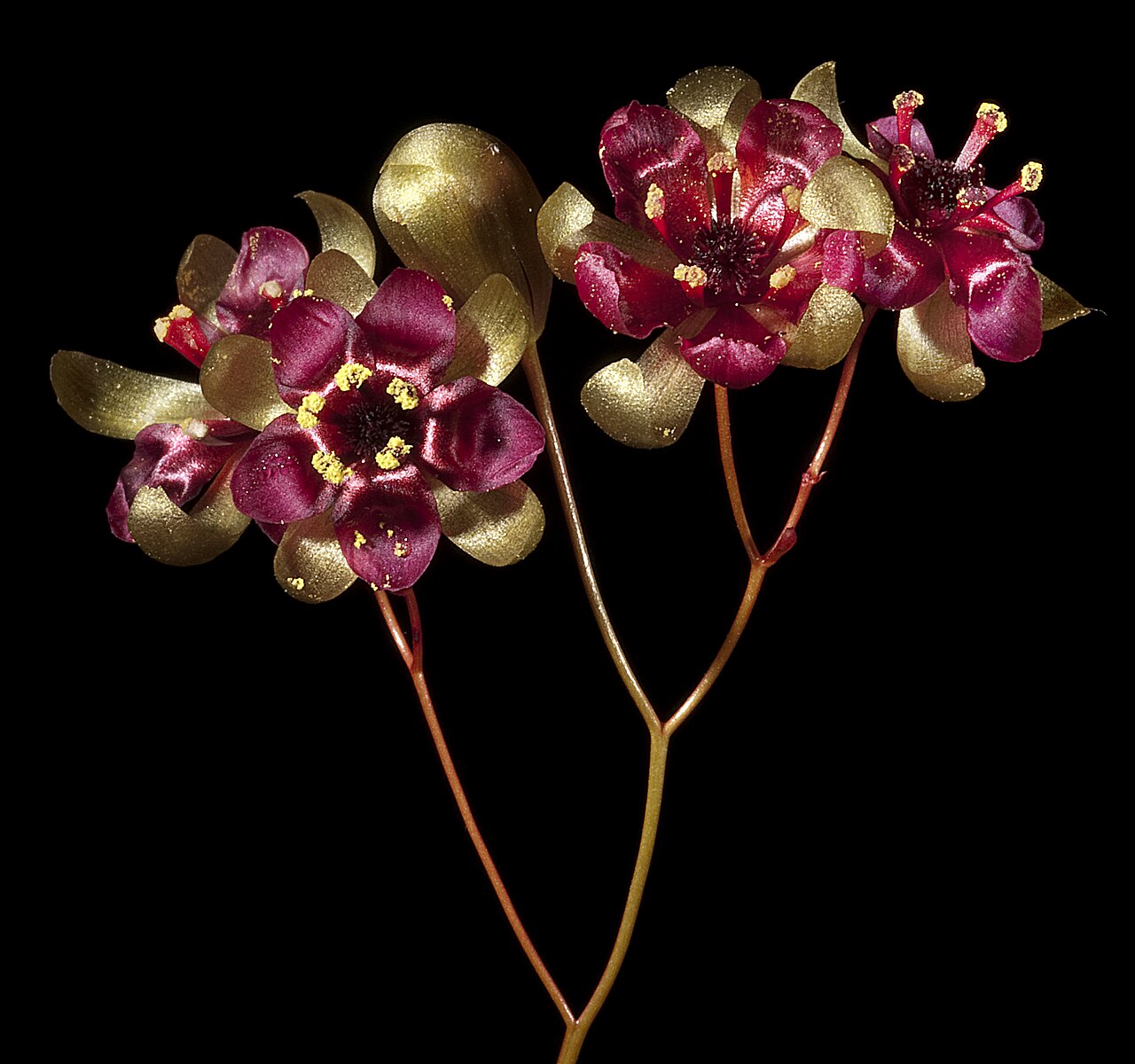
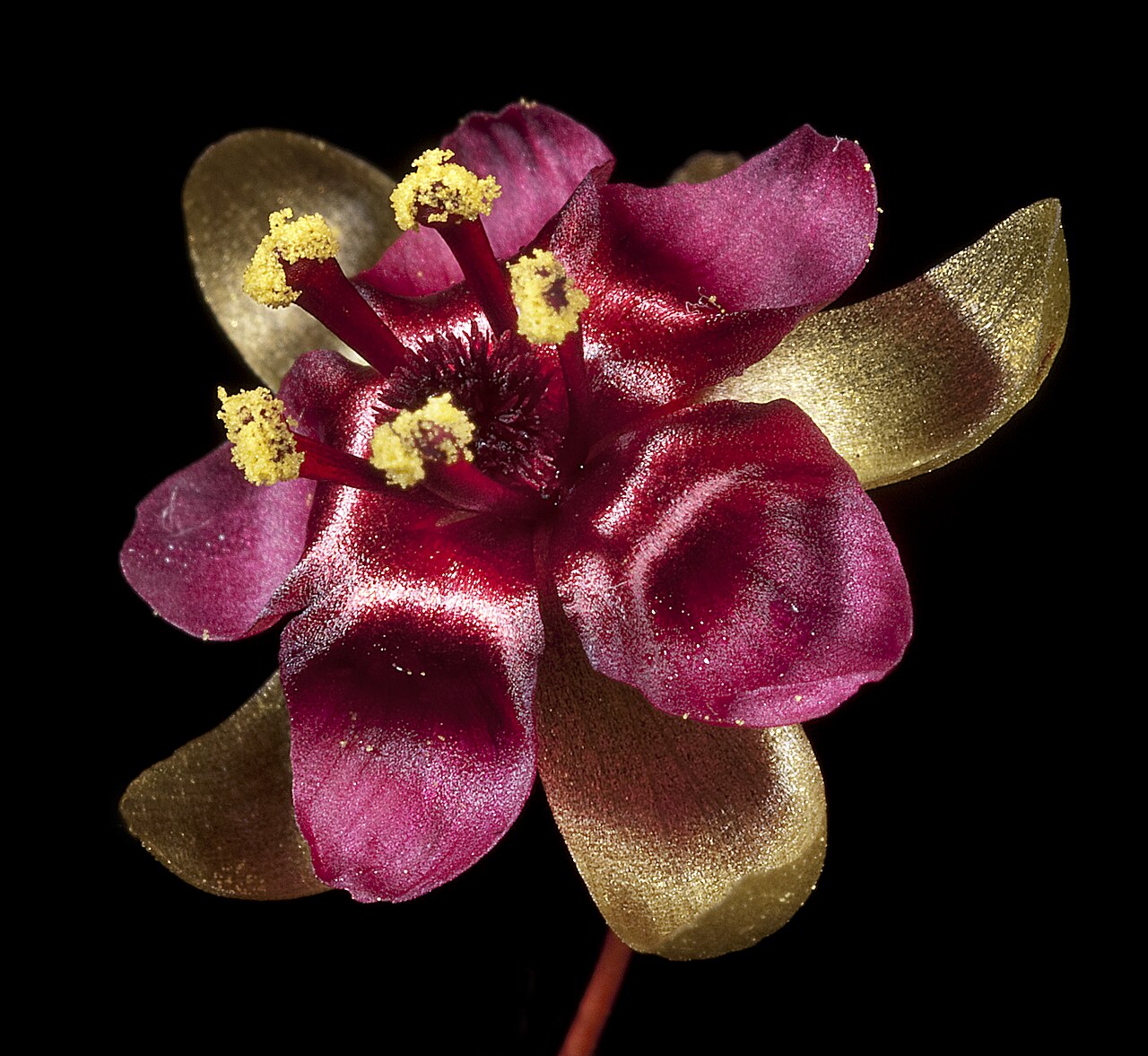
The Golden Rainbow of Western Australia, named after its most striking feature: not the petals but the sepals are large and golden yellow, so that the flower seems to shine. Drosera microphylla — 'small-leaved' — was described by Stephan Endlicher in 1837 and is one of the classic tuberous sundews of the south-west.
Identification
A perennial that each year produces from an underground tuber a straight stem 10 to 40 cm tall. Along the stem sit small, circular, peltate trapping leaves on stalks. The flower is unusually built: the sepals are large and golden yellow, the petals within smaller and variable in colour. Around Perth they are red, near Albany orange and east of Esperance white; FloraBase also lists pink. Flowering from June to September.
Similar species
No other tuberous sundew has such large golden sepals, which makes the species easy to recognise in flower. Out of flower it resembles other erect species with round, peltate leaves, such as Drosera peltata, D. marchantii and D. huegelii. Then look at the buds: the large sepals are often visible already in bud.
The trap and how it works
An active flypaper trap. The round leaf blades carry marginal tentacles with sticky droplets that catch small flying insects. After a catch the tentacles bend to the centre of the leaf and digestive enzymes are secreted. The reserves for the next year go to the tuber, which is formed anew each season.
Habitat and ecology
Granite outcrops and sandy or lateritic soils (R3, D1, D3), often where rainwater runs off the rock and the soil stays moist in winter. The plant grows in the wet winter, flowers from midwinter to early spring and survives the summer as a tuber.
Distribution and elevation
Endemic to south-west Australia, from around Perth through the south-west to the south coast near Albany and east beyond Esperance. FloraBase lists the Avon Wheatbelt, Esperance Plains, Jarrah Forest and Warren bioregions.
- Recorded (quarter-degree cells)
Forms and variation
No subspecies or varieties are recognised, although petal colour clearly varies by region. Several later names have been reduced to synonymy: Drosera calycina, described by Jules Émile Planchon in 1848, George Bentham's D. calycina var. minor (1864) and Ludwig Diels's D. microphylla var. macropetala (1906). The species belongs to section Ergaleium.
Where and when to see it
July and August are the best months. Search by granite outcrops, where the golden flowers glow against the grey rock. Anyone who looks at the species in different districts will see the petal colour shift from red around Perth to white in the east; so always note petal colour with a record.
Conservation status
On the global IUCN Red List the species is listed as Least Concern (LC); in Western Australia it is regarded as not threatened. It is not listed in CITES. Granite outcrops in the south-west are threatened by grazing, trampling, weeds and, in the Wheatbelt, salinisation of the surrounding landscape, but the species as a whole has a large range.
Scientific name
Drosera microphylla | Endlicher, 1837
Drosera microphylla was described in 1837 by Stephan Endlicher, in Enumeratio Plantarum Quas in Novae Hollandiae (the account of Karl von Hügel's expedition), p. 6. The type material is held in the Vienna herbarium (W) and was collected by Carl Alexander Anselm von Hügel at King George Sound, Western Australia; the exact collection date could not be established with certainty (Hügel's visit to Australia took place in 1833). The name combines Greek mikros ("small") and phyllon ("leaf"), meaning "small-leaved" — a descriptive name referring to this species' small, rounded trap leaves.
World Checklist of Vascular Plants (WCVP), via Plants of the World Online (POWO), Royal Botanic Gardens, Kew.