All species › Caryophyllales › Sundew family › Drosera browniana
Drosera browniana
A tuberous sundew of section Erythrorhiza, the group of flat rosettes that rise each year from an underground tuber. Drosera browniana was described in 1992 by Allen Lowrie and Neville Marchant in the journal Nuytsia, and named after Andrew Brown, who found the first population. It is a plant of the greenstone belt and granite rocks in the dry interior of the south-west.
Identification
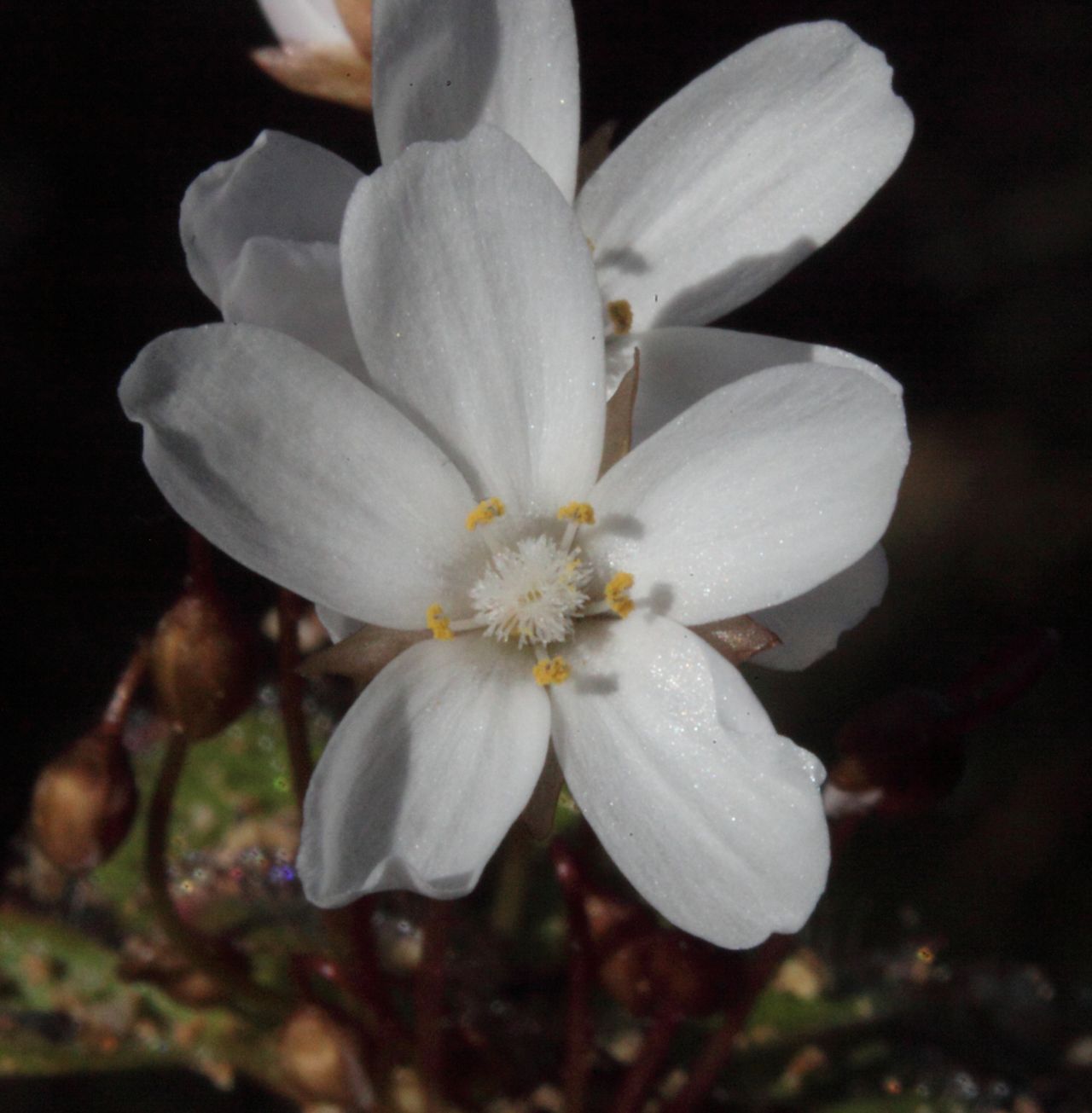
A perennial tuberous plant with a flat rosette about 3 to 4 cm across, reaching 4 to 10 cm including the flowering stem. The leaves lie flat on the ground and bear stalked glands. The flowers are pinkish white and appear in August and September. Precise measurements of blade and floral parts were not available in the accessible sources; the original description in Nuytsia 8 does contain them.
Similar species
The species is considered related to Drosera bulbosa, which also forms a flat rosette from a tuber. D. bulbosa, however, flowers earlier, from April to June, with pure white flowers held just above the rosette, and has a much wider range. Drosera erythrorhiza is larger and bears a many-flowered inflorescence. In the field, flowering time and flower colour are the best clues.
The trap and how it works
An active flypaper trap on the ground. The flat rosette works as a sticky mat for crawling and low-flying insects: ants, springtails, small beetles and flies. The stalked glands hold the prey, the tentacles bend over it and secrete digestive enzymes. The nutrients taken up are stored in the tuber, which carries the plant through the long dry summer.
Habitat and ecology
Loam in wet zones near granite rocks (FloraBase, Wikipedia): the strip at the foot of a granite dome where run-off from winter rain collects (R3, W7). Outside the wet season the plant is invisible; it survives the summer as a tuber deep in the ground.
Distribution and elevation
Endemic to Western Australia. According to the description the species is common in a band from Mount Holland to Hatters Hill along the greenstone belt of the interior. FloraBase lists the Avon Wheatbelt, Coolgardie and Mallee bioregions, with records in the shires of Kondinin, Lake Grace, Merredin, Narembeen and Yilgarn.
- Recorded (one-degree cells)
Forms and variation
No subspecies or varieties have been described. Like other rosette-forming tuberous sundews, the plant can reproduce vegetatively by forming daughter tubers, so that groups of rosettes stand side by side in favourable spots.
Where and when to see it
Visit the interior granite rocks in August and September after good winter rain; in dry years many tubers do not come up. Search the wet loam strip at the foot of the rock, not the bare stone. Flat rosettes are easiest to see among moss and litter in low morning light.
Conservation status
Assessed as Least Concern (LC) on the IUCN Red List and listed as not threatened in Western Australia. Not in CITES. Part of the habitat lies in a mining region; clearing of the Wheatbelt has turned many granite rocks into isolated islands of bush.
Scientific name
Drosera browniana | Lowrie & Marchant, 1992
Described by Allen Lowrie & Neville G. Marchant in 1992, in "Four new Drosera taxa from south western Australia", Nuytsia, volume 8, no. 3, p. 323-332 (species description on p. 323). South-western Australia, in an area from Mount Holland to Hatters Hill along the greenstone belt north-west of Esperance, growing in loam soils in wet zones near granite outcrops. Named in honour of Andrew Brown, who discovered the species' first population — not, as is often assumed, after the famous botanist Robert Brown. This explanation comes from secondary sources; the original publication itself could not be consulted to confirm it.
World Checklist of Vascular Plants (WCVP), via Plants of the World Online (POWO), Royal Botanic Gardens, Kew.