All species › Caryophyllales › Sundew family › Drosera pallida
Drosera pallida
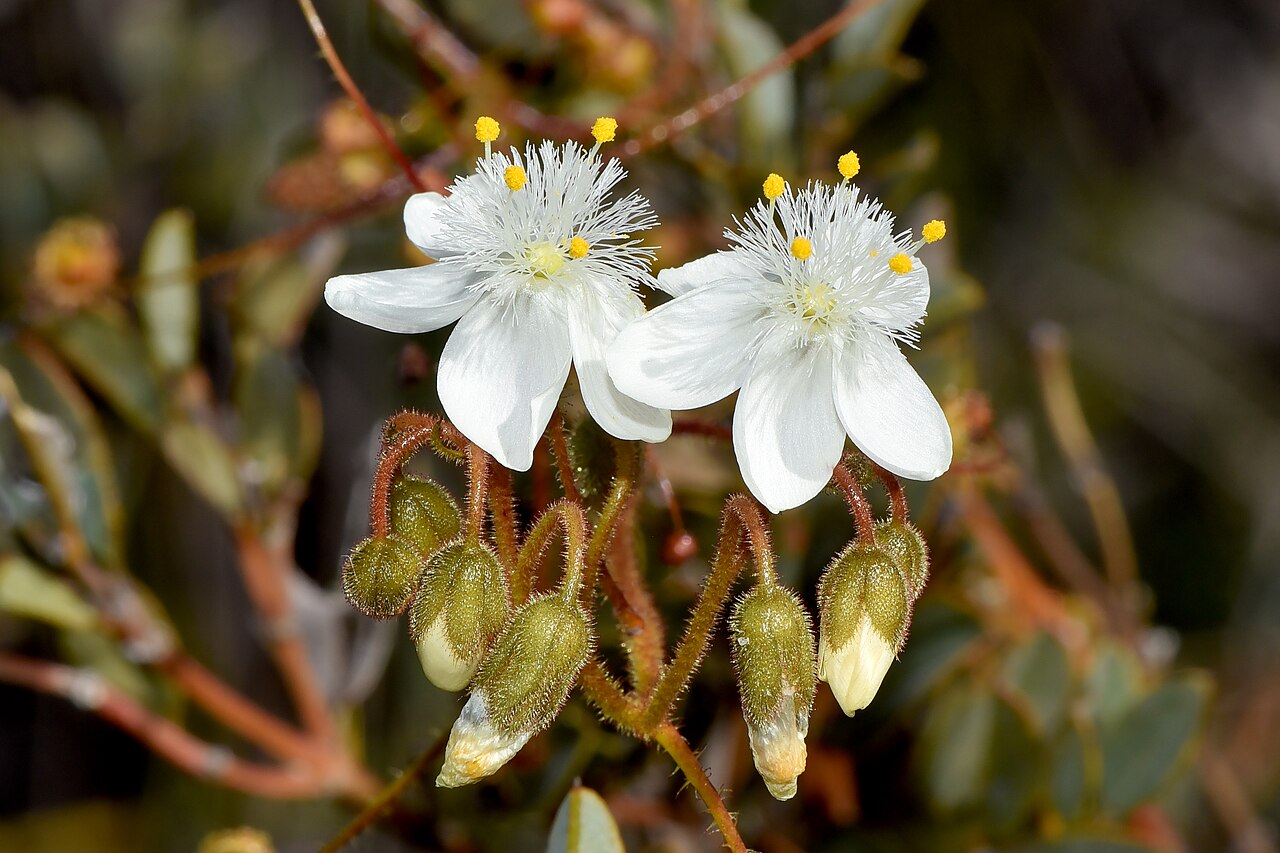
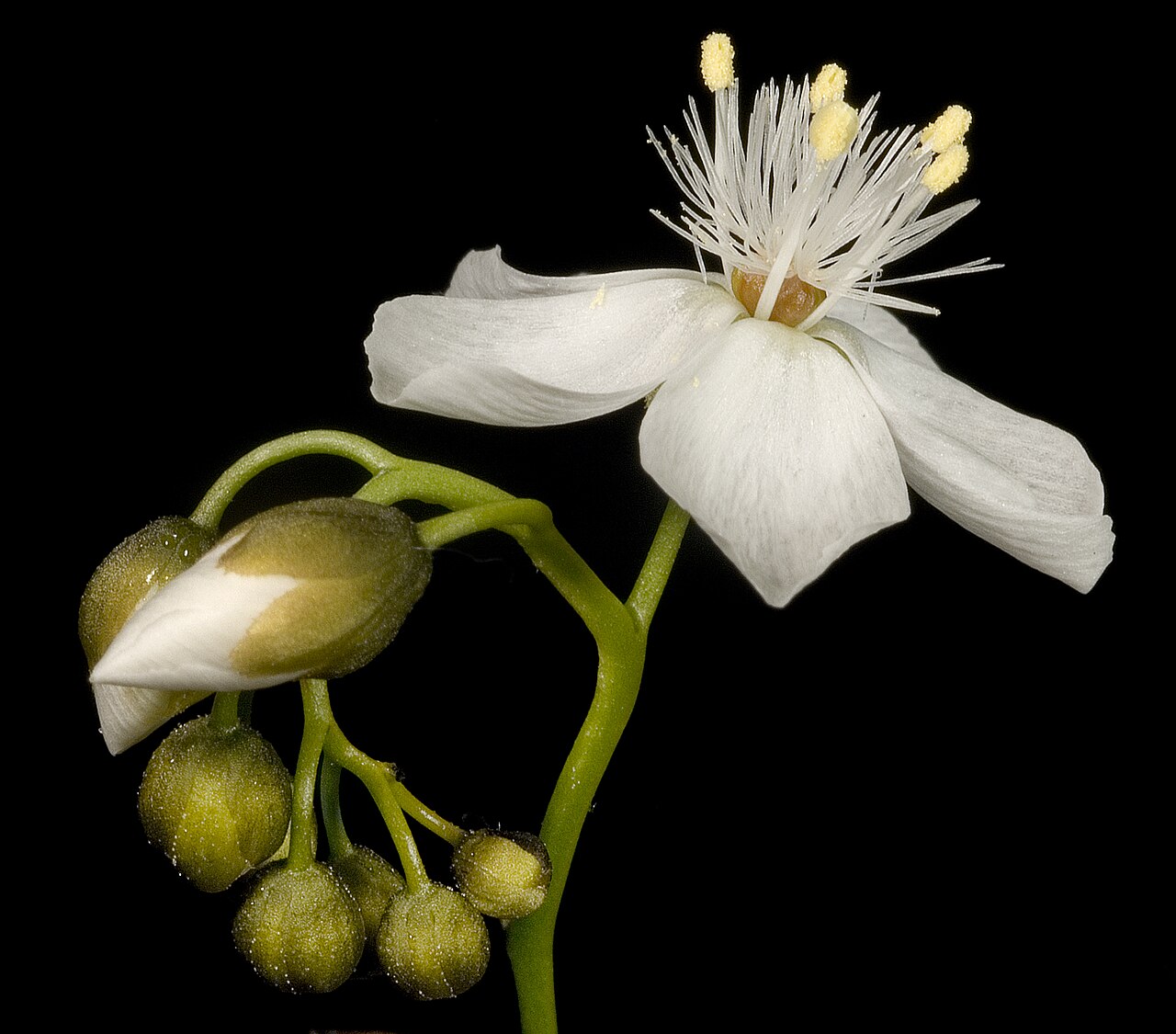
One of the large climbing sundews of south-west Australia, and a plant that turns the usual idea of a sundew — a small rosette in a bog — completely on its head. Each wet season Drosera pallida sends up a slender stem from an underground tuber that hooks itself onto shrubs with its own sticky leaves and climbs through the heath to almost two metres. In late winter and spring it is then covered in white flowers.
Identification
The plant appears as a single slender stem, often pale green to reddish, 30 cm to 1.8 m long, which falls over without support and so scrambles against and through surrounding shrubs. Along the stem the leaves stand in groups of three: small peltate blades on a short stalk, set with tentacles that glisten in the sun. The stem ends in a loose inflorescence of white flowers. Underground there is a tuber from which the plant shoots again every year; in the dry summer nothing is visible above ground. Exact measurements for leaf blade and flower are not published in the sources consulted, so those fields are left empty.
Similar species
South-west Australia has several climbing tuberous sundews, and in the field flower colour is the first clue. Drosera subhirtella and D. sulphurea climb in a similar way but flower yellow. Drosera macrantha and its allies also have white to pink flowers and climbing stems; they are separated by the hairiness of the calyx and the shape of the leaf blade, which calls for a lens and a good key. Drosera stricticaulis stays upright and flowers pink.
The trap and how it works
An active flypaper trap, but held well above the ground. The leaves along the stem are small, peltate and often cup-shaped, with longer tentacles on the margin and shorter ones on the blade. Flying insects — midges, small flies, sometimes bees or butterflies drawn to the flowers — touch the droplets and stay hanging. The marginal tentacles then bend inwards and the blade partly closes around the prey, after which the glands secrete enzymes and absorb the dissolved nutrients. Because the traps are spread along an upright or climbing stem, the plant sweeps a much larger volume of air than a rosette on the ground. In D. pallida the leaves also serve as climbing aids: the sticky blades adhere to twigs of the surrounding shrubs and so hold the long stem up.
Habitat and ecology
Sandplains, heathland and the margins of coastal-plain lakes, on deep sand or laterite (D1, B5, D3). These are nutrient-poor, heavily leached soils that are moist in winter and bone-dry in summer. The plant depends on shrubs to climb against, and so usually grows in dense heath or at the edge of open woodland rather than in fully open sand.
Distribution and elevation
Endemic to Western Australia, and within it a species of the south-west: the coastal plain around Perth and the sandplains and heathlands of the South-West Botanical Province. A precise range boundary is not worked out in the sources consulted; altitudinal limits are not published.
- Recorded (quarter-degree cells)
Forms and variation
The species was described in 1839 by John Lindley in his sketch of the vegetation of the Swan River Colony — one of the earliest botanical works on the Perth area. It belongs to subgenus Ergaleium, section Ergaleium: the group of erect and climbing tuberous sundews. No varieties or subspecies are recognised within it in the sources consulted.
Where and when to see it
Look for it from July into November, after the winter rains, and look not at the ground but into the shrubs: the thin stems only stand out once the white flowers are open or when the sticky leaves catch the light. The flowers open in sunny weather. Leave the stems alone — they break easily and the plant cannot make new ones in the same season. Digging tubers is prohibited and pointless: they lie deep and the plant does not survive it.
Conservation status
Assessed as Least Concern (LC) on the IUCN Red List; not listed in CITES. The species is widespread and the sources consulted name no specific threat. As for all plants of the coastal plain around Perth, however, urban expansion, clearing for agriculture and altered fire regimes have greatly reduced its habitat over the past century.
Scientific name
Drosera pallida | Lindley, 1839
Drosera pallida was described in 1839 by the English botanist John Lindley, in his work A Sketch of the Vegetation of the Swan River Colony, page 20. The species is endemic to south-western Western Australia and grows on sandplains, in heathland, and near coastal lakes on deep sand or laterite; the type material will have come from the Swan River Colony, the area covered in Lindley's work. However, the precise locality, collector and collection date could not be established with certainty. The epithet pallida is Latin for "pale." It is a descriptive name referring to the plant's light, pale flower colour — hence also the English common name "Pale Rainbow."
World Checklist of Vascular Plants (WCVP), via Plants of the World Online (POWO), Royal Botanic Gardens, Kew.