All species › Caryophyllales › Sundew family › Drosera myriantha
Drosera myriantha
An erect tuberous sundew of the swamps along the south-west coast, with a name that promises much: myriantha means 'with countless flowers'. Jules Émile Planchon described the species in 1848. Flowering from October into December, it is one of the late bloomers among the tuberous sundews.


Identification
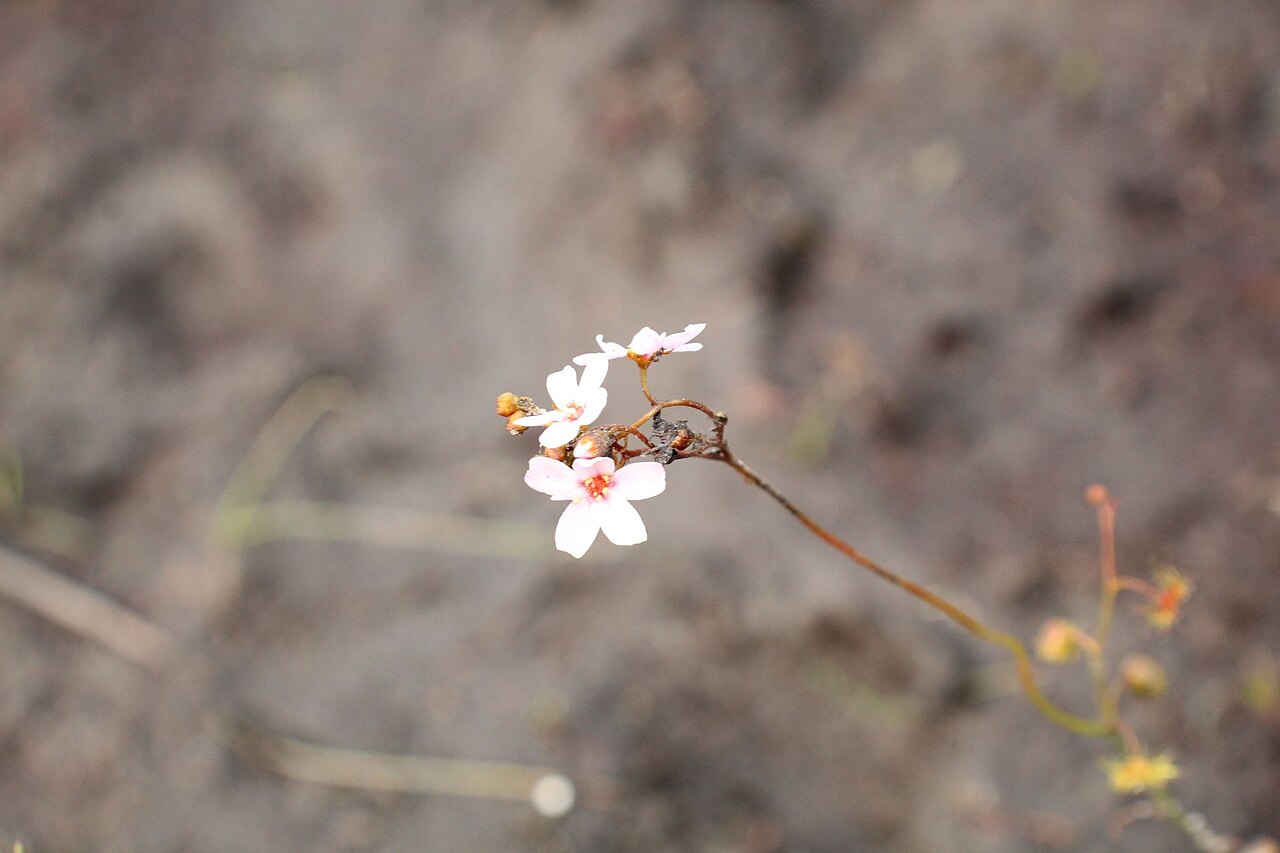
A perennial that each year produces from an underground tuber a straight stem 15 to 35 cm tall, with small trapping leaves along the stem. The inflorescence carries, as the name says, many flowers, white or pink, opening from October to December. The late flowering in wet, peaty hollows is the best field character. We did not find precise leaf and flower measurements in any source consulted.
Similar species
Other erect tuberous sundews of wet hollows, such as Drosera huegelii and D. heterophylla, flower in winter, from June to September, and have usually finished by late spring. D. heterophylla moreover has a many-petalled flower. The combination of a many-flowered inflorescence and the late flowering time makes D. myriantha recognisable.
The trap and how it works
An active flypaper trap. The leaves along the stem carry stalked glands with a sticky droplet that catch small flying insects. After a catch the tentacles bend to the centre of the leaf and digestive enzymes are secreted. In peaty swamps, where nitrogen is scarce, this is a welcome supplement.
Habitat and ecology
Swampy places with peaty sand (W4, W7, D1), on the coastal plain and in the wet hollows along the south-west coast. Because these swamps stay wet longer than the surrounding sandplains, the plant can still flower late in spring. After flowering it dies back above ground and survives the summer as a tuber.
Distribution and elevation
Endemic to south-west Australia, along the coast south of Perth to Albany.
- Recorded (one-degree cells)
Forms and variation
No subspecies or varieties have been described. The species belongs to section Ergaleium, the erect and climbing tuberous sundews.
Where and when to see it
Go in late October or November, when most other tuberous sundews have gone, to the edges of peaty swamps in the coastal strip between Perth and Albany. The many-flowered white or pink racemes then rise above the rushes and low shrubs. Expect wet feet.
Conservation status
On the global IUCN Red List the species is listed as Least Concern (LC). It is not listed in CITES. The coastal swamps of the south-west have largely been drained for agriculture and building over the past century and a half, and declining winter rainfall shortens the wet period; the species therefore depends on the remaining, often protected swamps. Uncertainty: we could not check the distribution in FloraBase.
Scientific name
Drosera myriantha | Planchon, 1848
Drosera myriantha was described in 1848 by the French botanist Jules Émile Planchon, in Annales des Sciences Naturelles, Botanique, 3rd series, volume 9, p. 291. The species occurs naturally along the coast of southwestern Australia, between Perth and Albany. The precise type locality, collector and collection date of the material used by Planchon (possibly collected by James Drummond, as with several other Western Australian species from the same publication) could not be established with certainty. The name is descriptive and derives from Greek: "myrias/myrios" (countless, numerous) and "anthos" (flower), together meaning "many-flowered". It refers to the large number of flowers produced per inflorescence in this species.
World Checklist of Vascular Plants (WCVP), via Plants of the World Online (POWO), Royal Botanic Gardens, Kew.