All species › Caryophyllales › Sundew family › Drosera kaieteurensis
Drosera kaieteurensis
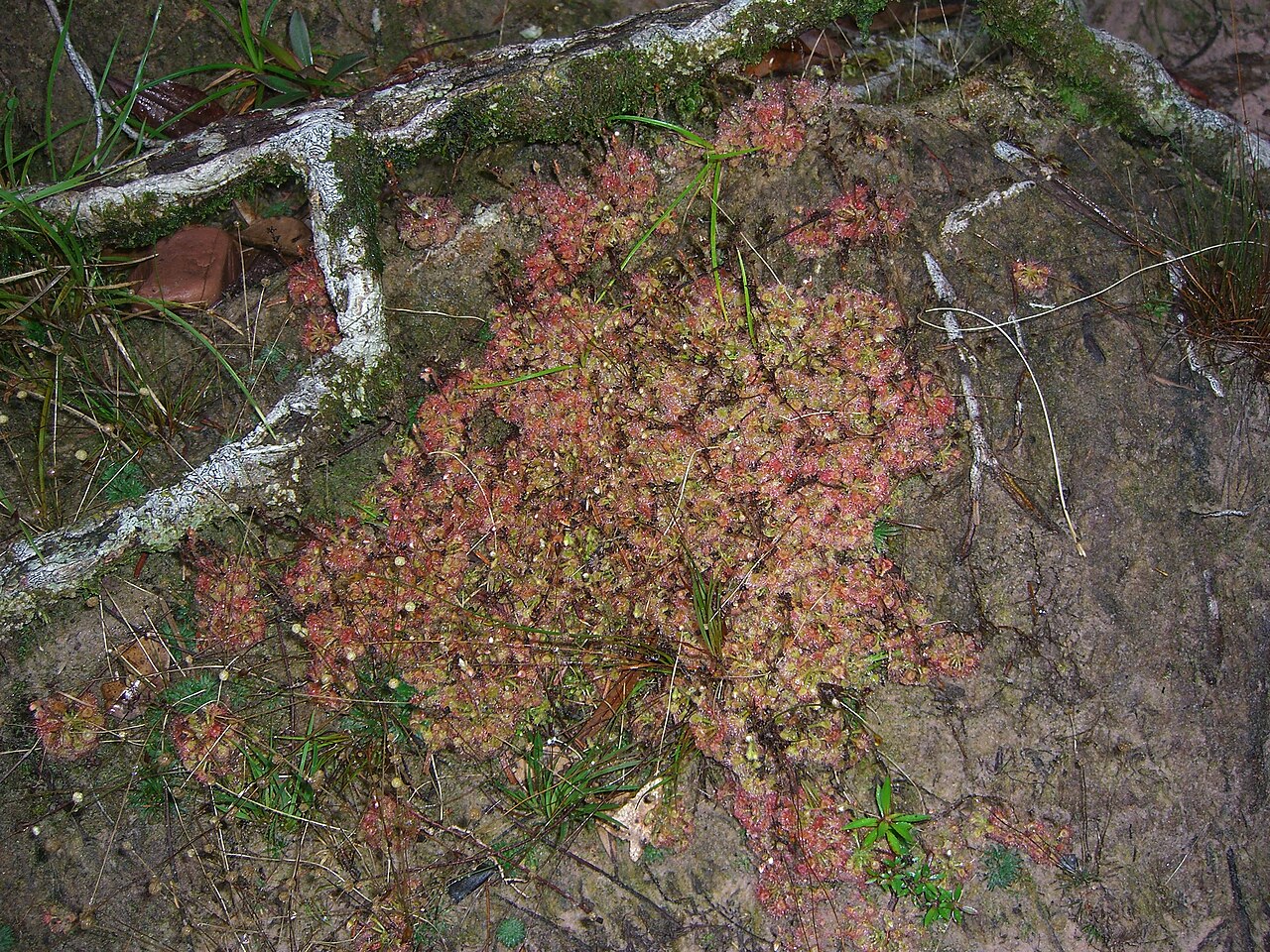
One of the smallest sundews in the Americas, named after Kaieteur Falls in Guyana, where the Potaro river drops more than 200 metres over a sandstone rim. On the open savanna above the falls, in the spray of the falling water, grow the tiny red rosettes of Drosera kaieteurensis. The rosette is smaller than a fingernail; the scapes are often larger than the plant itself.


Identification
A perennial rosette only 6 to 8 mm across. The blades are round to oval, 2 to 3 mm long and 2 to 2.5 mm wide, mostly red and densely covered in glandular hairs each holding a drop of sticky mucilage. The plant produces one to three inflorescences 13 to 60 mm long with two to nine white or pink flowers. The fruits are capsules that split lengthwise; the seeds are ejected when raindrops strike them.
Similar species
The closely related Drosera felix is almost identical in shape and size; according to some sources that name is a synonym of D. kaieteurensis, others keep the two apart. Drosera solaris from the Guyanese highlands is larger, with bright red rosettes, and is considered the closest relative of both. It differs from other Guiana sundews such as Drosera roraimae or Drosera biflora in its minute, almost round leaves without a distinct petiole.
The trap and how it works
An active flypaper trap in miniature. The bright red colour and glistening droplets attract small insects, which stick to the mucilage; the glandular hairs bend towards the prey and secrete digestive enzymes. The dissolved nitrogen compounds make up for the shortage in the extremely poor, acid soil. Prey consists of springtails, mites and the smallest flies.
Habitat and ecology
Sandy, extremely poor soils and moss-covered rocks in open savannas and on tepui slopes, from 460 to 2,400 m (B6, R1, W4). Around Kaieteur the plant grows in wet open patches of the savanna on the sandstone plateau, where the spray of the falls and the high rainfall keep the ground permanently damp.
Distribution and elevation
The tepui region along the Guyana–Venezuela border, with Kaieteur as the type locality. A possible occurrence on Trinidad is unconfirmed. The wide altitudinal range reflects that the species grows both on the low Kaieteur savanna and high on the table mountains.
- Recorded (one-degree cells)
Forms and variation
No varieties are recognised. The taxonomic relationship with D. felix is the main open question. This guide treats the two names separately for now, but a future revision may well unite them.
Where and when to see it
Kaieteur National Park can be reached by small plane from Georgetown and is one of the few places where a visitor can see a Guiana sundew without an expedition. Search the wet, open sandy patches along the trails and the moss on the rocks with a hand lens; the rosettes are scarcely larger than a pea. Keep to the trails: the savanna is fragile.
Conservation status
Not assessed for the global IUCN Red List and not listed in CITES. The best-known site lies in a national park, and many others on remote tepuis. Gold mining in the catchments around Kaieteur and growing tourism are local risks; little is known about population size or trends.
Scientific name
Drosera kaieteurensis | Brummer-Dinger, 1955
Described by Brummer-Dinger in 1955, in Acta Botanica Neerlandica, volume 4, p. 137. Not directly confirmed from the original description. The species occurs on the tepui plateaus of the Guyana-Venezuela border area, at 460-2400 m elevation, on sandy soils or mossy rock. The name strongly suggests a connection to Kaieteur Falls in Guyana, but this is not literally confirmed as the type locality. From the suffix -ensis ("from") — "of/from Kaieteur" (the Kaieteur Falls/region in Guyana).
World Checklist of Vascular Plants (WCVP), via Plants of the World Online (POWO), Royal Botanic Gardens, Kew.