All species › Caryophyllales › Sundew family › Drosera petiolaris
Drosera petiolaris
Drosera petiolaris gives its name to the D. petiolaris complex, a group of now fourteen closely related sundews of the tropical savannas of northern Australia. These plants live to the rhythm of the monsoon: in the wet season they grow and flower exuberantly, in the dry season they retreat into a dense, hairy bud. D. petiolaris itself is the most widespread species of the group and the only one also found outside Australia, in New Guinea.
Identification
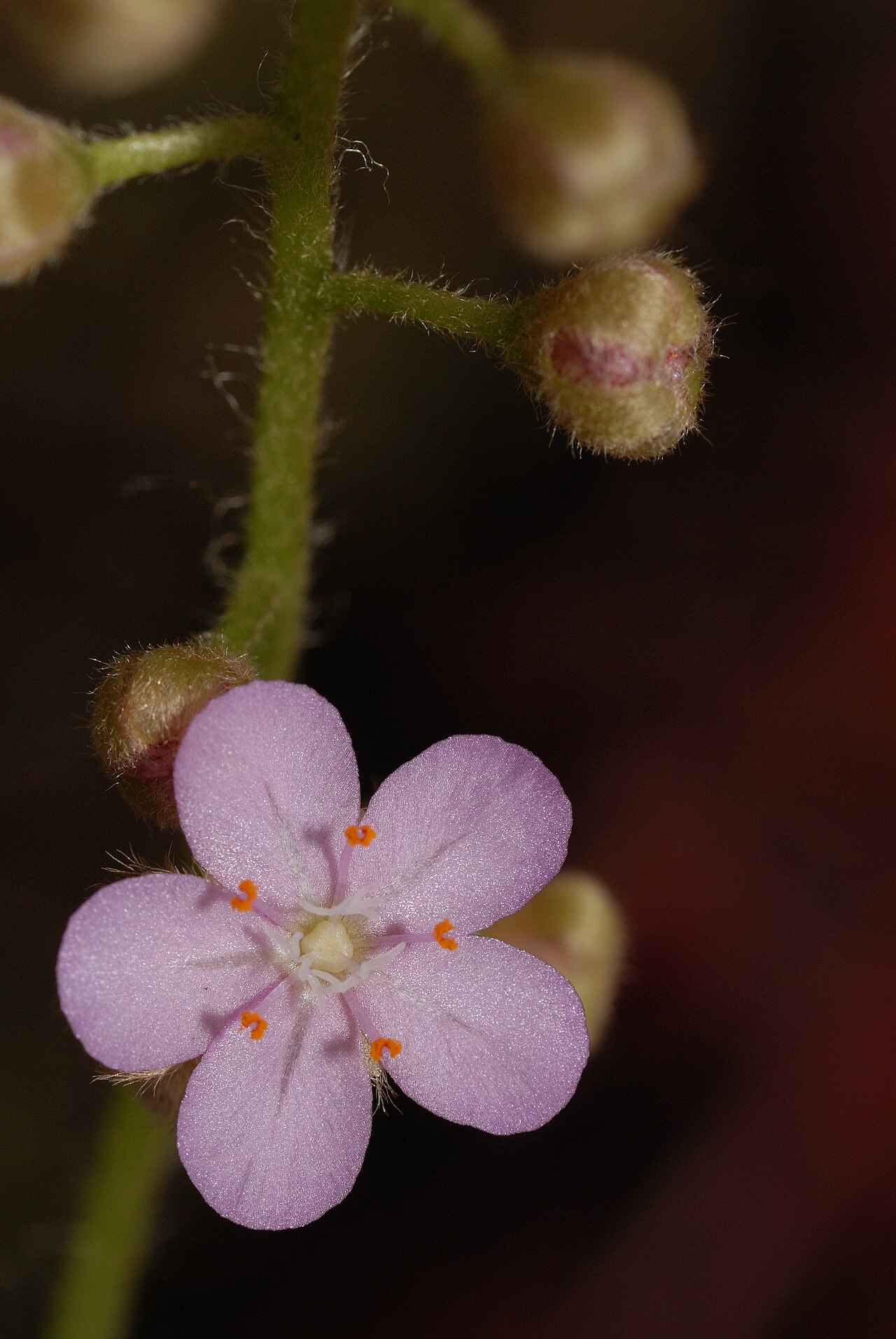
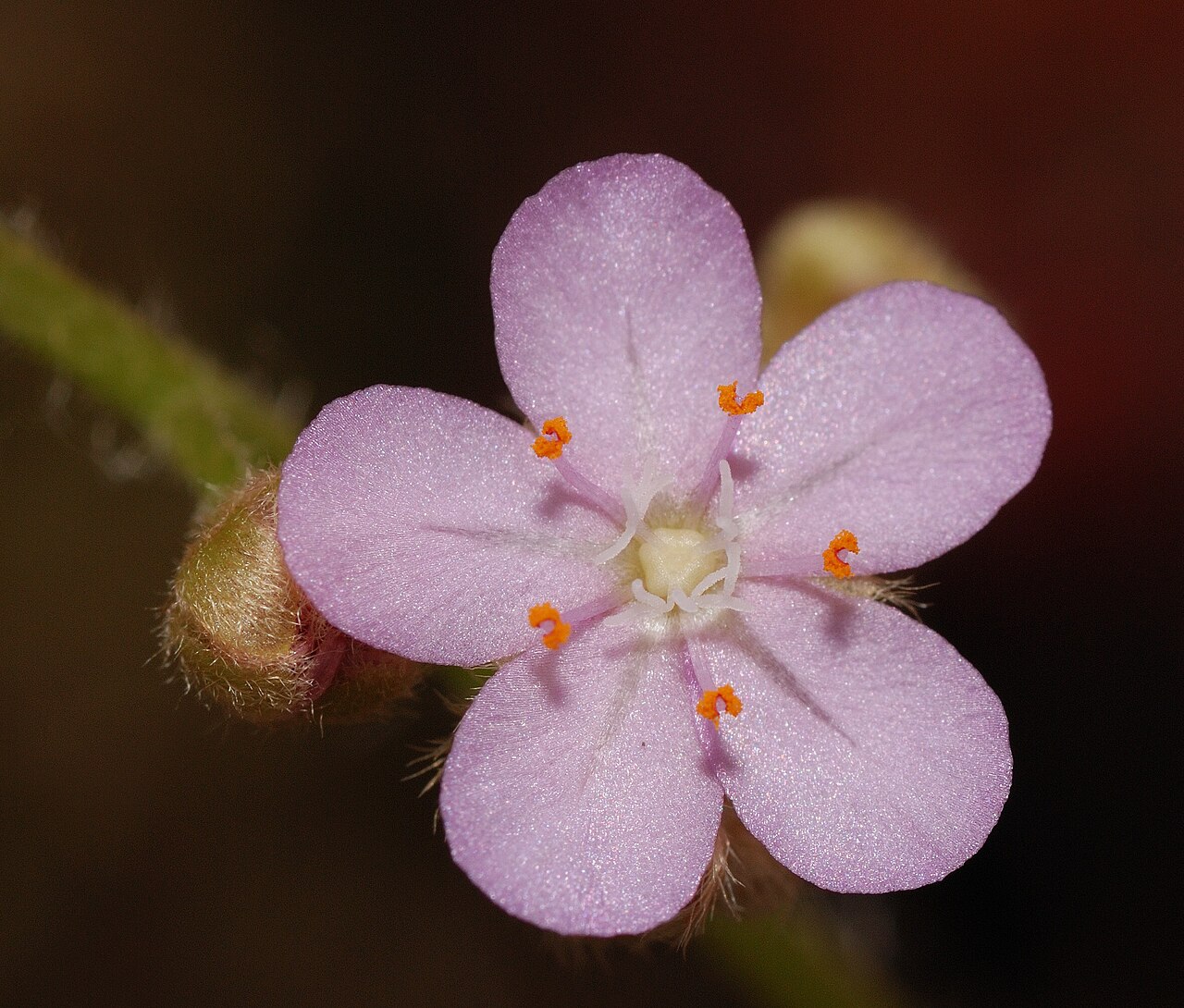
A rosette whose leaves consist of long, narrow petioles fanning out from the centre, with a small, round trapping blade at the tip bearing long glands. That combination — long stalk, small round blade — is characteristic of the whole complex. Stipules sit at the leaf bases, and parts of the plant carry white hairs, a feature of section Lasiocephala. The flowers are borne in racemes on erect stems rising well above the rosette. In the dry season the plant makes smaller, densely hairy leaves that protect the growing point. Reliable measurements were not available for this guide; the measurement fields are therefore left empty.
Similar species
Within the complex the differences are subtle and often determinable only with flowering or fruiting material. Drosera dilatatopetiolaris has broadened green petioles 3 to 5 mm wide; D. fulva has reddish-brown hairs and tall inflorescences; D. ordensis is densely silvery-hairy; D. derbyensis has woolly petioles and scapes; D. stipularis from Cape York has conspicuously upright white stipules and a short stem; D. lanata is strongly woolly. Where several species grow together, identification without a hand lens and flowers is unreliable.
The trap and how it works
An active flypaper trap at the end of a long stalk. The round blades carry glands that secrete sticky mucilage; small flies, gnats and ants landing on them stick fast, and the tentacles bend towards the prey. Because the blades stand above the sand on long stalks, they mainly catch low-flying insects over the wet ground.
Habitat and ecology
Seasonally wet sandy ground in tropical savanna: wet hollows, swamp margins and shallow depressions that flood in the wet season and dry out in the dry season (W7), open patches in savanna woodland (B6) and wet sand flats (D1). The species often grows lower in the landscape and wetter than relatives such as D. dilatatopetiolaris, which seeks out higher, damp sandy ground.
Distribution and elevation
Northern Australia — northern Western Australia (Kimberley), the Northern Territory and Queensland — and New Guinea. The type was collected during James Cook's first voyage by Joseph Banks and Daniel Solander at the Endeavour River in Queensland; De Candolle published the name in 1824 based on an unpublished description by Robert Brown. Altitudinal limits are not published in the sources consulted; the elevation field is left empty.
- Recorded (quarter-degree cells)
Forms and variation
For a long time much of the complex was treated as D. petiolaris in the broad sense. Since the 1980s Kondo, Lowrie and others have split off or reinstated many species, such as D. dilatatopetiolaris, D. fulva, D. brevicornis, D. darwinensis, D. derbyensis, D. ordensis, D. paradoxa and in 2020 D. stipularis. Variation within present-day D. petiolaris is also large; older records under this name may refer to other species.
Where and when to see it
The best time is the end of the wet season and the start of the dry, when the rosettes are full grown and the flowering stems appear. Search open, wet sandy ground in savanna, along swamp margins and where water lingers after rain. The long, star-like spreading petioles with their red blades are unmistakable up close. In the dry season the plant is a small hairy bud that is barely noticeable. Beware of crocodiles near water in northern Australia.
Conservation status
On the IUCN Red List the species is Least Concern (LC); it is not listed in CITES. The range is large and includes extensive, little-developed savanna country. Local threats are changes in fire regime, grazing and trampling by feral stock, and invasive grasses that close over open, wet sandy patches.
Scientific name
Drosera petiolaris | R. Brown ex de Candolle, 1824
Drosera petiolaris was validly published by Augustin Pyramus de Candolle in 1824, in volume 1 (page 318) of his Prodromus Systematis Naturalis Regni Vegetabilis, based on an earlier unpublished description by the Scottish botanist Robert Brown (hence the author citation "R.Br. ex DC."). The type material was collected at the Endeavour River in Queensland, Australia, by Joseph Banks and Daniel Solander during James Cook's first voyage aboard HMS Endeavour (1770); the exact collection date could not be established with certainty. The epithet petiolaris is descriptive Latin meaning "having a petiole (leaf stalk)"; it likely refers to the long, narrow petioles that emerge from the centre of this species' leaf rosette, though an explicit rationale from the describers themselves was not found.
World Checklist of Vascular Plants (WCVP), via Plants of the World Online (POWO), Royal Botanic Gardens, Kew.