All species › Caryophyllales › Sundew family › Drosera paradoxa
Drosera paradoxa
This species bears its name for good reason. When Allen Lowrie studied the plants in the field, young rosettes, dense 'pincushions' and upright specimens on woody stems looked like three different species. Only later did they prove to be stages in the life cycle of a single species: Drosera paradoxa, described in 1997 and thus the only member of the D. petiolaris complex that forms a true stem over the years.
Identification
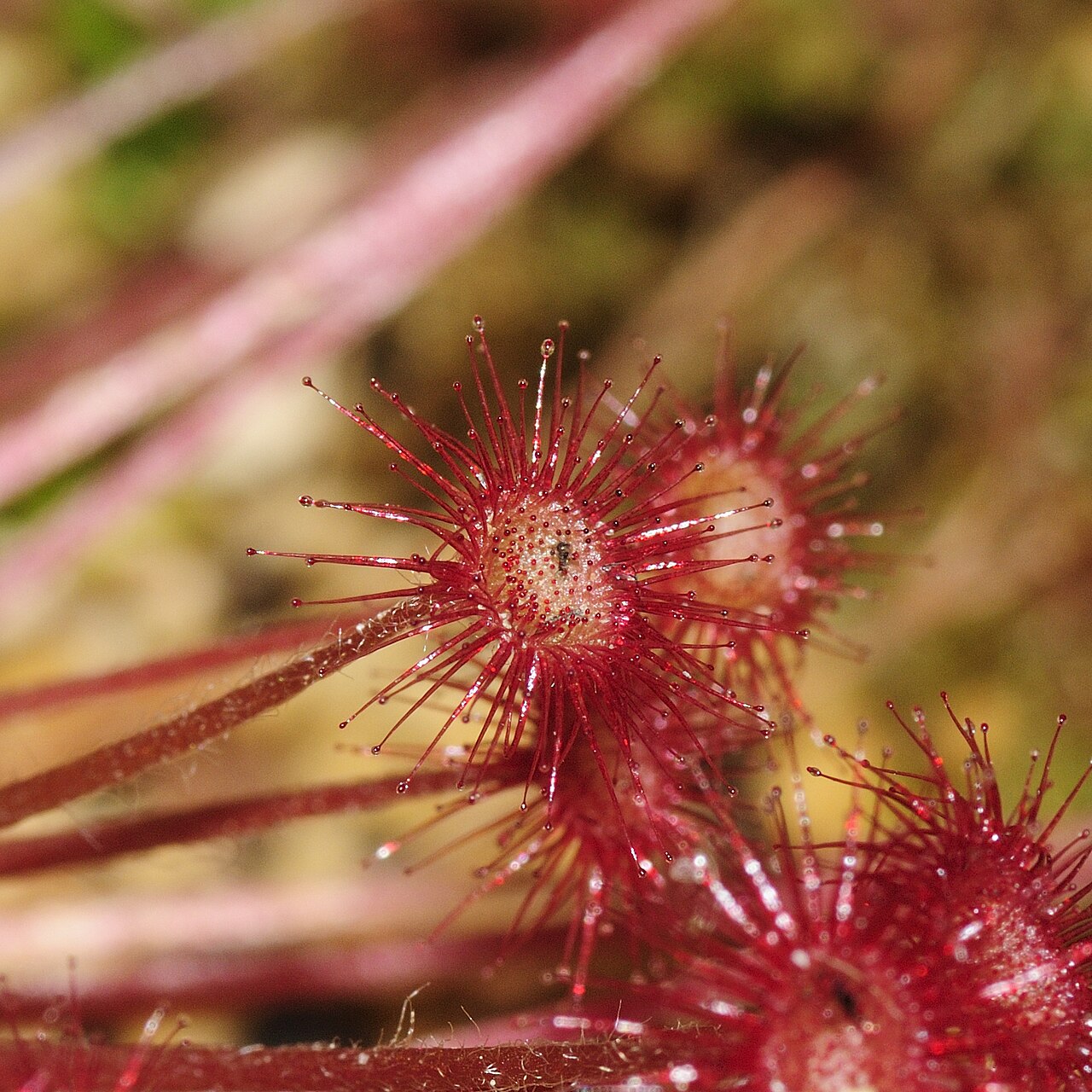
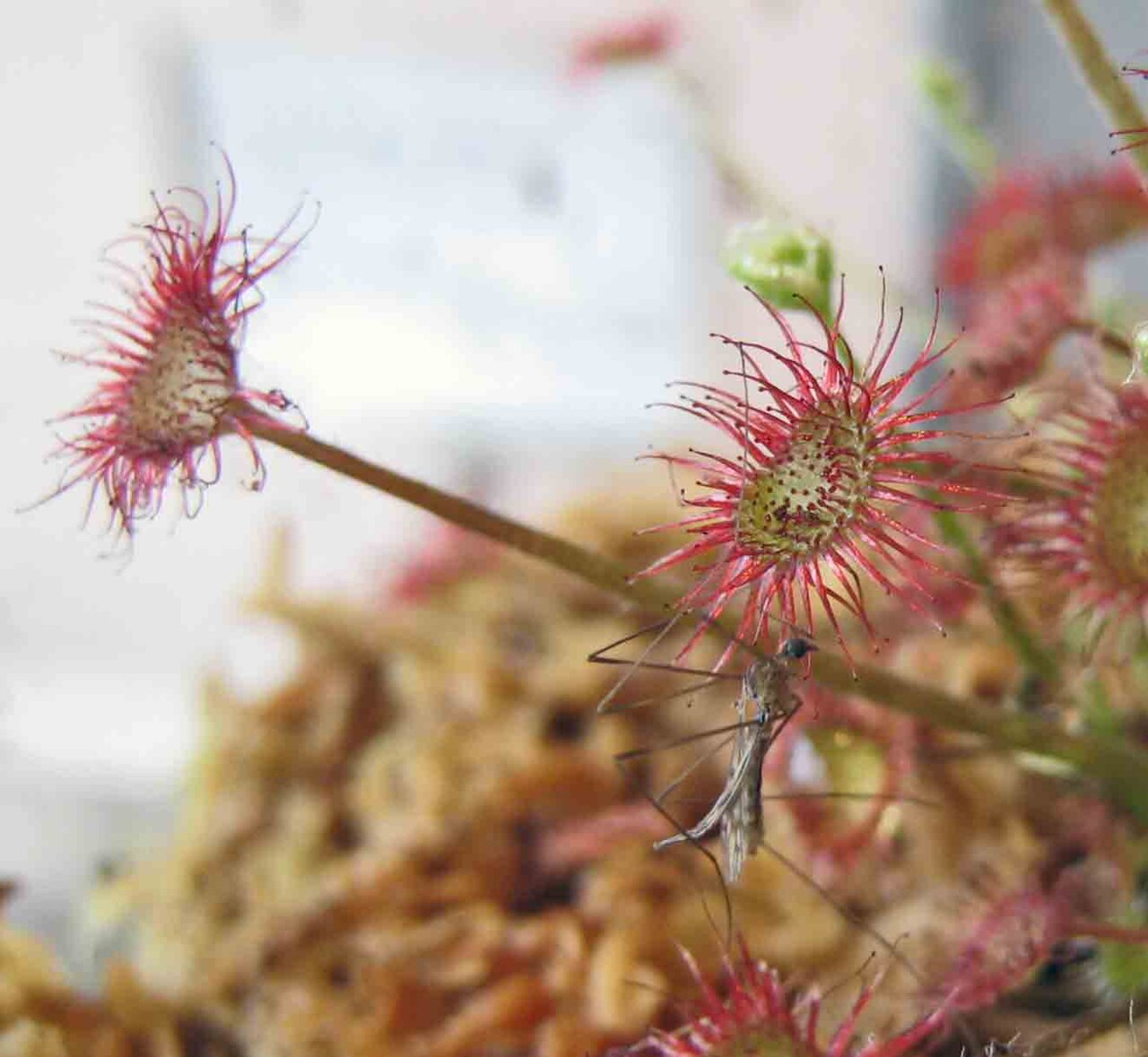
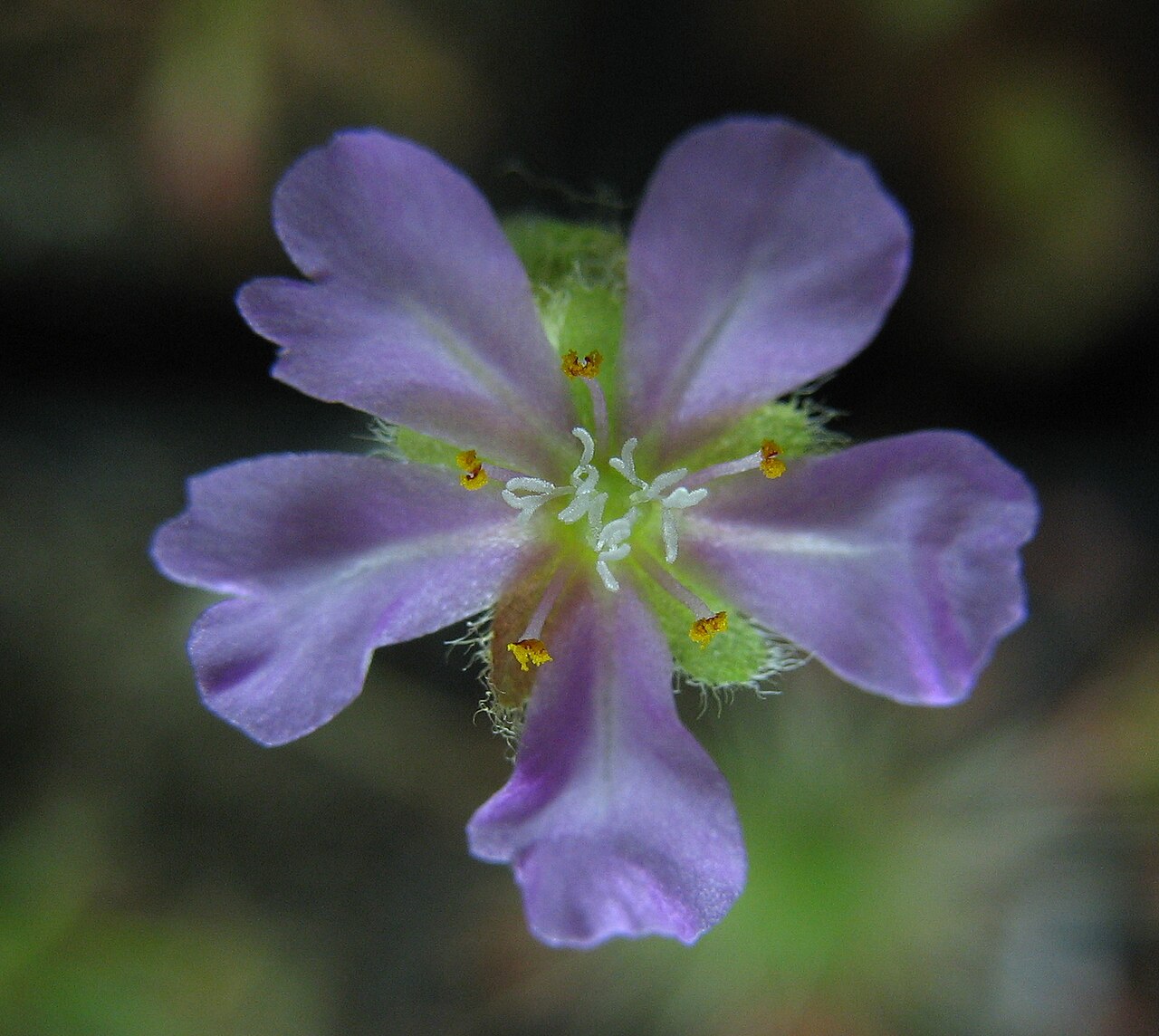
A perennial that starts as a flat rosette, then grows into a dense, domed 'pincushion' of leaves and finally forms an erect, woody stem up to 30 cm with the living rosette at the top and the withered leaves of previous years below. The leaves have linear petioles 20 to 35 mm long and a small round trapping blade only 2 to 3 mm long and 2.5 to 3 mm wide. The inflorescences are 20 to 40 cm long, with 50 to 70 pink or white flowers in crowded racemes.
Similar species
Older plants can hardly be confused within the complex thanks to their stem. Young rosettes, however, closely resemble Drosera petiolaris and relatives, all of which have long petioles with a small round blade; without a stem identification is difficult. D. stipularis from Cape York also forms a short stem of old leaves but stays much smaller (a few centimetres) and grows far outside the range of D. paradoxa.
The trap and how it works
An active flypaper trap. The small round blades on the long stalks carry glandular tentacles with sticky mucilage; small flying and crawling insects stick to them and the tentacles bend towards the prey. Because in older plants the rosette stands up to 30 cm above the ground, the plant also catches insects flying higher than those caught by flat-rosetted species.
Habitat and ecology
Skeletal sandy soils over sandstone (D2) in or near seasonal creek beds that dry out in the dry season and can flood heavily in the March–April wet season (W7), in a landscape of savanna and open woodland (B6). The woody stem probably helps the plant survive floods and sedimentation.
Distribution and elevation
Northern Australia: the Kimberley in Western Australia, west to Beverley Springs, and east into Kakadu National Park in the Northern Territory. Contrary to what the range description 'Kimberley' suggests, the species therefore also occurs in the Northern Territory. Altitudinal limits are not published in the sources consulted; the elevation field is left empty.
- Recorded (quarter-degree cells)
Forms and variation
No varieties are recognised. The great variation in form within a single plant over the years — from flat rosette through pincushion to stem — is precisely what made the species so confusing and gave it its name. As a result, older herbarium collections of young plants may be filed under other names from the D. petiolaris complex.
Where and when to see it
Search in the early dry season, July to September, when the plants are in flower, along drying creek beds on sandstone. The upright stems with their rosette at the top and long pink racemes are then easy to see. Bear in mind that many sites are remote and accessible only in the dry season; do not enter Aboriginal land without permission.
Conservation status
On the IUCN Red List the species is Least Concern (LC); it is not listed in CITES. When describing it in 1997 Lowrie already assessed it as common and not threatened. The range is large and lies mostly in remote, little-developed country, partly in national parks. Possible threats are changes in fire regime and in creek hydrology.
Scientific name
Drosera paradoxa | Lowrie, 1997
Drosera paradoxa was described in 1997 by Allen Lowrie, in the journal Nuytsia, volume 11, issue 3, page 347. The type material was collected on 1 August 1996 near Wren Creek, along the road to Pantijan, on a tributary of Bachsten Creek, in the Kimberley region of Western Australia. The collector is not explicitly named in the sources consulted, but it seems likely this was Allen Lowrie himself, the author of the species. The epithet paradoxa is Latin (via Greek) for "paradoxical, contradictory, surprising." The name refers to confusing field observations: populations initially seemed to show different growth forms (with or without a woody stem), which later turned out to represent different life stages of one and the same perennial species.
World Checklist of Vascular Plants (WCVP), via Plants of the World Online (POWO), Royal Botanic Gardens, Kew.