All species › Caryophyllales › Sundew family › Drosera pycnoblasta
Drosera pycnoblasta
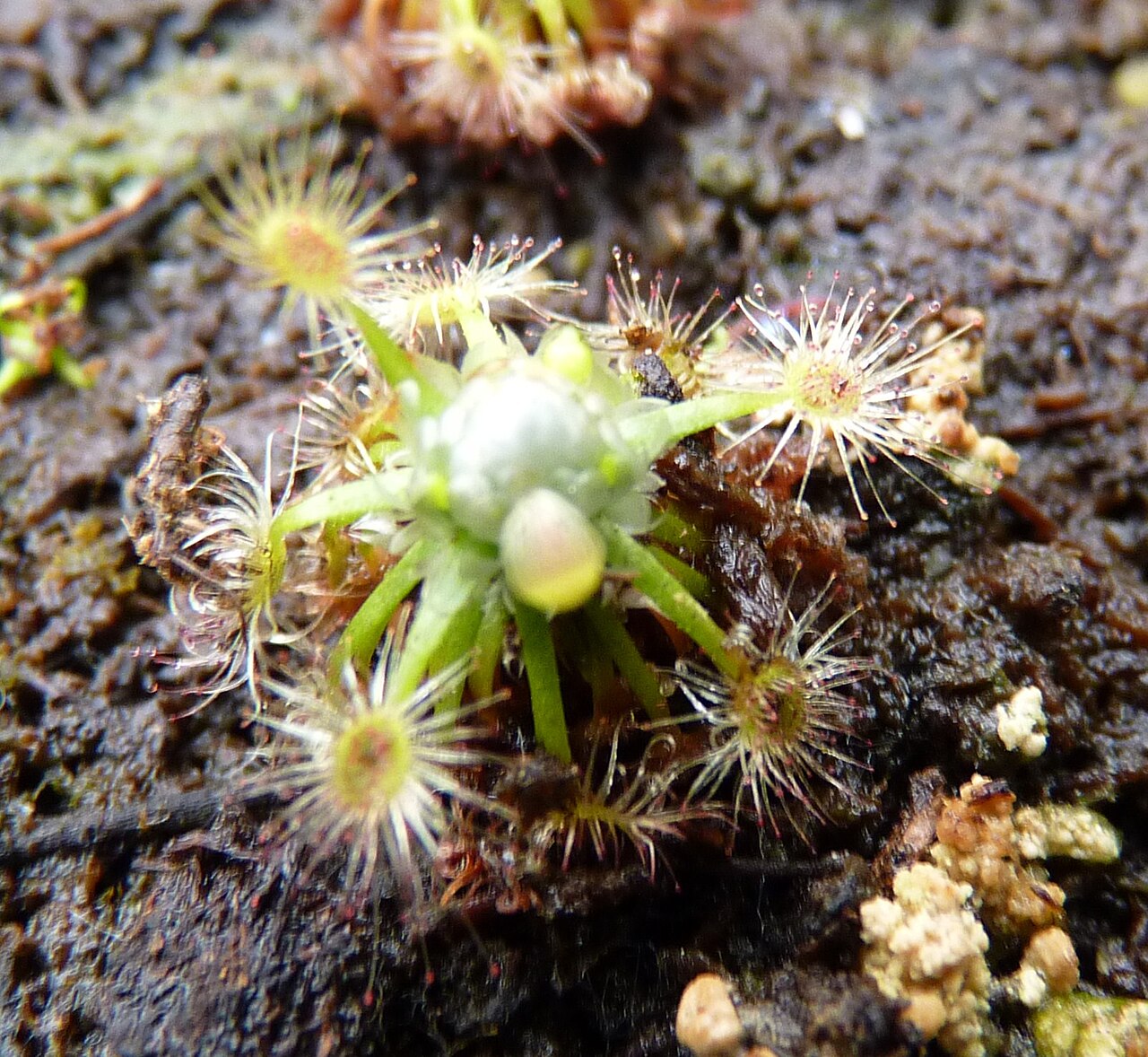
A pygmy sundew of the drier eastern half of south-west Australia's winter-rainfall zone, from the wheatbelt into the mallee and the edge of the Goldfields. Drosera pycnoblasta takes its name from the heart of the rosette: a globular, densely packed bud of stipules that protects the growing point in summer.

Identification
A small rosette with stalked glandular blades; with the inflorescence the plant reaches 9 cm. The best character is the stipule bud at the centre: simple, broad stipules packed so densely that together they form a round ball. The name derives directly from this: pycnos is 'densely packed', blastos 'bud'. The flowers are white to pink and appear from September to November. Exact leaf and flower measurements are not published in the sources consulted.
Similar species
Many pygmy sundews have a stipule bud, but rarely one so compact and globular. Drosera leucoblasta has a white, looser bud and orange flowers; D. parvula and D. pedicellaris flower white but grow in the west and north-west. When in doubt a lens is needed to examine the shape and arrangement of the stipules.
The trap and how it works
An active flypaper trap in miniature. Each leaf blade, often no larger than a pinhead to a few millimetres, carries stalked glands on its margin and upper surface, each holding a glistening sticky droplet; the marginal tentacles are usually the longest. A small animal that touches the droplets sticks fast, after which the tentacles bend towards the centre of the blade and press the prey against the digestive glands. The glands secrete enzymes and absorb nitrogen, phosphorus and minerals from whatever dissolves. Given the scale, the catch consists of the very smallest: springtails, mites, aphids, thrips and minute midges moving over or just above the sandy ground.
Habitat and ecology
White or yellow sand (D1), in heath and scrub (B5) and in open mallee — the low, multi-stemmed eucalypt woodland of the dry interior (B6). One observer describes the plant in deep white sand in mallee north of Ravensthorpe, together with Drosera zonaria. The compact stipule bud suits this drier setting.
Distribution and elevation
Endemic to southern Western Australia, from around Brookton and Bruce Rock to Ravensthorpe. FloraBase lists the Avon Wheatbelt, Coolgardie, Esperance Plains, Jarrah Forest and Mallee bioregions and records the species from 23 local government areas. Altitudinal limits are not published.
- Recorded (quarter-degree cells)
Forms and variation
Ludwig Diels described the species in 1904. No subspecies or varieties are recognised. Like all pygmy sundews it forms gemmae in the centre of the rosette in winter; the globular stipule bud is the most conspicuous part of that overwintering apparatus in this species.
Where and when to see it
Search in September and October in open sandy patches in mallee and heath on the sandplains; the white-pink flowers give the plant away fastest. Outside flowering, the round silvery bud at the heart of the rosette is the character to look for. In summer the plant has withdrawn into that bud and is almost impossible to find in the sand.
Conservation status
Assessed as Least Concern (LC) on the IUCN Red List; not listed in CITES, and rated not threatened in FloraBase. The species occurs over a large area. In the wheatbelt much of its habitat has been cleared; there it survives mainly on road verges and in reserves, and further east in the mallee in more extensive natural country.
Scientific name
Drosera pycnoblasta | Diels, 1904
Drosera pycnoblasta was described by the German botanist Ludwig Diels, in Botanische Jahrbücher für Systematik, volume 35, page 207, in 1904. The species is endemic to Western Australia. Diels described many new Western Australian species based on material he and Ernst Pritzel collected during their 1900–1902 expedition; it is plausible that the type specimen of this species comes from those collections, but the exact collection site, collector and date could not be confirmed with certainty. The epithet pycnoblasta is composed of the Greek pyknos ("dense") and blastos ("shoot, bud"), and thus likely means "with densely packed shoots/buds". This reading follows from the Greek construction but could not be confirmed in a dedicated etymological source.
World Checklist of Vascular Plants (WCVP), via Plants of the World Online (POWO), Royal Botanic Gardens, Kew.