All species › Caryophyllales › Sundew family › Drosera prostratoscaposa
Drosera prostratoscaposa
A tuberous rosetted sundew discovered only in 1989, in Fitzgerald River National Park on the south coast of Western Australia. Drosera prostratoscaposa — the name means roughly 'with a prostrate scape' — stands out for something its closest relatives lack: several flowers per stem, scented of jasmine.
Identification
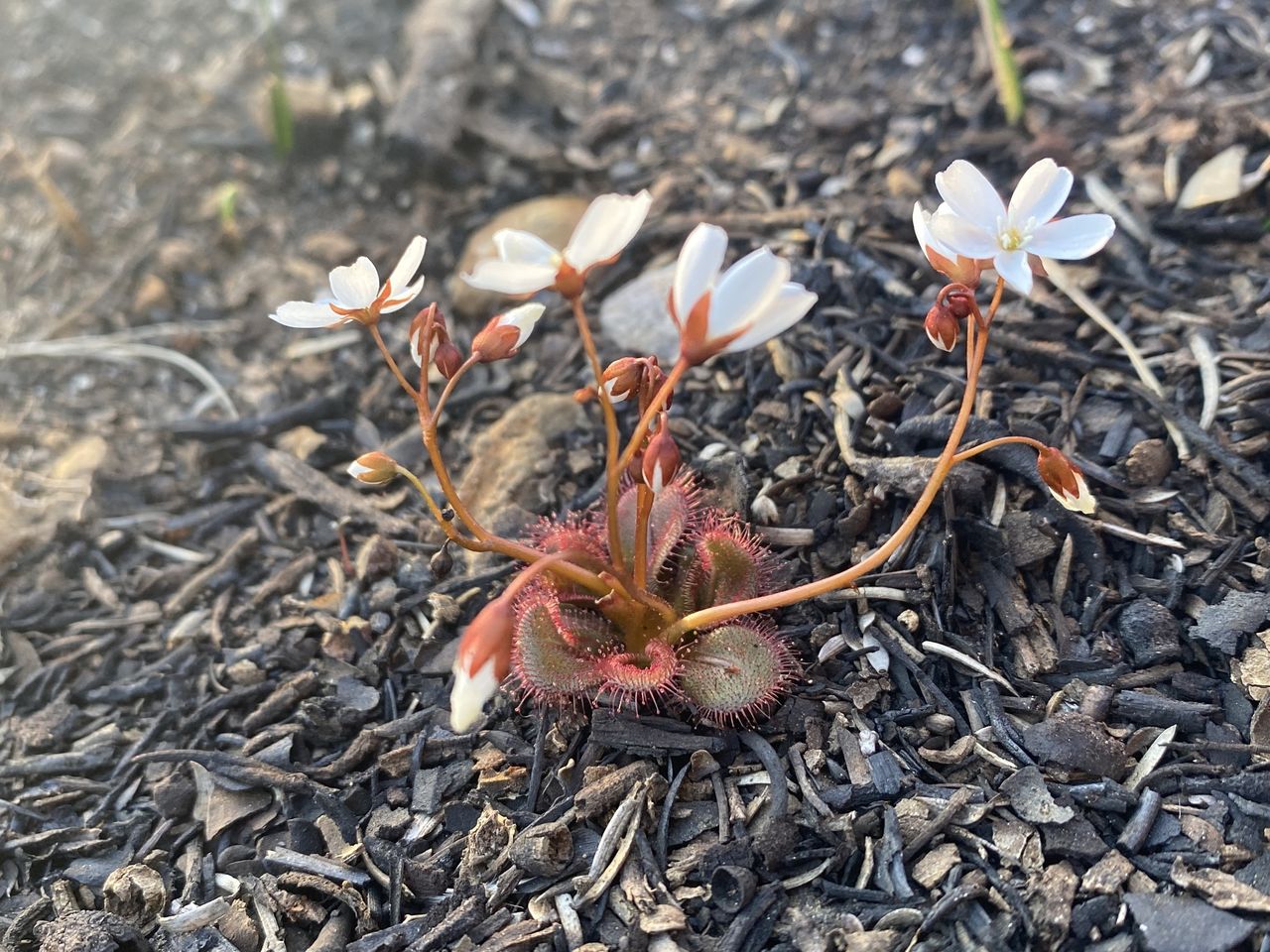
A flat rosette about 8 cm across, appearing in the wet season from an underground tuber. The leaves are petiolate: a distinctly narrower stalk carries a broader glandular blade, which according to the description is one of the characters separating the species from its closest relatives. The flower stems lie along or bend to the ground — hence the name — and each carries several jasmine-scented flowers. Flower colour, flowering time and exact leaf and flower measurements are not given in the sources consulted; those fields are left empty.
Similar species
Its closest relatives are Drosera macrophylla and D. bulbosa, also tuberous rosette plants of south-west Australia. According to the description the difference lies in two characters: D. prostratoscaposa has clearly petiolate leaves, and carries several scented flowers per stem. How exactly the relatives compare on these points is not worked out in the summary consulted. The small range in the Fitzgerald River district helps with identification.
The trap and how it works
An active flypaper trap held close to the ground. The rosette leaves lie flat on the soil and carry stalked glands with a sticky droplet on the upper surface and along the margin. Whatever crawls over the ground or lands briefly — ants, springtails, small beetles and midges — becomes entangled, after which the tentacles slowly bend inwards and the glands secrete digestive enzymes. Nitrogen, phosphorus and minerals from the prey are absorbed through the same leaf surface. Because the plant is in leaf for only a few months each year, that food goes straight into the tuber, which has to carry the plant through the next dry summer.
Habitat and ecology
Fine black sand (D1) — that is, sand rich in organic matter — in the heath and scrub of the south coast (B5). Further details of the site, such as the degree of winter waterlogging, are not worked out in the sources consulted.
Distribution and elevation
Endemic to Western Australia and known only from a small area within Fitzgerald River National Park, about 40 km south-east of the South Coast Highway between Albany and Esperance. The park is one of the richest botanical areas in Australia. Altitudinal limits are not published.
- Recorded (one-degree cells)
Forms and variation
The plant was discovered in 1989 by Phill Mann and formally described in 1990 by Allen Lowrie and Sherwin Carlquist. No subspecies or varieties are recognised. The species belongs to the tuberous rosetted sundews of subgenus Ergaleium.
Where and when to see it
Fitzgerald River National Park is large, rugged and partly accessible only by four-wheel drive; some areas are also closed to limit the spread of the root-rot pathogen Phytophthora. Respect those closures and clean shoes and tyres before entering an area. Anyone wanting to see the plant does best in the wet season, with someone who knows the site — the range is small and the rosettes are inconspicuous on dark sand.
Conservation status
Assessed as Least Concern (LC) on the IUCN Red List; not listed in CITES. The entire known range lies within a national park, which removes most clearing pressure. Its small distribution does, however, make the species sensitive to local events such as fire at the wrong time or the spread of root rot.
Scientific name
Drosera prostratoscaposa | Lowrie & Carlquist, 1990
Drosera prostratoscaposa was described in 1990 by Allen Lowrie and Sherwin Carlquist, in the journal Phytologia, volume 69(3), pages 160–162. The species was discovered in 1989 by Phill Mann. The type specimen was collected on 23 April 1990 by Allen Lowrie, near a tributary of the Hamersley River where it crosses Hamersley Drive, about 40 km south-east of South Coast Highway, in Fitzgerald River National Park, Western Australia. The specimen is held in the PERTH herbarium (number PERTH 1751247). The epithet prostratoscaposa is a compound Latin name from prostratus ("prostrate, lying flat") and scaposa ("bearing a scape/flower stalk"), and likely refers to the plant's prostrate flowering scapes. This reading is based on the Latin construction and could not be confirmed in a dedicated etymological source.
World Checklist of Vascular Plants (WCVP), via Plants of the World Online (POWO), Royal Botanic Gardens, Kew.