All species › Caryophyllales › Sundew family › Drosera salina
Drosera salina
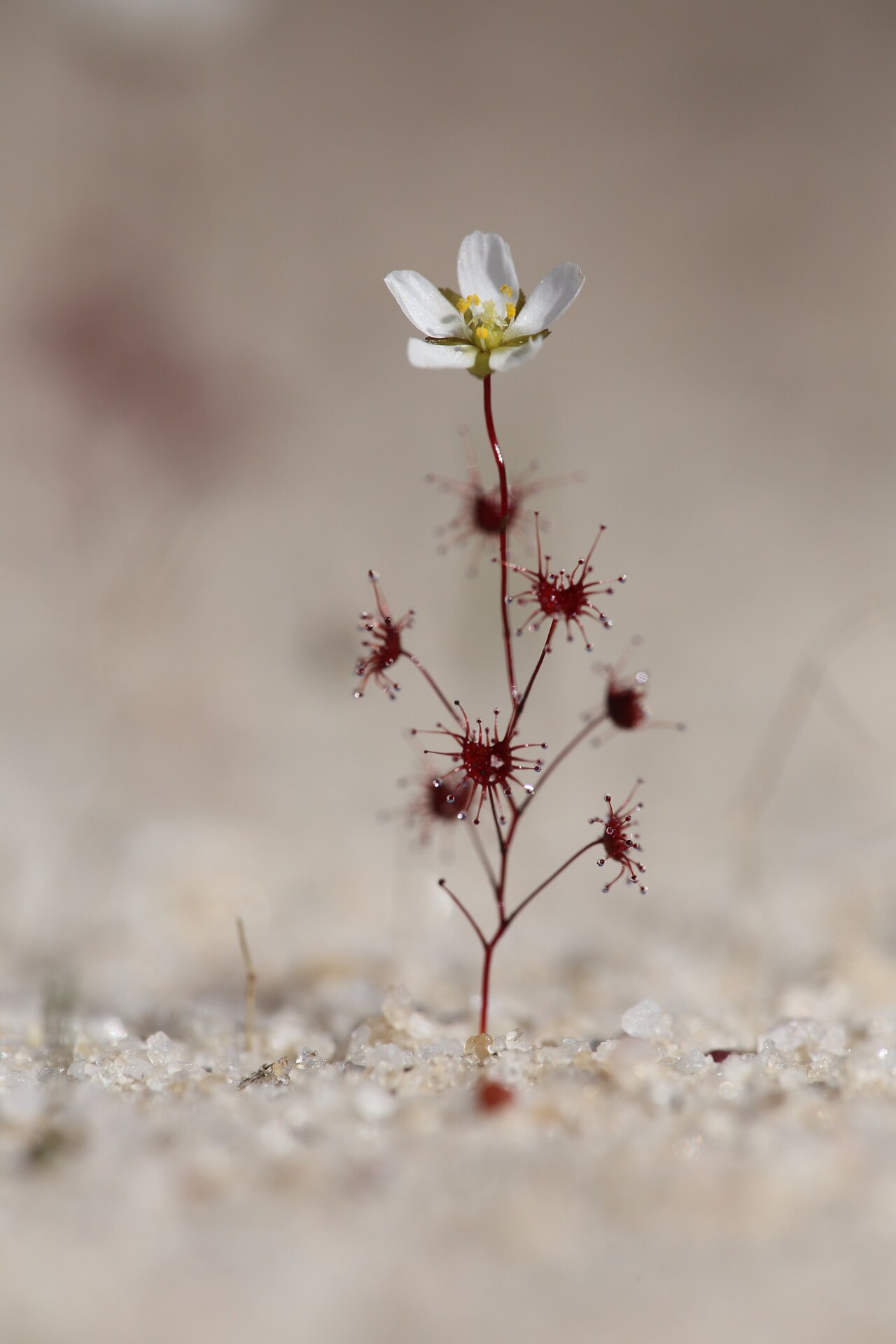
A small, erect tuberous sundew of the salt lakes of southern Western Australia — a setting in which no one would expect a carnivorous plant. Drosera salina does not grow in the salt itself but on salt-free sand along the margins of salt lakes, and is known from only a few places.
Identification
A perennial tuberous plant with an erect stem up to 7 cm tall, bearing small glandular trapping leaves. The flowers are white and appear from July to September. Exact leaf and flower measurements are not given in the sources consulted; those fields are left empty.
Similar species
Drosera zigzagia grows on the same salt-lake margins, also a small, erect tuberous sundew; it has a zigzag stem and yellow flowers, whereas D. salina flowers white. Other erect tuberous sundews of the south do not grow by salt lakes, so the habitat is an important clue here.
The trap and how it works
An active flypaper trap, but held well above the ground. The leaves along the stem are small, peltate and often cup-shaped, with longer tentacles on the margin and shorter ones on the blade. Flying insects — midges, small flies, sometimes bees or butterflies drawn to the flowers — touch the droplets and stay hanging. The marginal tentacles then bend inwards and the blade partly closes around the prey, after which the glands secrete enzymes and absorb the dissolved nutrients. Because the traps are spread along an upright or climbing stem, the plant sweeps a much larger volume of air than a rosette on the ground.
Habitat and ecology
Salt-free sand on the margins of salt lakes (D4, D1). The epithet refers to that saline setting, but the plant itself grows on the higher, leached sandy fringe, not on the salt crust. On such margins it has been found together with Drosera zigzagia, in company that also includes Stylidium species, Levenhookia leptantha and Frankenia.
Distribution and elevation
Endemic to Western Australia, at a small number of sites from north of Albany east to north-west of Esperance. Altitudinal limits are not published.
- Recorded (one-degree cells)
Forms and variation
N.G. Marchant and Allen Lowrie described the species in 1992. No subspecies or varieties are recognised.
Where and when to see it
July to September, when the white flowers are open. Search the sandy margin of salt lakes, just above the salt crust — not on the lake bed itself, which can be treacherously soft after rain. Because the species is rare and localised: look, photograph, move nothing.
Conservation status
Assessed as Vulnerable (VU) on the IUCN Red List; not listed in CITES. In Western Australia it is also registered as Priority Two: poorly known, from few sites, partly on unprotected land. The greatest landscape-scale threat to such sites is salinisation of the wheatbelt: clearing causes saline groundwater to rise, shrinking the salt-free margins around the lakes.
Scientific name
Drosera salina | Marchant & Lowrie, 1992
Drosera salina was described in 1992 by Neville Gordon Marchant & Allen Lowrie, published in Kew Bulletin, volume 47(2): 320, as part of the paper "New names and new combinations in 34 taxa of Western Australian tuberous and pygmy Drosera." The holotype was collected on 14 September 1984 by Allen Lowrie on the southwestern shore of a salt lake, about 72 km east of Lake King and then 5 km southeast of that point, in Western Australia; the specimen is deposited in herbarium PERTH (no. 4178998). The species occurs only in salt-free sand at the margins of salt lakes, from north of Albany to northwest of Esperance. The epithet salina is Latin for "saline" or "salt-loving" (from sal, "salt") and refers directly to the species' habitat at the margins of salt lakes — a descriptive name.
World Checklist of Vascular Plants (WCVP), via Plants of the World Online (POWO), Royal Botanic Gardens, Kew.