All species › Caryophyllales › Sundew family › Drosera pilosa
Drosera pilosa
A hairy sundew of the tropical highlands. Drosera pilosa was described in 1956 by Exell and Laundon in their revision of the African sundews. The name — 'hairy' — refers to the plant's indumentum, which sets it apart from most of its relatives.
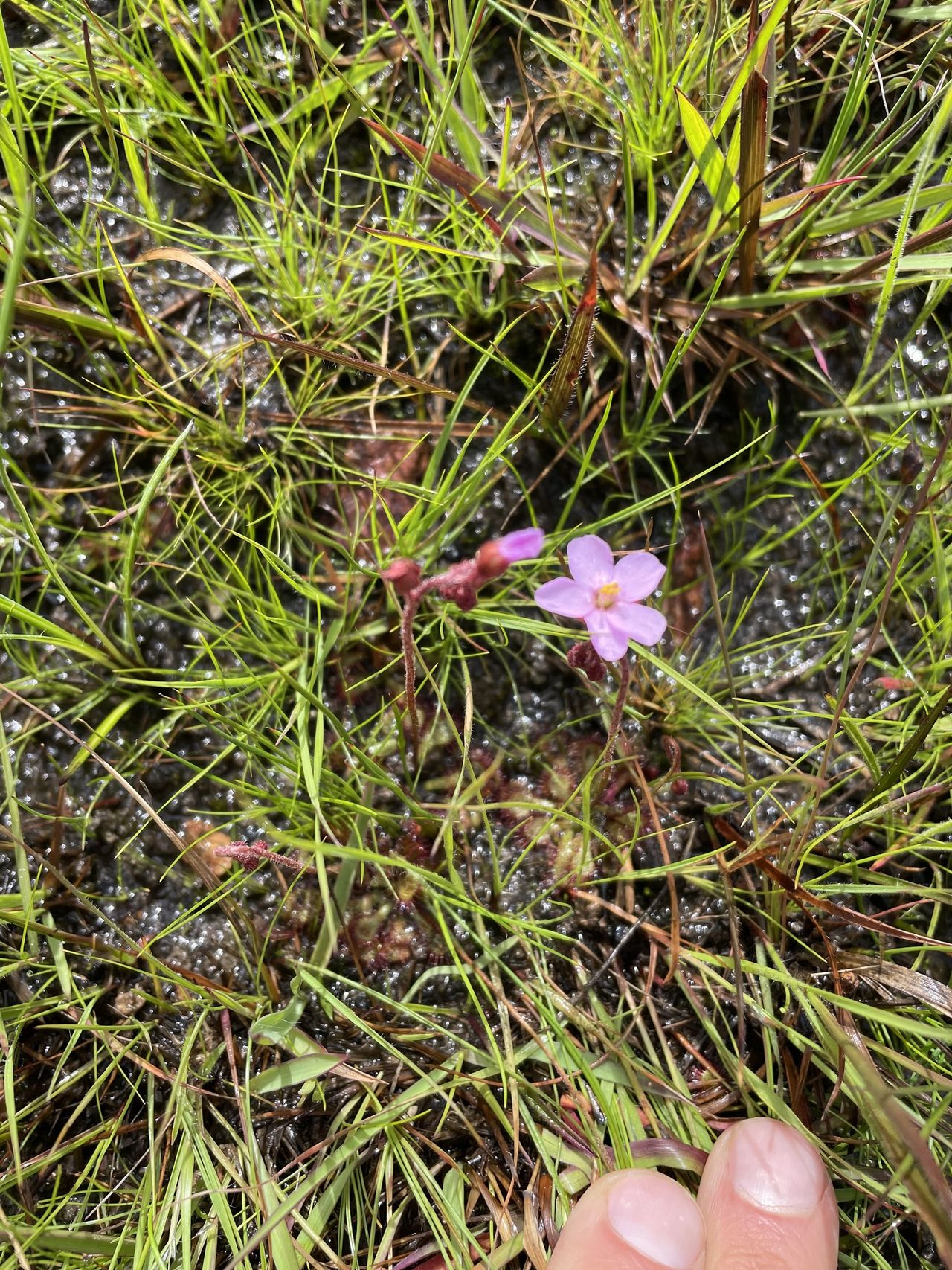
Identification
A sundew with glandular trapping leaves and a conspicuously hairy scape and leaf underside. Detailed, reliable measurements from a flora were not available for this text; the measurement fields are left empty.
Similar species
East Africa also holds D. madagascariensis and D. burkeana. The former forms a long stem with scattered leaves; the latter is a small rosette with round blades and without the conspicuous hairiness.
The trap and how it works
An active flypaper trap: stalked glands with sticky droplets hold small insects, after which the tentacles bend towards the prey and the glands secrete digestive enzymes.
Habitat and ecology
Wet, open places in the mountains: marshes, waterlogged grassland, seeps and peaty places in the highlands (W4, W7, W1). Specific habitat data are scarce.
Distribution and elevation
Tropical Africa: recorded from Guinea and Cameroon in the west and Kenya and Tanzania in the east, mainly in the highlands. This departs strongly from the label 'Cape, South Africa' in this guide's working list: the species is not known from the Cape. Altitudinal limits were not found.
- Recorded (one-degree cells)
Forms and variation
No varieties are recognised. The disjunct occurrence in West and East Africa is striking; whether all populations truly belong to one species deserves further study.
Where and when to see it
Search in the rainy season in wet grassland and marshes in the East African mountains. Look for the hairiness of stem and leaf; a hand lens is useful.
Conservation status
Assessed on the IUCN Red List as Least Concern; not in CITES. Locally highland marshes are lost to drainage for agriculture and to grazing.
Scientific name
Drosera pilosa | Exell & Laundon, 1956
Drosera pilosa was described in 1956 by Arthur Wallis Exell and John Raymond Laundon, in the journal Boletim da Sociedade Broteriana, second series, volume 30, page 213. The species occurs in montane areas of tropical Africa (including Angola, Cameroon, the Democratic Republic of the Congo, Guinea, Kenya, Malawi, Rwanda, Sierra Leone, Tanzania and Burundi); exactly which of these countries the type material was collected in, by whom, and when, could not be established with certainty. The epithet pilosa is descriptive Latin for "hairy", referring to the distinctly hairy peduncles, pedicels and sepals that distinguish this species from the closely similar Drosera burkeana.
World Checklist of Vascular Plants (WCVP), via Plants of the World Online (POWO), Royal Botanic Gardens, Kew.