All species › Caryophyllales › Sundew family › Drosera subtilis
Drosera subtilis
The odd one out in this series. Drosera subtilis is not a plant of south-west Australia's winter-rainfall zone but of the tropical north: the sandstone plateaus of the Kimberley and one site in the Northern Territory. And unlike its closest relatives it is not a tuberous plant but an annual that grows and flowers in the northern wet summer.
Identification
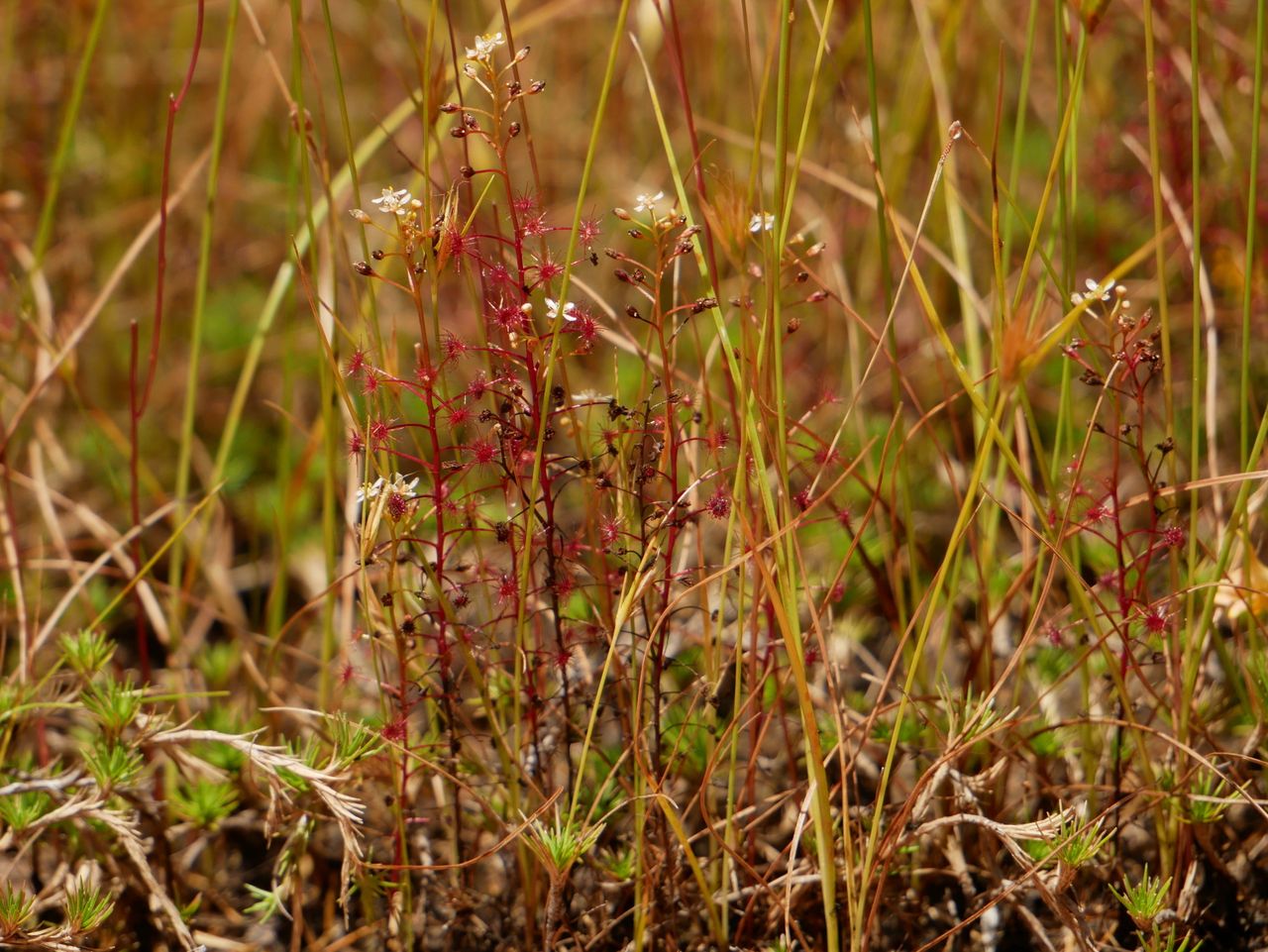
An erect annual with a reddish stem up to 20 cm tall and thin, fleshy roots; there is no tuber. Small trapping leaves stand along the stem. The inflorescence can carry fifty or more flowers. The flowers are white and have four petals — unusual, since most sundews have five — with four white stamens 1.3 to 1.5 mm long, yellow pollen and two styles. Flowering in February and March.
Similar species
In the tropical north of Australia most sundews belong to the petiolaris group: rosette plants with densely hairy petioles that look nothing like D. subtilis. Erect, slender sundews with white flowers are rare there; the four-petalled flowers and large numbers of flowers per inflorescence are characteristic of D. subtilis. The sources consulted name no further look-alikes.
The trap and how it works
An active flypaper trap, but held well above the ground. The leaves along the stem are small, peltate and often cup-shaped, with longer tentacles on the margin and shorter ones on the blade. Flying insects — midges, small flies, sometimes bees or butterflies drawn to the flowers — touch the droplets and stay hanging. The marginal tentacles then bend inwards and the blade partly closes around the prey, after which the glands secrete enzymes and absorb the dissolved nutrients. Because the traps are spread along an upright or climbing stem, the plant sweeps a much larger volume of air than a rosette on the ground.
Habitat and ecology
Over sandstone, along the edges of seepages, in thin sandstone sand mixed with black humus (R1, D2). In the wet season water seeps from the rock here; in the dry season everything dries out, and the plant then survives only as seed.
Distribution and elevation
Northern Australia: the north of Western Australia — the Kimberley, with sites near Beverley Springs, on Bigge Island and around the Mitchell Plateau — and one site in the Northern Territory, near Little Nourlangie Rock. The 'endemic' field here refers to northern Australia, not the south-west. Altitudinal limits are not published.
- Recorded (quarter-degree cells)
Forms and variation
N.G. Marchant described the species in 1982. It is placed in section Ergaleium, the tuberous erect and climbing sundews — remarkable, since it has no tuber itself. That placement rests on other characters, but shows that the classification of this group is still in flux. No subspecies are recognised.
Where and when to see it
February and March are the months, at the end of the wet season; the Kimberley is then largely inaccessible by road. The Mitchell Plateau and surrounding areas are remote and need careful preparation. Search sandstone where water seeps from the rock, and look for fine red stems with many small white flowers.
Conservation status
Assessed as Least Concern (LC) on the IUCN Red List; not listed in CITES. Its sites lie in remote, little-disturbed country. The sources consulted name no specific threats; changes in fire regime and wet-season patterns are general risks for seepage plants in this landscape.
Scientific name
Drosera subtilis | Marchant, 1982
Drosera subtilis was described in 1982 by the Australian botanist Neville Gordon Marchant, in Flora of Australia, volume 8, p. 385 (in the Droseraceae treatment by Marchant & George). The precise type locality and collection details could not be established with certainty. The species occurs in northern Western Australia and at a single site in the Northern Territory (known localities include Beverley Springs Station, Bigge Island, the Mitchell Plateau, and near Nourlangie Rock), but which of these is the actual type locality is not confirmed. The name subtilis is Latin for "fine, subtle, delicate" and refers to the slender, delicate appearance of this small, erect annual species.
World Checklist of Vascular Plants (WCVP), via Plants of the World Online (POWO), Royal Botanic Gardens, Kew.