All species › Caryophyllales › Sundew family › Drosera sulphurea
Drosera sulphurea
A scrambling tuberous sundew with sulphur-yellow flowers from the south coast of Western Australia, where it often grows among the Albany pitcher plant, Cephalotus follicularis. Drosera sulphurea has a turbulent naming history: for a century and a half it was treated as a variety or synonym of another species, until Allen Lowrie reinstated it in 1999.
Identification
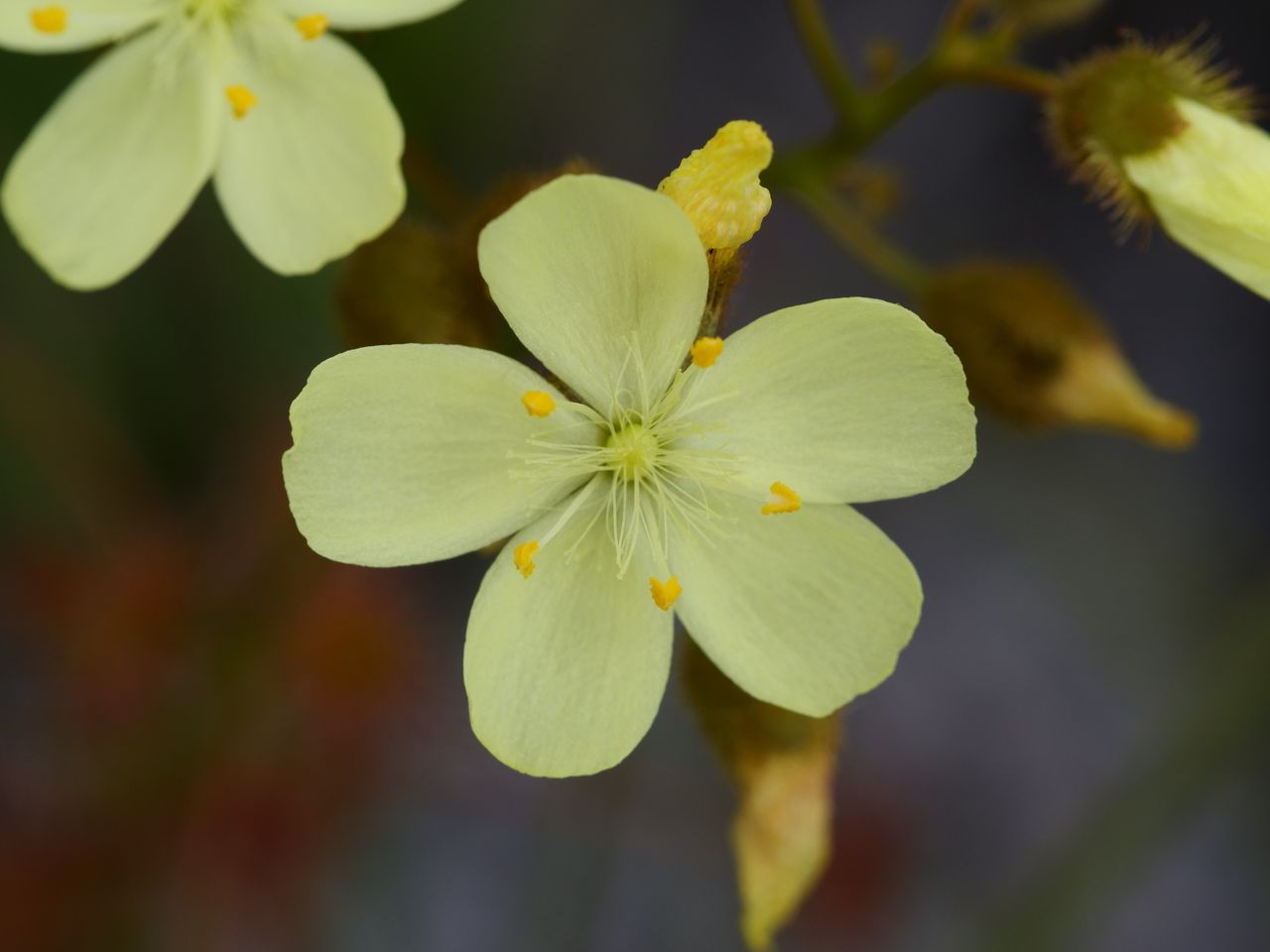
A scrambling perennial tuberous plant with stems 40 to 60 cm long bearing small, peltate trapping leaves. The flowers are yellow — the epithet means 'sulphur-coloured' — and appear in September. Exact leaf and flower measurements are not published in the sources consulted.
Similar species
Drosera subhirtella also climbs and flowers yellow, but stays smaller (up to 40 cm) and grows in a broader range of habitats; Lowrie regards the two as only distantly related. Drosera neesii, with which D. sulphurea was long merged, is the other obvious confusion; the difference is not worked out in the sources consulted. A coastal habitat among Cephalotus is a good clue.
The trap and how it works
An active flypaper trap, but held well above the ground. The leaves along the stem are small, peltate and often cup-shaped, with longer tentacles on the margin and shorter ones on the blade. Flying insects — midges, small flies, sometimes bees or butterflies drawn to the flowers — touch the droplets and stay hanging. The marginal tentacles then bend inwards and the blade partly closes around the prey, after which the glands secrete enzymes and absorb the dissolved nutrients. Because the traps are spread along an upright or climbing stem, the plant sweeps a much larger volume of air than a rosette on the ground.
Habitat and ecology
Sandy loam in coastal areas (D1), in heath and scrub (B5), often among Cephalotus. That company points to moist, peaty sites: the Albany pitcher plant grows along seepages and in wet hollows (W4).
Distribution and elevation
Endemic to Western Australia, in the coastal areas of the south-west. No closer range boundary is given in the sources consulted. Altitudinal limits are not published.
- Recorded (quarter-degree cells)
Forms and variation
Johann Georg Christian Lehmann described the species in 1844. George Bentham reduced it to a variety of D. neesii in 1864, and N.G. Marchant merged it fully with that species in 1982. Allen Lowrie reinstated D. sulphurea as a species in 1999. Older floras may therefore list the plant under D. neesii.
Where and when to see it
September, in sunshine, when the yellow flowers are open. Search coastal heath in the south-west, especially where Cephalotus also grows — two carnivorous plants side by side. Such places are often wet and fragile; keep to paths and touch nothing.
Conservation status
Assessed as Least Concern (LC) on the IUCN Red List; not listed in CITES. The sources consulted name no specific threats. The coastal areas of the south-west are, however, under pressure from development, root rot and altered fire regimes.
Scientific name
Drosera sulphurea | Lehmann, 1844
Drosera sulphurea was described in 1844 by the German botanist Johann Georg Christian Lehmann, in Novarum et Minus Cognitarum Stirpium Pugillus, part 8, p. 43 (cited as p. 37 in some sources). The precise type locality and collection details could not be established with certainty. The species is endemic to Western Australia. The name sulphurea is Latin for "sulphur-coloured, sulphur-yellow" and refers directly to this species' sulphur-yellow flowers.
World Checklist of Vascular Plants (WCVP), via Plants of the World Online (POWO), Royal Botanic Gardens, Kew.