All species › Ericales › New World pitcher plant family › Heliamphora folliculata
Heliamphora folliculata
Los Testigos, 'the witnesses', is a short chain of four table mountains in the south of Bolívar state, Venezuela: Aparamán, Murisipán, Tereke-yurén and Kamarkawarai. Heliamphora folliculata grows on all four and nowhere else. The species was described only in 2001, and it owes its name to one detail it shares with no relative: the nectar organ on the back of the pitcher is hollow inside.
Identification
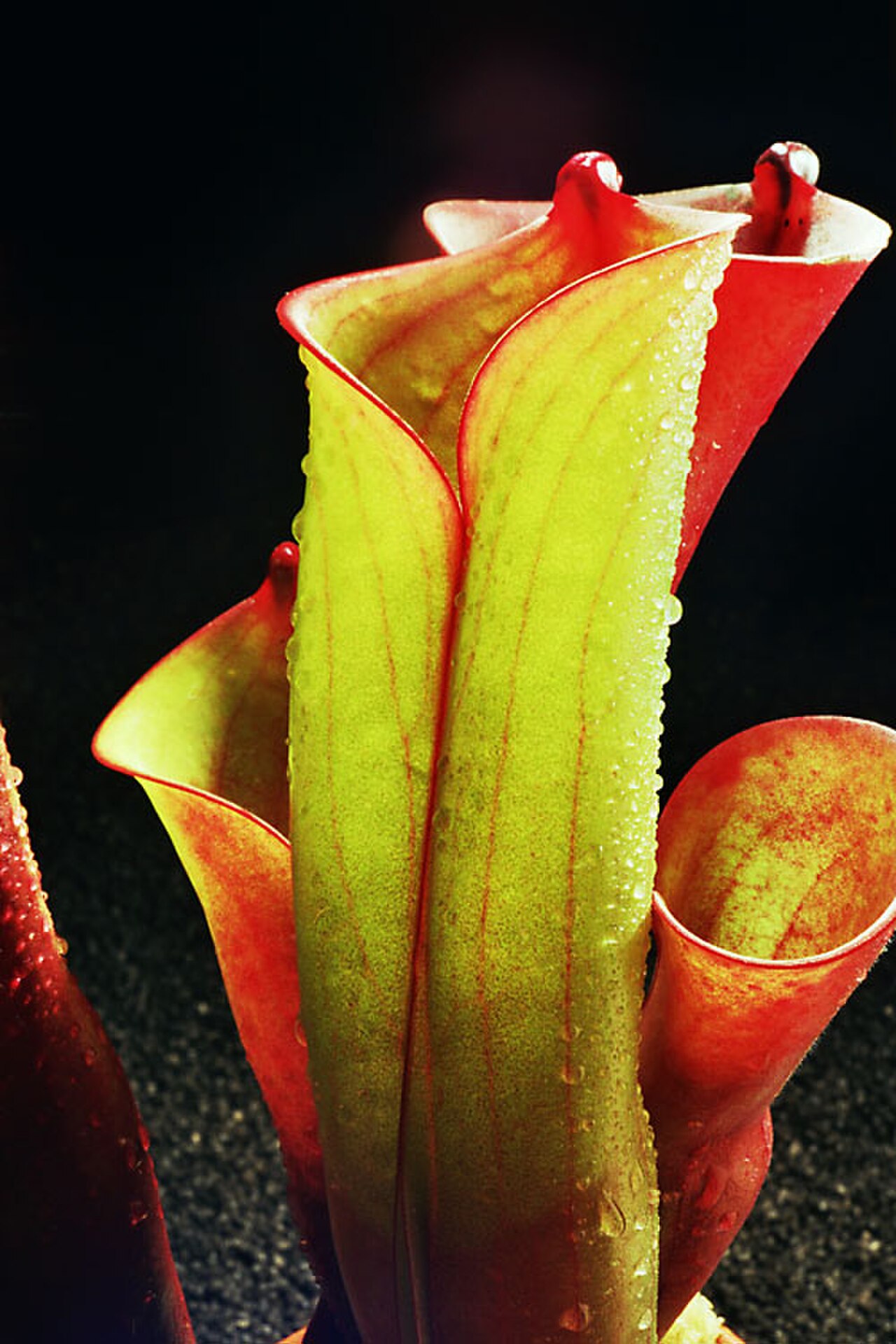
A rosette of erect pitchers. Each pitcher is a single leaf grown shut into a funnel with a seam down the front; the wall widens towards the top, and the colour runs from green in sheltered plants to red-brown in plants in full light. The identifying character sits on the back rim. Where other Heliamphora species carry an open spoon or a small hood there, this one has a closed structure that falls into three parts: a base, a narrow nectar channel and, behind it, a true nectar chamber. That hollow pouch is what the epithet refers to, from Latin folliculus, a little bag. Płachno, Świątek and Wistuba described its contents in 2007: giant nectaries about 430 by 450 micrometres, for the most part sunk into the surrounding tissue, of which only the apical cells meet the space inside the chamber. To the naked eye there is nothing more to see than a conspicuous, thick, often deep red organ above the pitcher mouth — but that is exactly enough to recognise the species in the field.
Similar species
On the Los Testigos chain itself there is nothing to confuse it with: this is the only member of the family on those four mountains. Beyond them the nectar organ is the key. Heliamphora minor, of Auyán-tepui, carries a small hooded spoon on a slender stalk, with no internal chamber. Heliamphora nutans of the Roraima group is sturdier and has an ordinary forward-facing spoon. Heliamphora exappendiculata, of the Chimantá and Aprada massifs, is the opposite extreme: there the organ is so far withdrawn that it no longer projects above the pitcher as an appendage at all. So do not go by the size or colour of the pitcher, which varies widely within every species, but by the profile of the back rim seen from the side. Confusion with Sarracenia is ruled out geographically, and structurally too, since Heliamphora has no broad hood over the mouth.
The trap and how it works
A pitfall trap. The plant produces little or no digestive enzyme of its own; breaking the prey down is left largely to bacteria and other micro-organisms in the pitcher fluid, after which the plant takes up the nitrogen and phosphorus compounds released. The luring is done at the nectar organ. The researchers who described the nectar chamber suspect it does two things at once: it keeps the energetically costly nectar out of the rain and it forces visiting insects to squeeze into a narrow space directly above the pitcher mouth. The nectaries themselves resemble scent glands in their structure, which suggests that volatile compounds are given off along with the sugar. A drainage slit in the pitcher wall holds the fluid level steady, so a downpour does not flush the catch over the rim.
Habitat and ecology
The summit plateau of the table mountain (R4): bare sandstone with fissures, basins and hollows in which acid peat and bog moss collect, with nothing that counts as soil in the ordinary sense. The species also grows on the wet rock ledges and overhangs along the flanks of the mountains (R1), where seepage runs permanently over the stone. In both, the substrate is extremely poor in nitrogen and phosphorus and rain washes away what little there is. The climate is cool and all but permanently wet: the plateaus lie in cloud for much of the day. Under those conditions a trap that turns insects into usable nitrogen is not a luxury but a condition of growing there at all.
Distribution and elevation
Endemic to the Los Testigos chain in Bolívar state, Venezuela, and known there from all four mountains: Aparamán, Murisipán, Tereke-yurén and Kamarkawarai. Sites lie roughly between 1700 and 2400 m, both on the summits and on rock faces along the walls. The genus as a whole is confined to the table mountains of the Guiana Shield — Venezuela, western Guyana and the far north of Brazil — and Heliamphora folliculata shows clearly how that works: a chain of four mountains lying close together shares one species, while the next massif has one of its own.
- Recorded (one-degree cells)
Forms and variation
No varieties or subspecies have been described. There is, however, the colour variation that marks the whole genus and carries no taxonomic name: plants on open, sunny parts of the plateau turn deep red, plants in the shade of boulders or down in the fissures stay green, and the nectar organ itself ranges from yellow-green to almost blackish red. No natural hybrids are known for this species, which follows from the fact that no second member of the genus grows on Los Testigos to cross with.
Where and when to see it
The chain lies remote in southern Bolívar and can be reached only by helicopter or on a long trek with a local guide; in practice a visit is always made with permission and an escort. Once up there, do not look down into the pitchers but at them from the side and slightly below: only then does the thick, closed nectar organ stand out against the sky, and that is the one character that reliably takes you further in the field. The flowering period of the species is not established in the literature; plants in flower are recorded throughout the year.
Conservation status
The species has not been assessed for the IUCN Red List, and there is no CITES listing: Heliamphora appears in no appendix. What can be said is that its distribution covers four neighbouring mountains and nothing else, which makes any species vulnerable by definition to whatever befalls that small area. Against that, the chain is hard to reach, the populations on the wet ground are large, and the region carries no agricultural or mining pressure of any consequence. Collection for trade is the risk usually named for the genus, but plants in cultivation now come almost entirely from seed and tissue culture. The absence of a formal assessment therefore signals a gap in the record rather than a known decline.
Scientific name
Heliamphora folliculata | Wistuba, Harbarth & Carow, 2001
Described by Andreas Wistuba, Ulrike Harbarth and Bernd Carow in 2001, in Carnivorous Plant Newsletter 30(4): 120–125. The type area lies on the Aparaman tepui group in Venezuela; the species has been found on all four mountains of this group: Aparaman, Murosipan, Tereke and Kamakeiwaran tepui. The species name folliculata is Latin for "furnished with follicles/small sacs" and refers to the shape of the seed capsules.
World Checklist of Vascular Plants (WCVP), via Plants of the World Online (POWO), Royal Botanic Gardens, Kew.