All species › Caryophyllales › Tropical pitcher plant family › Nepenthes alfredoi
Nepenthes alfredoi
Most pitcher plants of the Hamiguitan massif in south-eastern Mindanao are montane species of the pygmy forest and the cloud forest on the summit. Nepenthes alfredoi is the exception: a vigorous climber of the lowlands at the foot of the massif, on ultramafic ridges between 175 and 345 m. It was described in 2017 by Victor Amoroso and colleagues at Central Mindanao University and is named for Alfredo Bolante Sr., 'Pidoy', a forest guard and well-trained local researcher who first found the plant.
Identification
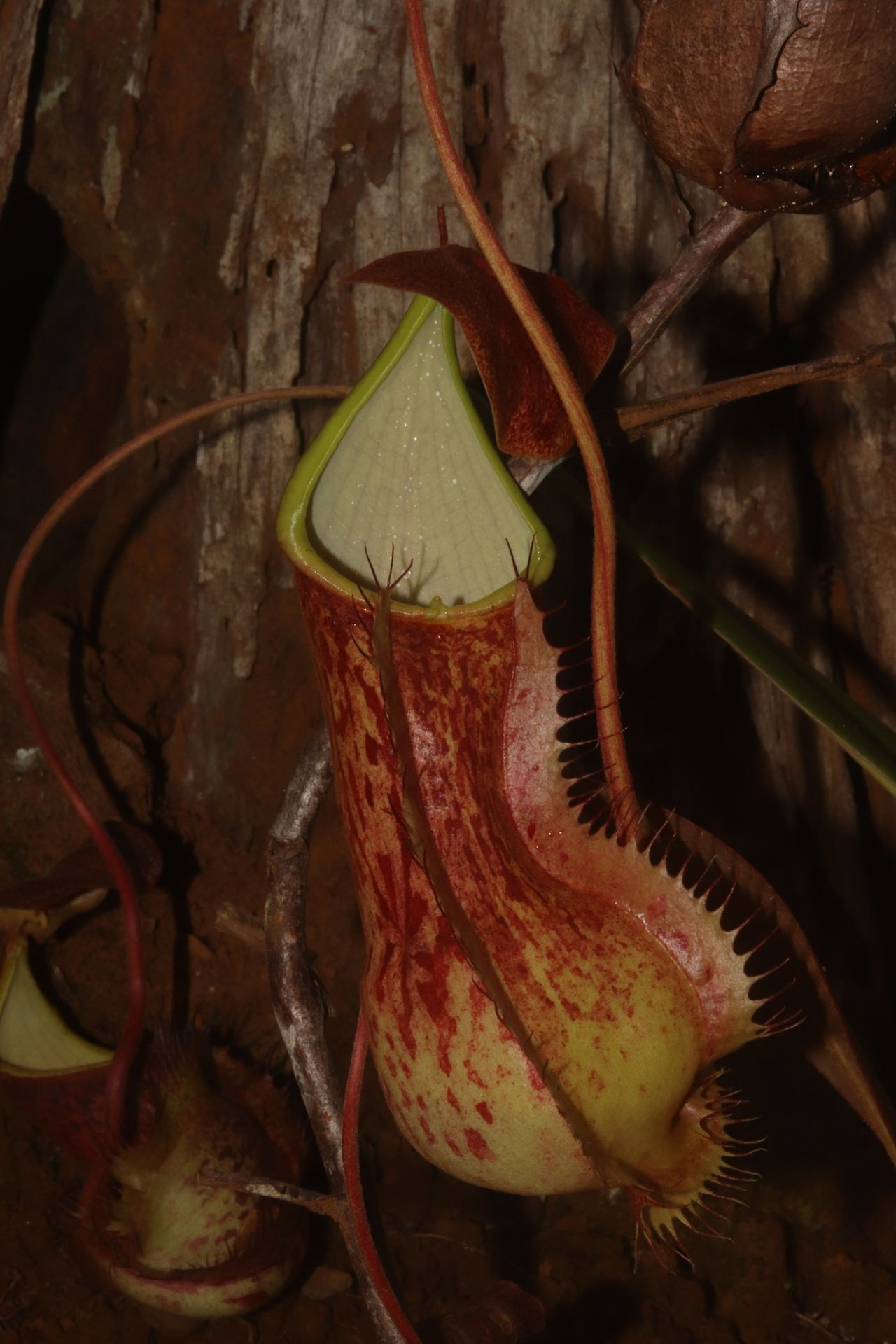
A large climber scrambling eight to twelve metres up through trees twelve to thirty metres tall. The stem is glabrous, terete to triangular and up to seven millimetres thick; stems, leaves and pitchers carry scattered hydathodes, small water-secreting glands. The leaves are linear to ovate, to 27 cm long and 4.3 cm wide, dark green above and paler beneath, with an obtuse tip and a decurrent base. Lower pitchers are up to 12 cm tall and 4.5 cm wide: the lowest third inflated with a distinct hip, the middle cylindrical and slightly funnel-shaped towards the mouth, with wings up to 0.8 cm wide and fringes up to 8 mm long. They are olive green with garnet to blood-red blotches, or wholly suffused ruby red in sun. Upper pitchers are larger, to 19 cm tall and 8 cm wide, funnel-shaped with a slight hip below and similar wings. The peristome is round, about five millimetres wide; the lid, up to 5.3 by 4.1 cm, is suffused blood red and bears a triangular appendage at its base.
Similar species
On Hamiguitan the species is largely separated from the others by its low station: Nepenthes justinae, Nepenthes hamiguitanensis, Nepenthes peltata and Nepenthes micramphora grow higher, in the pygmy forest and montane forest. Morphologically Nepenthes alfredoi stands out by the combination of size, a glabrous stem, long-fringed wings on both lower and upper pitchers and a blood-red lid with a triangular appendage. Nepenthes justinae has a rounded appendage and a distinct rim in the upper pitchers; Nepenthes peltata has a petiole attached beneath the middle of the blade.
The trap and how it works
A pitfall in two forms that closely resemble each other. Lower pitchers stand on the ground, with broad, long-fringed wings as a walkway for ants and other crawling animals. Upper pitchers hang high in the trees and are funnel-shaped, which in many species goes with catching flying insects. The rounded, finely ribbed peristome, with ribs a tenth of a millimetre wide spaced two tenths apart, turns slippery when wet. The lid bears nectar glands and the triangular appendage beneath. The scattered hydathodes on the pitcher secrete water; what role that plays in capture has not been studied. Nothing has been published on prey.
Habitat and ecology
Lowland mixed dipterocarp forest on the ultramafic ridges at the foot of the Hamiguitan massif, between 175 and 345 m (B2, R3). It is a different environment from the pygmy forest higher up: here stands tall, closed forest, and the plant climbs into the canopy. What the two environments share is the nutrient-poor ultramafic soil.
Distribution and elevation
Endemic to Mindanao, and known only from the ultramafic ridges near Barangay Luzon in the municipality of Governor Generoso, Davao Oriental province, in the Hamiguitan range. The label 'Mt. Hamiguitan' in our species list is correct, with the proviso that this is the lowland foot of the massif and not the summit. The authors estimated the range at less than ten square kilometres.
- Recorded (one-degree cells)
Forms and variation
No varieties have been described. Pitcher colour varies with light, from olive green with red blotches to wholly ruby red in full sun. No natural hybrids have been reported; because the other Hamiguitan species grow higher, there are few potential partners in its habitat.
Where and when to see it
Look for this species not on the summit but at the foot of the mountain, in the forest on the low ridges. Look up along tree trunks: the plant climbs into the crown, and the large red upper pitchers often hang far above the ground. The lower pitchers sit at the base of the climbing stems. The area falls under the management of the protected Hamiguitan range; go with permission and a local guide.
Conservation status
The species has not yet been assessed by the IUCN (Not Evaluated). The authors rated it Critically Endangered, on account of a range of less than ten square kilometres with fragmentation and habitat loss. Lowland forest on ultramafic ground is sought after in the Philippines for mining and clearance, and the low ridges are not protected to the same degree as the core of the World Heritage Site on the summit. Like all Nepenthes it is listed in CITES Appendix II.
Scientific name
Nepenthes alfredoi | Amoroso & Lagunday, 2018
Described by Victor B. Amoroso and Noel E. Lagunday in 2017, in Philippine Journal of Systematic Biology 11(2): 15–19, based on material collected on 12 October 2016. The type locality lies in the expansion area of the Mount Hamiguitan Range Wildlife Sanctuary, Barangay Luzon, Governor Generoso municipality, Davao Oriental province, on the island of Mindanao, Philippines, at 345 metres altitude. The species name honours Alfredo Bolante Sr. ("Pidoy"), a forest guard and well-trained local researcher of the sanctuary, who was the first to observe and collect this new species.
World Checklist of Vascular Plants (WCVP), via Plants of the World Online (POWO), Royal Botanic Gardens, Kew.