All species › Caryophyllales › Tropical pitcher plant family › Nepenthes andamana
Nepenthes andamana
A coastal pitcher plant, growing as low as a pitcher plant can: from sea level to at most fifty metres. Nepenthes andamana is named after the Andaman Sea, for it grows on the open sand flats along the west coast of the peninsula of southern Thailand, in Phang Nga Province. The Italian pitcher-plant specialist Marcello Catalano described it in 2010 in his book on the pitcher plants of Thailand, together with a series of other Thai species. It belongs to the thorelii group of savanna pitcher plants that survive drought and fire with a thickened rootstock.
Identification
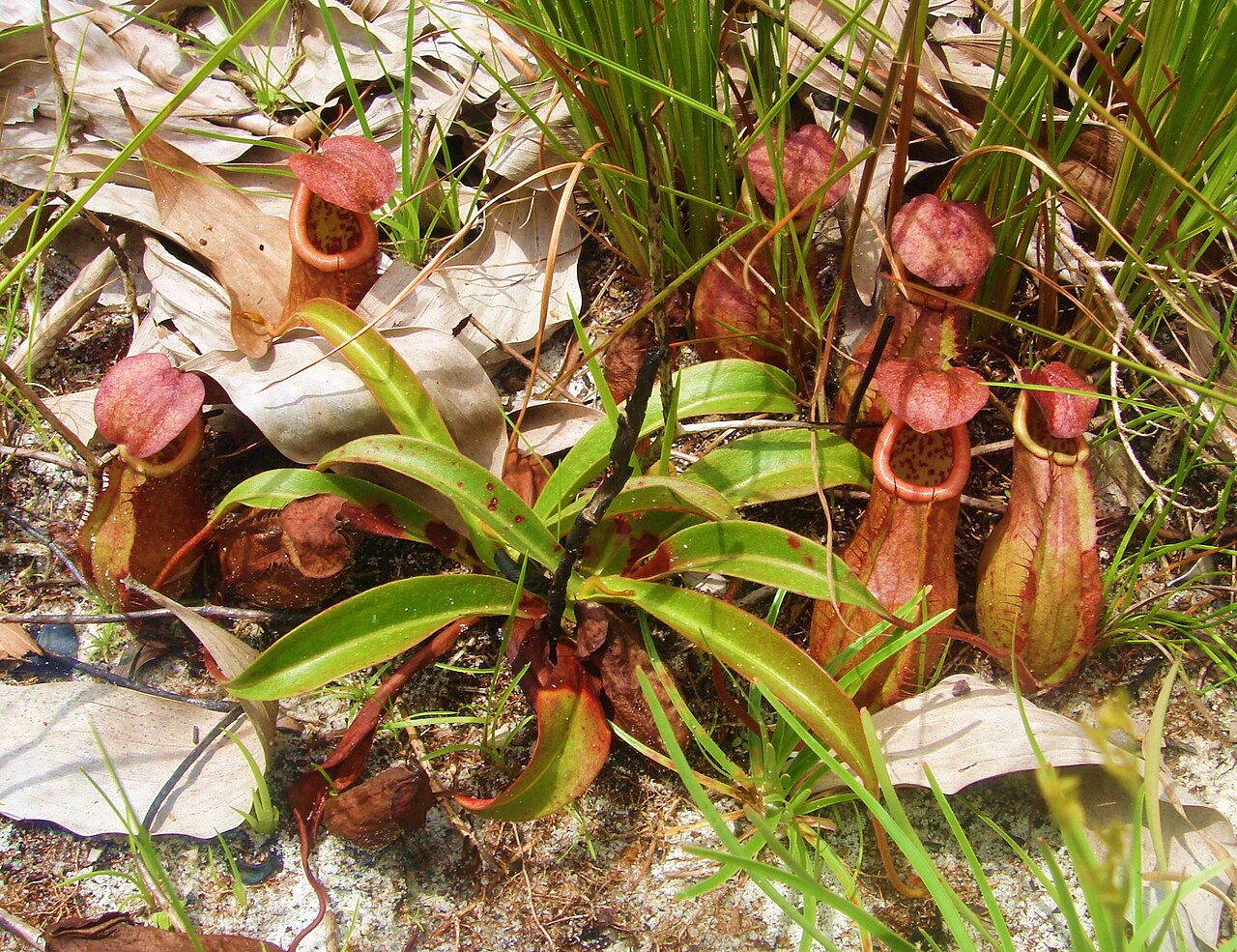
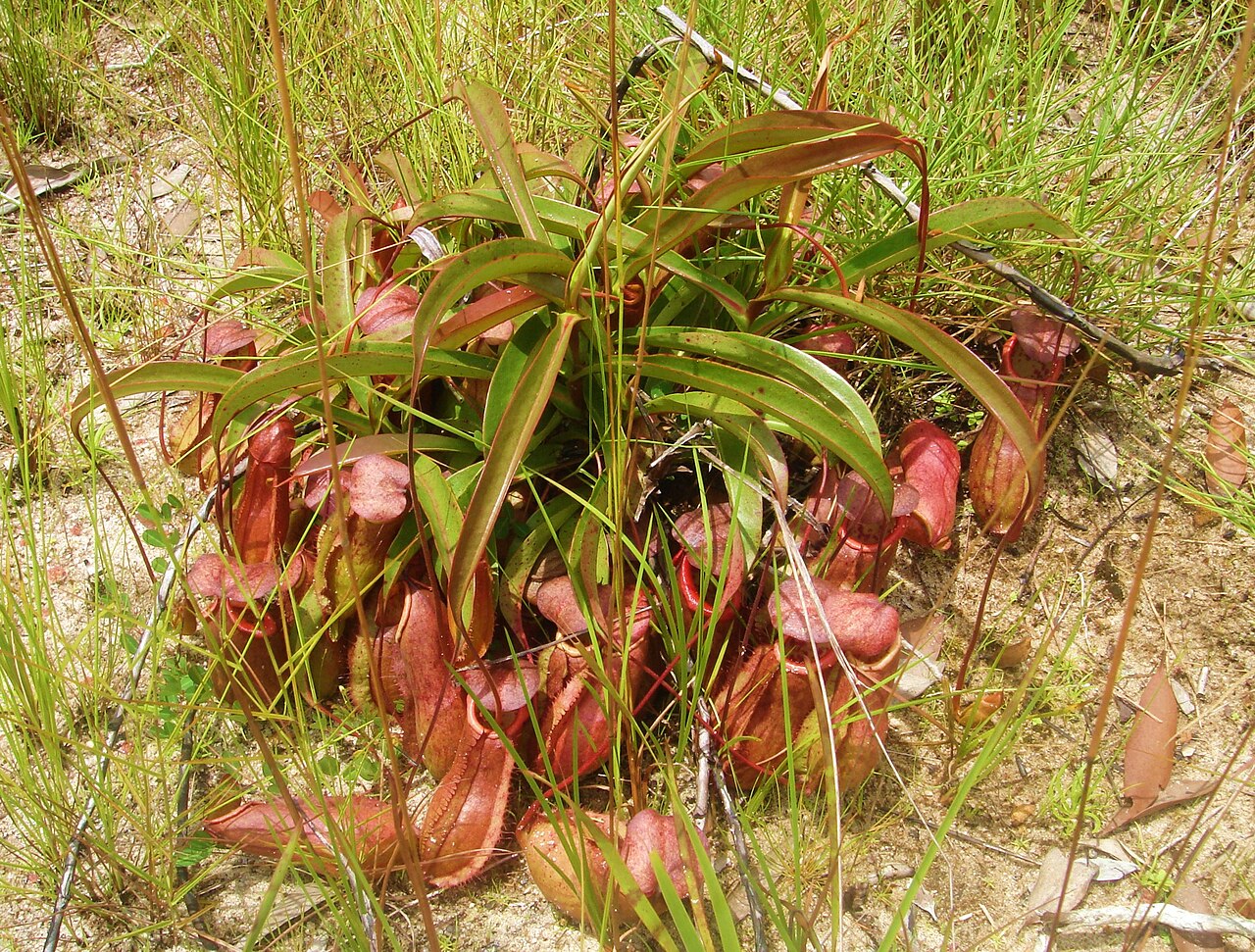
A climber to about three metres with terete stems five millimetres thick. The leaves are leathery, sessile, linear to lanceolate, 15 to 30 cm long and two to 3.5 cm wide, with an acute or narrowly acuminate tip. Lower pitchers are ovate in the lower half, 10 to 16 cm tall and 3.5 to 5 cm wide, with two wings four to six millimetres wide and a cylindrical peristome four to ten millimetres wide, with teeth up to a millimetre on the inner edge. They are green to orange with red stripes, or entirely red. Upper pitchers are about as tall but slimmer, tubular to narrowly funnel-shaped, 2.5 to 3 cm wide, with wings reduced to a ridge, and they are yellow to white. The male inflorescence is strikingly large, up to 110 cm, with 40 to 190 flowers; male flowers have red tepals, female flowers green ones.
Similar species
The closest relative is Nepenthes suratensis, from Surat Thani Province on the other side of the peninsula. Other relatives in the thorelii group are Nepenthes kerrii, Nepenthes kongkandana and Nepenthes bokorensis. Nepenthes andamana differs from these by its linear to lanceolate leaves and hairs that fall early. Nepenthes kerrii has obovate leaves and persistent hairs in the leaf axils; Nepenthes kongkandana grows on the east coast. The common Nepenthes mirabilis, which occurs at the same sites, has stalked, papery leaves.
The trap and how it works
A pitfall trap with clearly different lower and upper pitchers. The ovate lower pitchers stand in the sand among the grass, with wings that guide crawling animals to the mouth and teeth on the inner edge of the peristome that hinder escape. The pale yellow-white upper pitchers hang from the tendrils above the vegetation. Nectar glands on the peristome and under the lid lure insects to the rim. Few pitchers are formed in the dry season. No specific study of this species' prey was found in the sources consulted. As in related species of the group, the production of new pitchers largely coincides with the rainy season, when insects are also most numerous.
Habitat and ecology
Sandy soil in open coastal savannas and grasslands, from sea level to about 50 m (D1, W5). These are low-lying, nutrient-poor sand flats behind the coast, wet in the rainy season and parched in the dry season, with an open vegetation of grasses, sedges and low shrubs. Fire is frequent, and the plant survives it with its underground rootstock. Coastal savannas like these have become rare in Southeast Asia: they lie on flat land near the sea that is easy to build on, and are often not recognised as valuable habitat. Sundews and bladderworts usually grow on the same ground, and together they form a community of carnivorous plants of its own on poor, wet sand.
Distribution and elevation
Endemic to Thailand, in the coastal zone of Phang Nga Province on the Andaman coast of the peninsula. The type collection was made in 2009 at sea level near Takua Pa. Our own list names the Andaman coast of Thailand, which agrees with the literature.
- Recorded (one-degree cells)
Forms and variation
No varieties are recognised. The colour of the lower pitchers ranges from green through orange with red stripes to entirely red; the upper pitchers are yellow to white. In the wild the species forms hybrids only with Nepenthes mirabilis, including the form known as Nepenthes mirabilis var. globosa. Hybrids with Nepenthes mirabilis are not rare at mixed sites and can complicate identification: intermediates often have a shortly stalked leaf and pitchers intermediate in shape and colour between the two parents.
Where and when to see it
The coastal flats around Takua Pa and further along the Phang Nga coast are the place to look, preferably at the end of the rainy season, when the plants carry plenty of pitchers. On open, sandy grass flats, look for low plants with narrow, stiff leaves and red-striped pitchers at ground level. Many of these flats lie close to tourist coastal towns, and some have already been built over; do not walk straight through fragile wet patches.
Conservation status
The species has not (yet) been assessed for the Red List. Its range is small and confined to a coastal strip under pressure from tourism development, building, plantations and aquaculture. Low-lying coastal savannas are among the fastest-disappearing habitats in Southeast Asia. As a member of Nepenthes it is listed in CITES Appendix II, so international trade in wild plants requires a permit.
Scientific name
Nepenthes andamana | Catalano, 2010
Described by Marcello Catalano in 2010, in his book Nepenthes della Thailandia: Diario di viaggio (Prague, 2010: 34); the description was reviewed by Alastair Robinson, with the Latin diagnosis supplied by Andreas Fleischmann. The type locality lies near Takua Pa, in Phang Nga Province, Thailand, at sea level. The name refers to the Andaman Sea coast of Thailand, where this species occurs.
World Checklist of Vascular Plants (WCVP), via Plants of the World Online (POWO), Royal Botanic Gardens, Kew.