All species › Caryophyllales › Tropical pitcher plant family › Nepenthes bokorensis
Nepenthes bokorensis
A species described twice in one year. The pitcher-plant specialist François Mey published Nepenthes bokorensis in March 2009 in the Australian journal Carniflora Australis, having seen the plant on Mount Bokor in southern Cambodia in 2007. Three months later Martin Cheek of Kew described the same plant as Nepenthes bokor; that name has lapsed as a later synonym. The plant itself was anything but new: a collector had gathered it at the Popokvil Falls on the same mountain as early as 1904, and it had lain in the cabinets in Paris ever since.


Identification
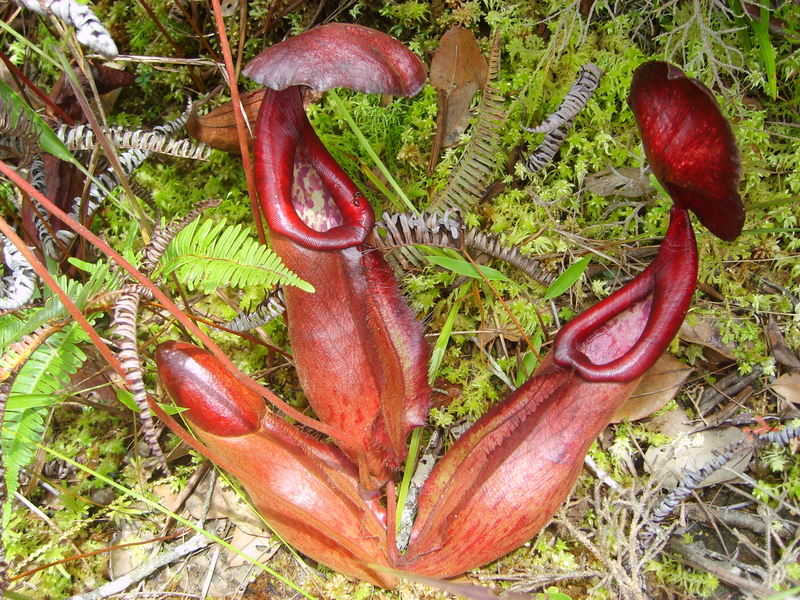
A climbing shrub with terete stems six to eight millimetres thick. The leaves are leathery, lanceolate to narrowly oblong, mostly 21 to 32 cm long and three to five, sometimes nine centimetres wide. Lower pitchers are ovoid, about 9 cm tall and 6 cm wide, with two broad fringed wings. Upper pitchers are much larger: narrowly funnel-shaped to cylindrical, 21 to 30 cm tall and three to five centimetres wide, with a lid up to six or seven centimetres. The colour is green mottled purple, with a reddish, purple-banded peristome and a greyish reddish-purple, blotched interior. The measurements above come from the description by Cheek and Jebb; Mey describes more robust plants, up to seven metres long, with lower pitchers to 20 cm, upper pitchers to 25 cm and a much broader, rounded, striped peristome up to almost two centimetres. The plant is covered with silvery or brownish hairs up to a millimetre long.
Similar species
Mey places the species in the thorelii group of Indochinese savanna pitcher plants, Cheek and Jebb in the group Montanae, and that disagreement already says something about how distinctive the plant is. From Nepenthes kampotiana, Nepenthes smilesii and Nepenthes thorelii it differs by broader, oblong leaves; from the hairless kampotiana also by its hairs. Against smilesii it has more robust, more colourful pitchers with a broader peristome, against thorelii sessile rather than stem-clasping leaves. Characteristic according to Mey are the wholly funnel-shaped upper pitchers, the vaulted lid and the striped, rounded peristome.
The trap and how it works
A pitfall trap tuned to ants. A 2012 study of the contents of thirty pitchers found ten species of ant; a species of the genus Polyrhachis was the most numerous at forty per cent of all specimens, followed by Dolichoderus thoracicus and a Camponotus species. The pitcher fluid is strongly acidic, with a measured pH of 2.7, which aids digestion. Lower pitchers stand on the ground with broad fringed wings as walkways; upper pitchers, funnel-shaped with a large lid, hang higher in the shrubs. The rounded, ribbed peristome turns slippery with moisture, and nectar glands on the inner edge and under the lid lure the ants.
Habitat and ecology
Seasonally dry scrub and stunted montane forest on the sandstone plateau of Mount Bokor, at 800 to 1080 m, on sandy, acidic soils with a measured pH of 4.6 (R4, B5, D4). The plants grow in clearings and along forest edges, under sparse tree cover; in full sun they stay stunted and sometimes flower when less than 60 cm tall. It is a pyrophyte with a fleshy rootstock that stores water. The sundews Drosera peltata and Drosera burmanni and a range of bladderworts grow on the same ground.
Distribution and elevation
Endemic to Cambodia, confined to Mount Bokor in Bokor National Park in Kampot Province, in the Elephant Mountains. Three populations are known: the original one along the road to the summit, and two large populations found in August 2011 by Mey and Alastair Robinson. Our own list gives the Bokor plateau, which is correct.
- Recorded (one-degree cells)
Forms and variation
No varieties are recognised. The large difference between the descriptions by Mey and by Cheek and Jebb in plant size and peristome width probably reflects variation between plants in shade and in full sun and between young and mature plants. In the wild, hybrids with Nepenthes kampotiana have been reported. Nepenthes bokor is a synonym, not a separate form.
Where and when to see it
Mount Bokor is reached by a good road from Kampot, and along the road and around the old French buildings on the plateau pitcher plants grow in open scrub. Come in the rainy season or shortly after for mature pitchers. Pick nothing and leave the pitchers intact: in 2022 Cambodia's Ministry of Environment warned that the species could be driven to extinction if visitors keep picking the plants to pose with them for photographs. Look at the ground too: the plateau's sundews and bladderworts are worth seeing.
Conservation status
The species has not (yet) been assessed for the Red List. Mey considered it potentially vulnerable in 2009, and in 2010 cited assessments ranging from vulnerable to endangered. Mount Bokor has largely been leased for tourism development; since 2009 a new town with hotels and a casino has risen there, and in 2011 both the original and the two newly found populations were threatened by that development. Picking by tourists comes on top of this. As a member of Nepenthes it is listed in CITES Appendix II, so international trade in wild plants requires a permit.
Scientific name
Nepenthes bokorensis | Mey, 2009
Nepenthes bokorensis was described in March 2009 by François Sockhom Mey, in Carniflora Australis 7(1): 6-15. The holotype (M. Martin 1231bis, with female floral parts and lower pitchers) had already been collected on 7 December 1968 on Mount Bokor, and is held at the Muséum National d'Histoire Naturelle, Paris. Mount Bokor in Bokor National Park, Kampot Province, southern Cambodia, at 800-1,080 m elevation. The specific epithet refers to both Mount Bokor and Bokor National Park.
World Checklist of Vascular Plants (WCVP), via Plants of the World Online (POWO), Royal Botanic Gardens, Kew.