All species › Caryophyllales › Tropical pitcher plant family › Nepenthes cornuta
Nepenthes cornuta
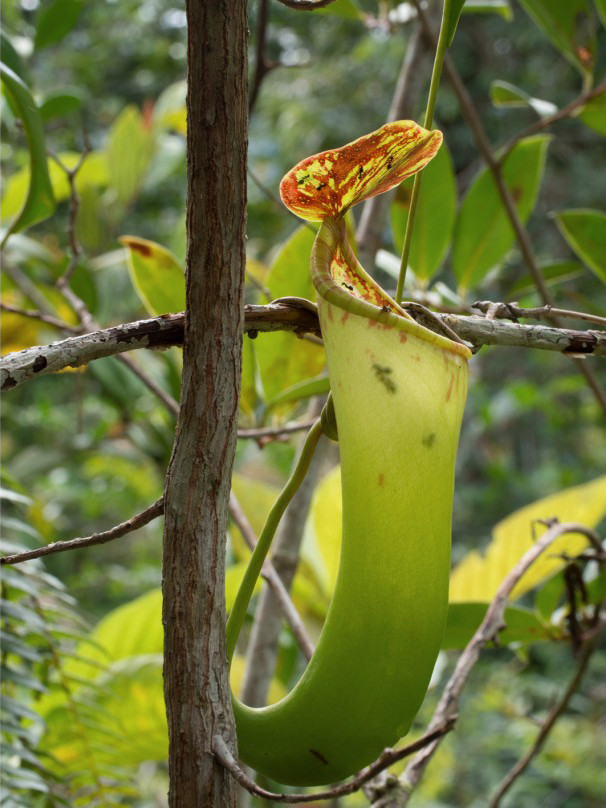
One of four new species described together in 2014 from the mountains of central Mindanao, in the Philippines. Nepenthes cornuta takes its name from the shape of its upper pitchers: swollen below, tapering towards the tendril and cylindrical above, like a horn. Our own species list placed it on Sumatra; according to the description and the world checklist it is a Philippine species of the Pantaron range. It belongs to the circle of N. alata, a group especially well represented in the Philippines.
Identification
A climber with stems to 3 m long and 7 to 8 mm thick, with internodes of 4 to 5 cm. The leaves are stalked, linear to lanceolate, to 30 cm long and 4.5 cm wide, with three longitudinal veins on each side of the midrib; the channelled petiole to 4 cm clasps a third to half of the stem, and the tendril reaches 24 cm. Lower pitchers are to 15 cm tall and 3.4 cm wide, bulbous in the lowest third and cylindrical to slightly funnel-shaped above, with wings reduced to unfringed ridges, a peristome to 5 mm and an ovate lid of about 3 cm. Upper pitchers are to 20 cm long and 4.5 cm wide at the mouth, swollen below and tapering towards the tendril: the horn shape that gives the species its name.
Similar species
Its closest relatives are Nepenthes copelandii and N. ceciliae, both also from Mindanao, and it belongs to the group around N. alata, recognised by winged petioles, a ridge or appendage at the base of the lid's underside, and upper pitchers usually broadest near the base. From N. copelandii, N. cornuta differs in narrower leaf blades, upper pitchers with a swollen base and cylindrical upper part, and smaller lower pitchers without wings, where N. copelandii always has them. N. truncata, with much larger pitchers and a truncate leaf base, and N. surigaoensis grow in the same area.
The trap and how it works
A pitfall in two forms. Lower pitchers, bulbous below and narrowing upwards, stand among the low vegetation and catch walking animals; they are green in the bottom third and blotched red or maroon above, and their peristome is finely ribbed. The horn-shaped upper pitchers hang from tendrils in the scrub and catch flying insects; they are always green or yellow, only the inner wall and the underside of the lid may be speckled red to maroon. The upper-pitcher lid is ovate to cordate, to 5 cm, without appendage; in the lower pitcher the appendage is reduced to a keel of at most a millimetre. No prey data have been published.
Habitat and ecology
A terrestrial plant of clearings and open scrub on ultramafic soil (R3, B5), at about 1000 m. Ultramafic soils, rich in magnesium, iron and heavy metals and poor in the usual nutrients, keep the forest low and open, and there pitcher plants meet little competition. The species grows alongside N. surigaoensis and N. truncata. No precise altitudinal range has been published; the description gives only an elevation of about 1000 m, so the elevation field is left empty.
Distribution and elevation
Endemic to Mindanao, Philippines, and known there from the Pantaron range in Bukidnon province, in the centre of the island. The Pantaron range has been explored botanically only in recent decades and yielded several new pitcher plants in a short time. How far the species extends there is unknown; the describers noted explicitly that distribution data are scarce. Our own species list gave Sumatra as its area; that is wrong, since both the description and the World Checklist (WCVP) give the Philippines only.
- Recorded (one-degree cells)
Forms and variation
No varieties or forms have been described, and the known material is limited to the type area. Colour varies with light: stems and tendrils may turn reddish in the sun, and the lower pitchers are more or less heavily blotched. The difference between lower and upper pitchers is large: lower pitchers are bulbous below, wingless and red-blotched, upper ones horn-shaped and plain green or yellow. No natural hybrids are mentioned in the description, although other species grow in the same area.
Where and when to see it
The Pantaron range lies in the interior of Mindanao and can be reached only through local communities and with guides; safety and permission must be arranged in advance. In the open scrub on ultramafic soil around 1000 m the upper pitchers are easiest to find: green to yellow, horn-shaped pitchers on tendrils in low shrubs. The lower pitchers sit lower, among grass and litter. Because the range is small and poorly known, the rule here is: look and photograph, take nothing.
Conservation status
The Red List data used by this guide contain no assessment for this species (Not Evaluated). In 2014 the describers proposed the category Vulnerable, because little is known about its distribution and the area is under pressure. Ultramafic soils in the Philippines attract mining, and open scrub is easily burned or converted; newly described species are also sought after by collectors. As a member of the genus, N. cornuta is listed in CITES Appendix II.
Scientific name
Nepenthes cornuta | Marwinski, Coritico, Wistuba, Micheler, Gronemeyer, Gieray & Amoroso, 2014
Nepenthes cornuta was described in 2014 by Wolfram Marwinski, Franco Coritico, Andreas Wistuba, Volker Micheler, Thomas Gronemeyer, Angelika Gieray and Victor B. Amoroso, in "Four new species of Nepenthes L. (Nepenthaceae) from the central mountains of Mindanao, Philippines" (Plants 3(2): 284-303). The Pantaron Mountain Range, central Mindanao, Philippines, where the species grows terrestrially on ultramafic soils at around 1,000 m elevation — known from nowhere else. The specific epithet is Latin for "horned" and alludes to the distinctive, horn-like shape of the upper pitchers.
World Checklist of Vascular Plants (WCVP), via Plants of the World Online (POWO), Royal Botanic Gardens, Kew.