All species › Caryophyllales › Tropical pitcher plant family › Nepenthes ultra
Nepenthes ultra
The name is short for 'ultramafic', the soil on which this pitcher plant grows. Nepenthes ultra was described in 2013 by Martin Cheek and Matthew Jebb as a lowland species of Luzon, the largest island in the Philippines. That makes it stand out in a country where almost all pitcher plants are mountain species: according to the authors it is the only species growing below 400 m on Luzon, in open coastal scrub on ultramafic rock.
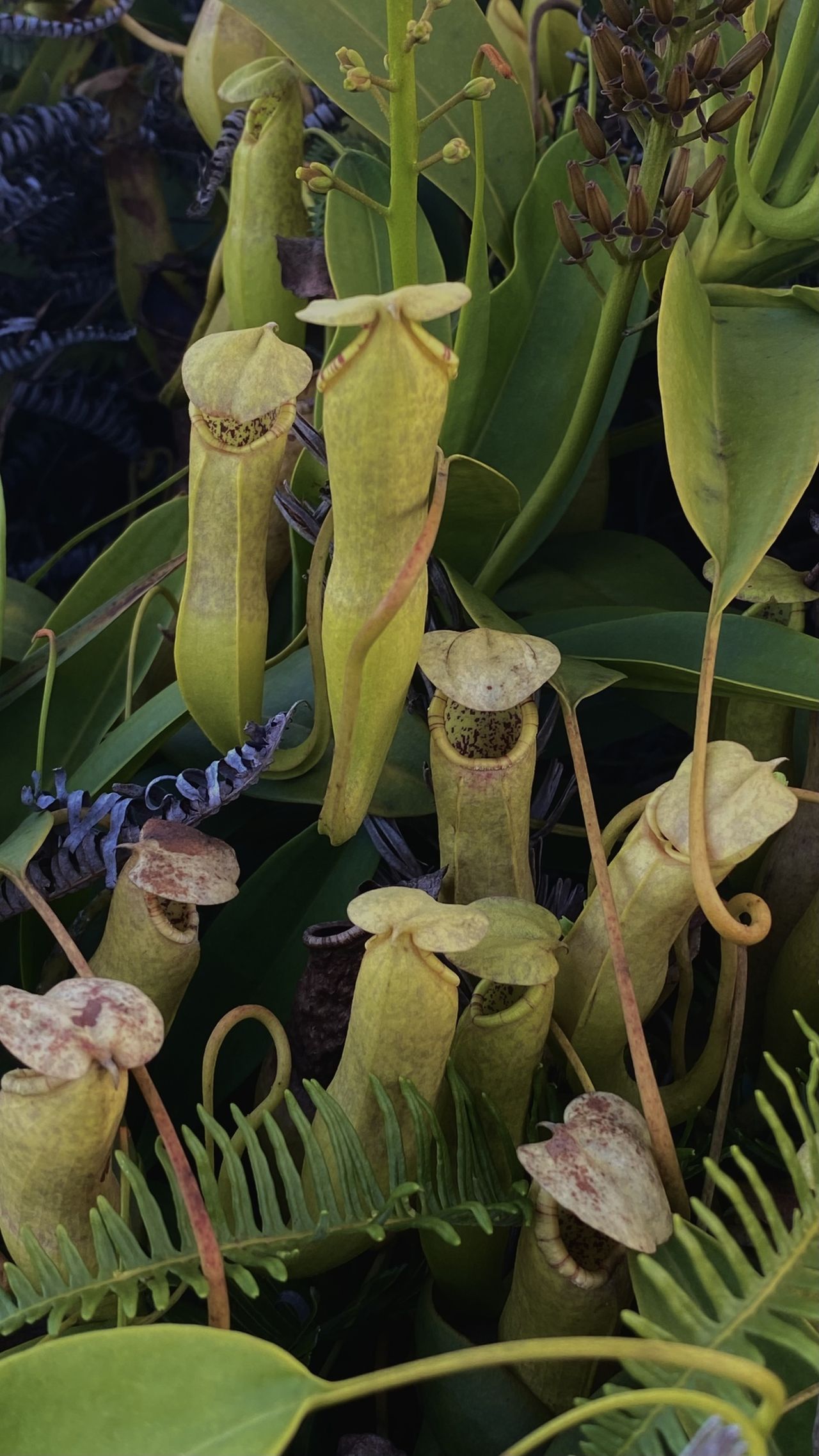
Identification
A climber of the group around Nepenthes alata, with winged petioles and a thickened ridge beneath the lid. The upper pitchers are greenish white with red markings, almost cylindrical, 11.5 to 16 cm tall and 3.2 to 4.3 cm wide, narrowing gradually at the middle to 3 to 3.5 cm before widening a little again towards the mouth; as in most species of the group they are broadest in the lower half. The description sets out the differences from related species in a comparative table of leaf shape, indumentum and lid characters. The data on leaves, lower pitchers and inflorescence could not be consulted for this guide; those fields are therefore left empty.
Similar species
The two species most easily confused with Nepenthes ultra are Nepenthes alata and Nepenthes graciliflora, both also of the alata group and both from Luzon. Nepenthes alata in its current narrow sense is a mountain species, and Nepenthes graciliflora usually grows between 800 and 1280 m in mossy submontane forest. Altitude and soil are thus the first clue in the field: a slender, greenish-white pitcher plant in open scrub on ultramafic rock near the coast of north-eastern Luzon is almost certainly this species. The morphological differences lie in details that need a hand lens.
The trap and how it works
A pitfall of the type usual in the alata group: a slender, almost cylindrical pitcher with a narrow peristome, a lid shielding the mouth from rain and bearing nectar glands beneath, and a thickened midline ridge on the underside of the lid that in many species of the group carries an appendage. The peristome turns slippery when wet and lets insects slide inside; the upper inner wall is waxy, and digestive fluid stands at the bottom. Specific data on prey are lacking.
Habitat and ecology
Open coastal scrub on ultramafic rock (R3, B6), at low altitude: the authors call it the only pitcher plant of Luzon below 400 m. Ultramafic soils are poor in nitrogen, phosphorus and potassium and rich in nickel, chromium and magnesium; few plants grow well on them, and the vegetation stays low and open. That is exactly the kind of ground pitcher plants profit from. A precise altitudinal limit could not be consulted for this guide, so the elevation field is left empty.
Distribution and elevation
Endemic to Luzon. The two main populations lie on the Aubarede peninsula and around Palanan in Isabela province, on the north-east coast, within Northern Sierra Madre Natural Park; there are further records about 80 km to the south in Aurora province and in Zambales province on the west coast. The label 'Mindoro' in our species list is wrong: the species is not known from Mindoro, and the type locality and all sites lie on Luzon.
- Recorded (one-degree cells)
Forms and variation
No varieties have been described. Pitcher colour, greenish white with red markings, will vary with light as in its relatives, but nothing has been published on it. No natural hybrids have been reported. Because the species grows at low altitude on an unusual soil, few other pitcher plants occur at its sites with which it might cross.
Where and when to see it
The Isabela coast around Palanan is remote and mostly reachable only by boat, small aircraft or a long trek across the Sierra Madre. Those who get there should search open, low scrub on red or dark, stony ground; the reddish tint of weathered ultramafic rock is often easy to pick out in the landscape. The area is a national park; visit with permission and local guidance.
Conservation status
The species has not yet been assessed by the IUCN (Not Evaluated). The authors rated it Endangered, with an area of occupancy of about 20 km², and named open-cast mining and tourism development as the main threats. Ultramafic areas are the principal source of nickel and chromium in the Philippines, and the lowlands are the most accessible to mining. The Isabela populations lie within a protected natural park. Like all Nepenthes the species is listed in CITES Appendix II.
Scientific name
Nepenthes ultra | Jebb & Cheek, 2013
Described by Cheek & Jebb in 2013, in Blumea (published online 24 October 2013). Sources differ slightly on the order of the author names (Cheek & Jebb versus Jebb & Cheek). The Philippine island of Luzon; a more specific site, coordinates or elevation could not be established with certainty. "Ultra" refers to the ultramafic (heavy-metal-rich) soils on which the plant grows.
World Checklist of Vascular Plants (WCVP), via Plants of the World Online (POWO), Royal Botanic Gardens, Kew.