All species › Caryophyllales › Tropical pitcher plant family › Nepenthes dactylifera
Nepenthes dactylifera
A species split from a familiar name in 2019. Nepenthes fusca was long regarded as one of the most widespread mountain species of Borneo, an epiphyte with narrow, dark pitchers ranging from Sabah to Kalimantan. When an expedition reached the type locality of N. fusca on the Kemul Massif in the interior of East Kalimantan, for the first time since it was collected there in 1925, the true fusca turned out to be a plant of small range. Alastair Robinson, Michal Golos, Stewart McPherson, Marc Barer and colleagues then split off two species: Nepenthes zakriana in Sabah, and the more southerly, widespread Nepenthes dactylifera. The name means 'finger-bearing'.
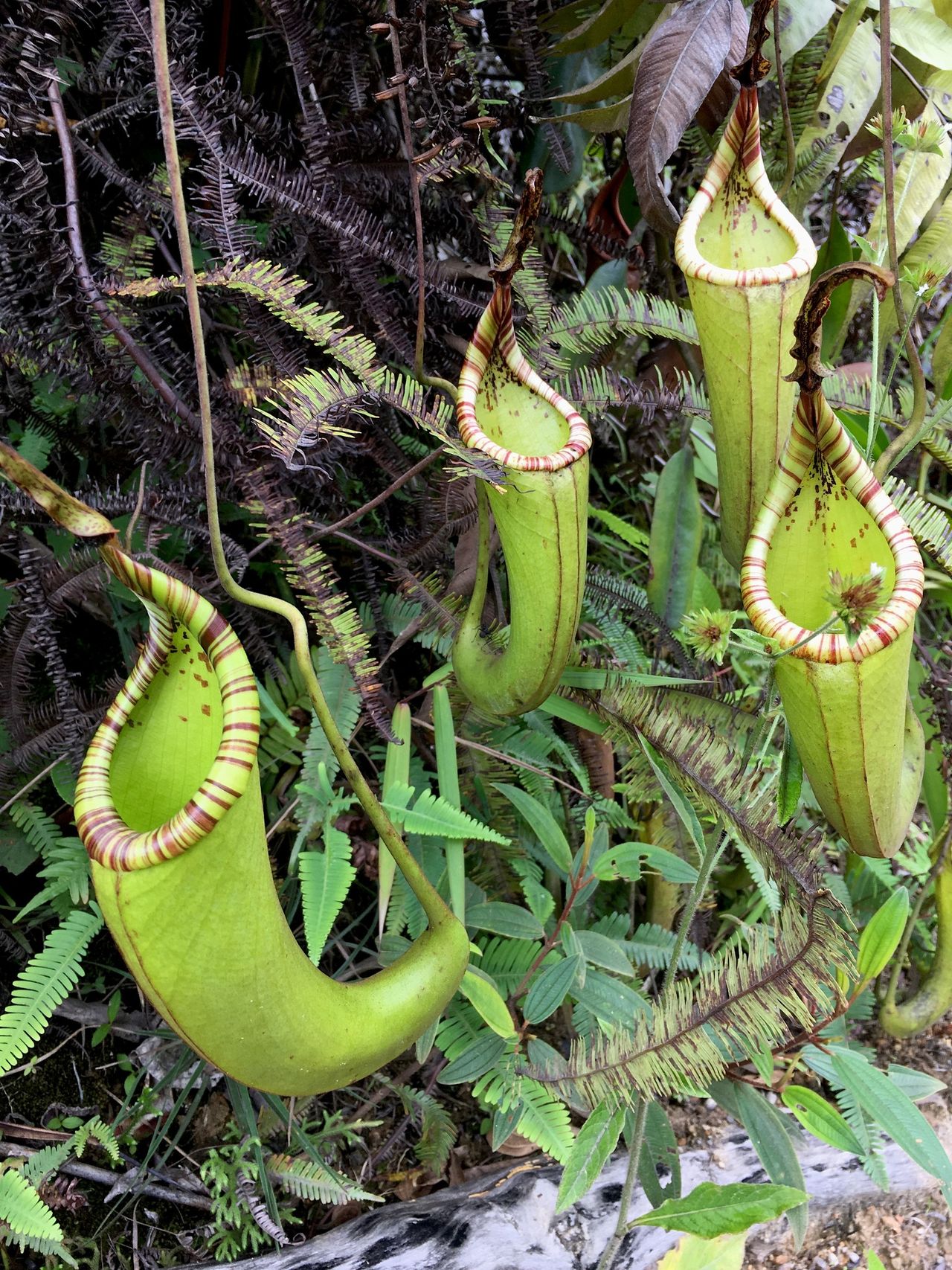
Identification
A mainly epiphytic climber much like what used to be regarded as N. fusca: slender stems, narrow leaves and pitchers hanging from branches and in moss. The upper pitchers are funnel-shaped to cylindrical and have a lid that is very narrowly ovate to triangular, one of the characters by which the authors separate the species from its relatives. Lower pitchers are formed where the plant stands on the ground or in thick moss. As throughout the fusca group, pitcher colour ranges from green to dark reddish brown, often blotched. Since the full species description was not consulted for this guide, no measurements are given here. The difference between lower and upper pitchers is linked to growth stage: young plants and rosettes form lower pitchers, and only when the stem begins to climb do upper pitchers appear, their tendrils often coiling around a support.
Similar species
Within the fusca group separation is difficult and often possible only from the upper pitchers and provenance. Nepenthes fusca in the strict sense grows only on the Kemul Massif, strictly terrestrial on rocky ridges, and has a flat, ovate lid. Nepenthes zakriana is confined to the Crocker Range in Sabah and has a narrow, strap-shaped lid. N. dactylifera is the species of Sarawak, Brunei and most of Kalimantan. Nearly all older photographs and herbarium specimens of 'N. fusca' from those areas therefore belong to this species.
The trap and how it works
A pitfall as in the rest of the genus: nectar on the peristome and under the lid lures insects, which slip on the wet, smooth peristome and end up in the digestive fluid. Because the plant grows mainly as an epiphyte, most pitchers hang from branches and take mainly flying insects and ants walking along the branches. No prey study specific to this species has been published; work on 'N. fusca' from before 2019 may concern this species. Work on other species of the genus has shown that the peristome works by 'aquaplaning': a thin film of water on the finely ribbed surface makes it so slippery that the adhesive pads of insect feet can no longer grip. The trap therefore works best when it is damp, which in cloud forest is almost always the case.
Habitat and ecology
Mountain forest between about 800 and 1900 m, where the species grows mainly as an epiphyte on trees (B1). Notably, it also colonises disturbed ground: the authors mention ruderal sites on clayey laterite soil, such as road verges and cut slopes (H1). That combination partly explains why the species is so widespread: it is not bound to one special soil type and profits from open ground.
Distribution and elevation
Endemic to Borneo, with a large range through Sarawak, Brunei and Kalimantan. This agrees with the guide's own species list. In Sabah it is replaced by N. zakriana, on the Kemul Massif by N. fusca in the strict sense. As the species was split off only in 2019, its exact boundaries have not yet been established everywhere.
- Recorded (one-degree cells)
Forms and variation
No varieties or wild forms have been described. Pitcher colour varies greatly, from green to dark reddish brown, and plants in open sites generally colour darker. Natural hybrids attributed in the literature to 'N. fusca', for instance from Sarawak, probably concern this species, but have not been reassessed since the split.
Where and when to see it
Because the species is widespread and also grows along mountain roads, it is one of the easier mountain species of Borneo to find: above about 800 m, look at tree branches along clearings and road verges, where the dark, funnel-shaped upper pitchers hang. Protected mountains with trails in Sarawak and Brunei are good places. When identifying, note the shape of the lid and record the provenance.
Conservation status
There is no IUCN assessment of this species (Not Evaluated), which is unsurprising for a species described only in 2019. What is known: the range is large, the species occurs on many mountains, and it can survive on disturbed ground. That makes a serious short-term threat unlikely, although mountain forest in Borneo is steadily disappearing. As a member of Nepenthes it is listed in CITES Appendix II.
Scientific name
Nepenthes dactylifera | Robinson, Golos, McPherson & Barer, 2019
For Nepenthes dactylifera, no accessible source could be found giving the precise describer, publication year, or original publication; several consulted sources (Wikipedia-style mirror pages, taxonomic portals) were unreachable or returned no result for this species. The precise type locality could not be established with certainty from the accessible sources. The name is likely derived from the Latin "dactylus" ("finger") and "-fera" ("bearing"), "finger-bearing" — similarly formed to the date palm's name (Phoenix dactylifera) — but which feature of the plant this refers to could not be confirmed with certainty.
World Checklist of Vascular Plants (WCVP), via Plants of the World Online (POWO), Royal Botanic Gardens, Kew.