All species › Caryophyllales › Tropical pitcher plant family › Nepenthes domei
Nepenthes domei
In 2020 the Malay Peninsula gained two pitcher plants in a single publication, both from the hills of the eastern state of Terengganu. One of them is Nepenthes domei, described by M.N. Faizal, A. Amin and A. Latiff in the journal Webbia. The name honours Dome Nikong, who first found the population. It is a hill species from the affinity of Nepenthes benstonei, with round, squat lower pitchers and a peculiar habit the describers called ‘burrowing’. With the two new species the number of pitcher plants on the peninsula reached fifteen.
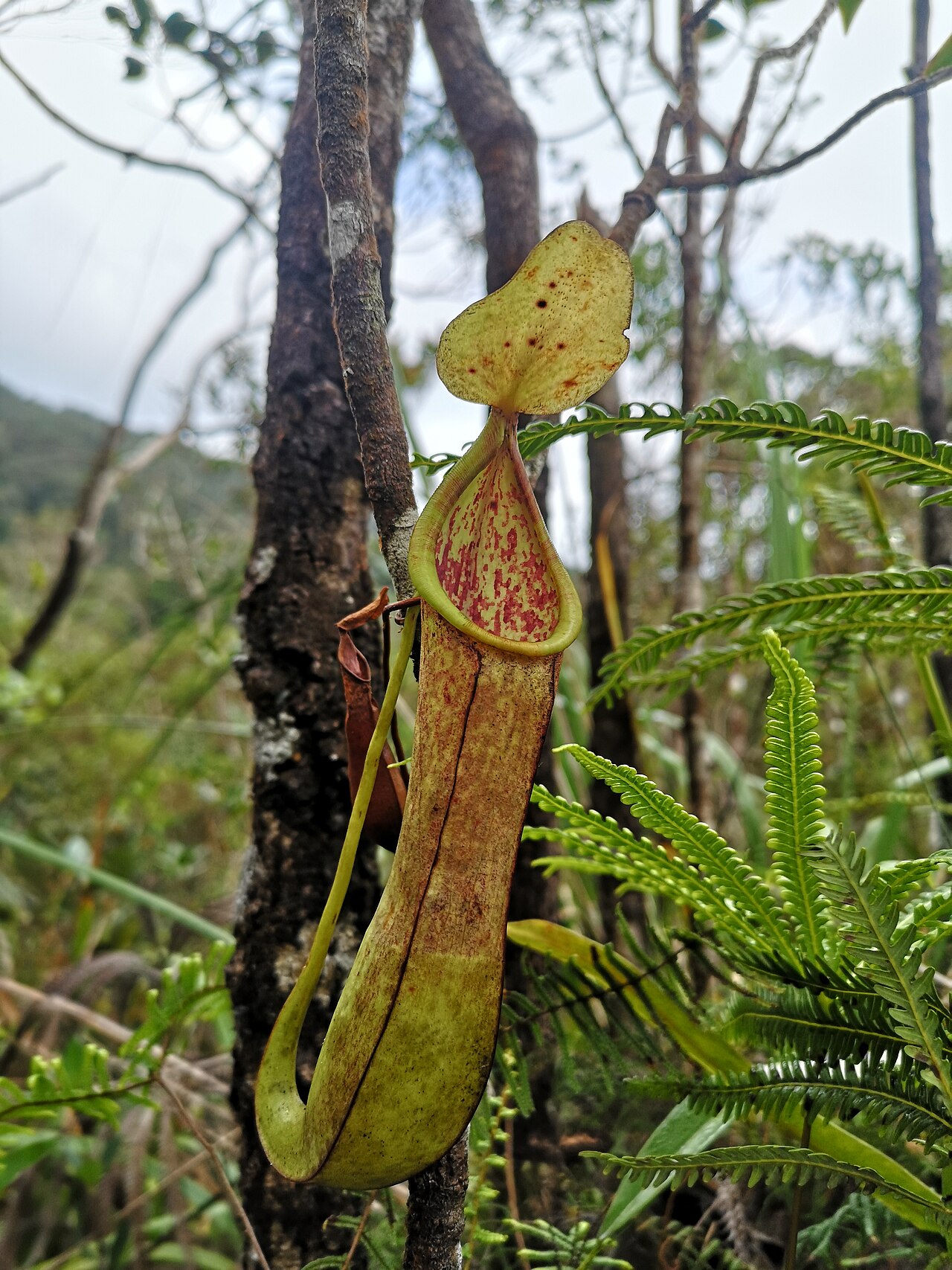
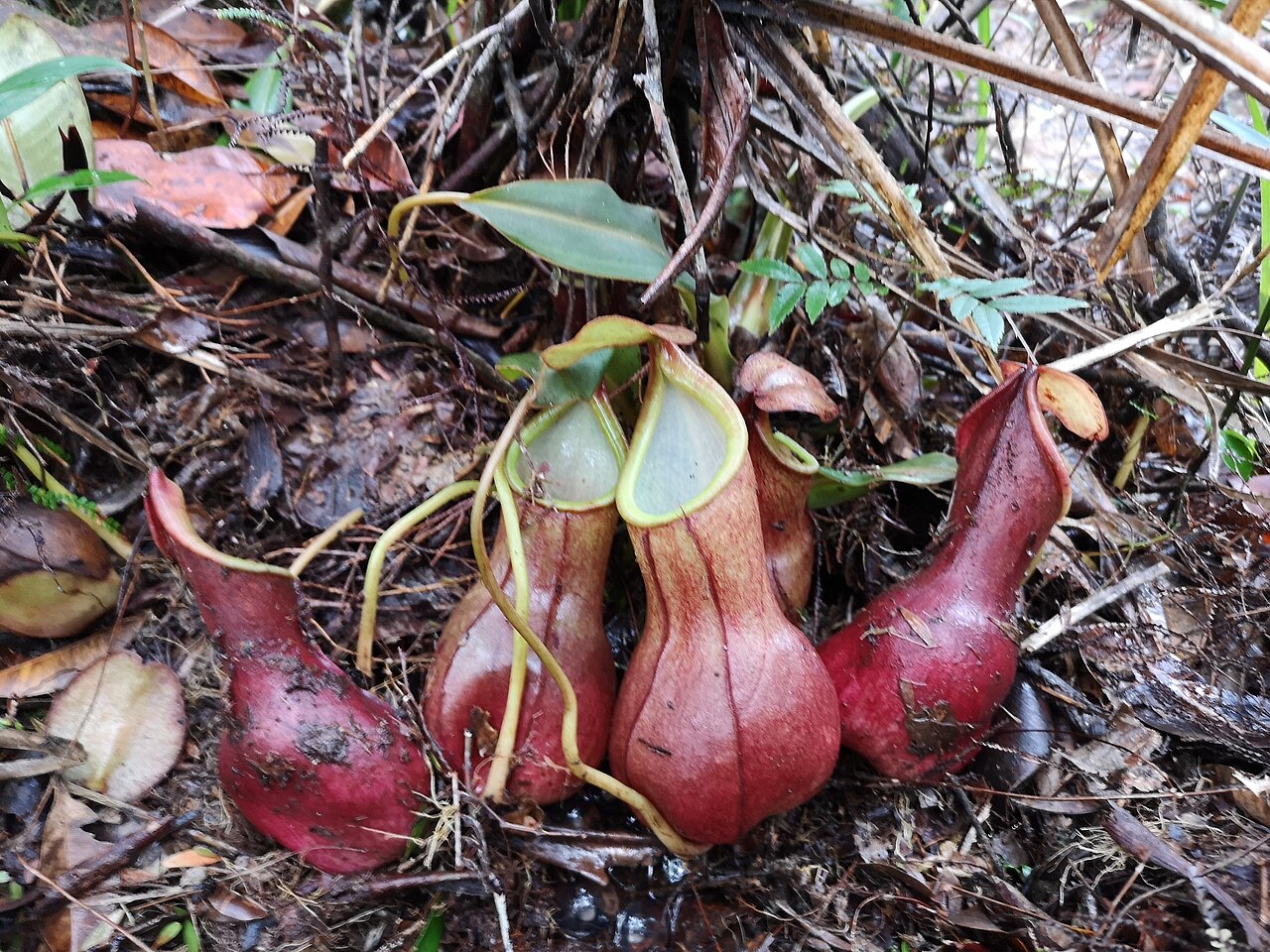

Identification
A climbing plant of the hill zone. According to the description the lower pitchers are rounder and stouter than in N. benstonei, and often lie partly sunk into the substrate — the behaviour the describers call ‘burrowing’. The lid is much narrower than in N. benstonei; in some plants it is even lanceolate. As in related species, the upper pitchers are slimmer and more funnel-shaped than the lower ones and hang from the climbing stems. No verifiable source with measurements of stem, leaves or pitchers was found for this guide, so the measurement fields are left empty.
Similar species
The closest relative is Nepenthes benstonei, known from Bukit Bakar in the neighbouring state of Kelantan. According to the description the difference lies in the lower pitchers, which are rounder and sturdier in N. domei, and in the lid, which is much narrower in N. domei, sometimes lanceolate. The same hills of Terengganu also hold N. latiffiana, described in the same paper, which according to its describers is best compared with N. sanguinea and differs from it in the peristome. Other montane species of the peninsula, such as N. macfarlanei, grow higher and have different pitchers.
The trap and how it works
A pitcher trap with a striking detail: lower pitchers lying partly within the substrate. Such a pitcher has its mouth at or just above the level of the leaf litter or moss, which makes it particularly suited to crawling prey — ants, beetles, centipedes — that more or less walk straight in. Similar behaviour is known from a few other species whose lower pitchers sink into moss or litter. The upper pitchers hang higher and also catch flying insects. Otherwise the trap works as in the whole genus: nectar on peristome and lid, a slippery wet peristome and digestive fluid at the bottom.
Habitat and ecology
Hill and montane forest in Terengganu, at about 800 to 1000 m (B1). This is the transition from lowland rainforest to montane forest, where the trees grow lower and moss, ferns and shrubs cover the ground. More detailed habitat data are not worked out in the sources consulted. The related N. benstonei and N. latiffiana grow in comparable hill vegetation on poor, often sandy or rocky soil.
Distribution and elevation
Endemic to the Malay Peninsula, in the state of Terengganu, at about 800 to 1000 m. The species is known from a limited area in the hills of Terengganu; precise sites are not given here. With N. latiffiana it is among the latest additions to the peninsula's pitcher plant flora, which reached fifteen species with these two.
- Recorded (one-degree cells)
Forms and variation
No varieties or forms are distinguished. Within the species the shape of the lid varies: in some plants it is narrow, in others even lanceolate. No natural hybrids are mentioned in the sources consulted. Because the species was described only in 2020 and is known from a small area, little has yet been published on variation within populations.
Where and when to see it
The hills of Terengganu are remote and largely forested; a trip to the higher parts needs a permit from the state forestry department and a local guide. Between about 800 and 1000 m, look at the ground: the round lower pitchers lie partly sunk into the moss or litter and are easy to miss. The east coast of the peninsula has a marked wet monsoon from about November to January; outside it the ground is easier going.
Conservation status
The species is not evaluated for the Red List (Not Evaluated) in the source this guide uses. What is known: it was described only in 2020 and as far as is known occurs only in a limited area in the hills of Terengganu. Logging, road building and collection for trade are the obvious risks for such small hill populations. As a member of the genus it is listed in CITES Appendix II; international trade in wild plants requires a permit.
Scientific name
Nepenthes domei | Faizal, Amin & Latiff, 2020
Nepenthes domei was described in 2020 by M.N. Faizal, A. Amin and A. Latiff, published in Webbia, together with N. latiffiana — one of three new Malayan Nepenthes species described that year. Peninsular Malaysia, likely in Terengganu, at 800-1,000 m elevation; a more precise type locality could not be confirmed with certainty. The specific epithet honours Mr. Dome Nikong, the first person to discover the population.
World Checklist of Vascular Plants (WCVP), via Plants of the World Online (POWO), Royal Botanic Gardens, Kew.