All species › Caryophyllales › Tropical pitcher plant family › Nepenthes ephippiata
Nepenthes ephippiata
The name tells you what to look for: ephippiata comes from the Latin ephippium, a saddle-cloth, and refers to the leaf base, which drapes over the stem like a saddle and runs down it on either side. The Dutch botanist B.H. Danser described the species in 1928, in his monograph of the pitcher plants of the Netherlands Indies, from remarkably little material: a piece of stem and an infructescence collected in central Borneo. Only much later, with expeditions to the mountains of the interior, did it become clear what the pitchers look like: broad, bizarrely shaped upper pitchers closely resembling those of the related Nepenthes lowii. It remains one of the least known pitcher plants of the island.
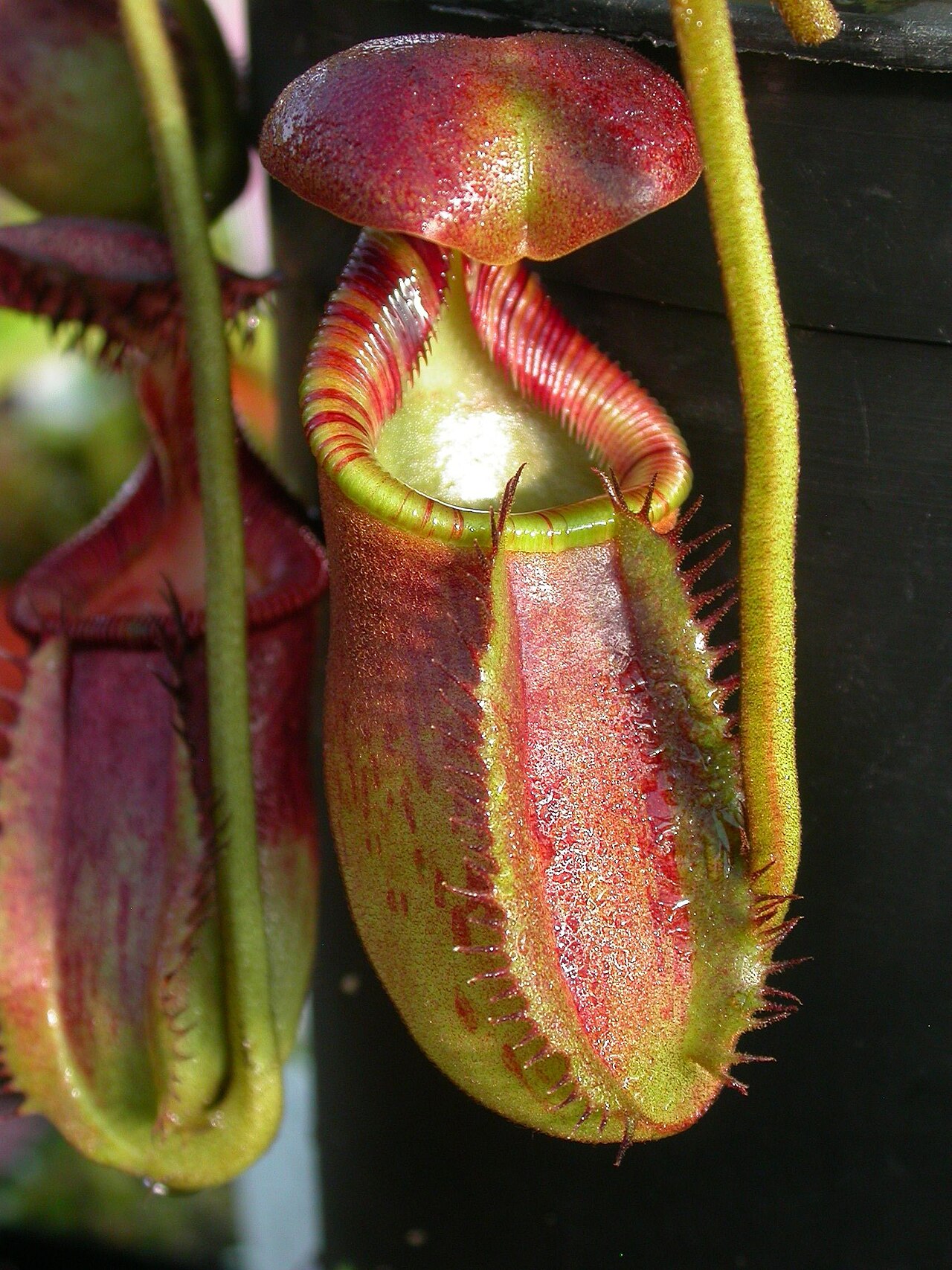
Identification
A climber of mountain forest, or in open vegetation a non-climbing clump. The best field character is the leaf base: the base of the blade is broad and runs down the stem on two sides, so that it sits over the stem like a saddle. In climbing plants this saddle is fully developed; in non-climbing plants from the Hose Mountains it is less pronounced than in plants from central Kalimantan. The lower pitchers are cylindrical with a well-developed peristome. The upper pitchers are the most striking: broad, bulbous below and strongly flared towards the mouth, with a toothed peristome and short, tubercle-like appendages under the lid. No verifiable measurements were found for this guide, so the measurement fields are left empty.
Similar species
The closest relative is Nepenthes lowii, a species of higher summits scattered across Borneo with similarly shaped, broad upper pitchers with a constricted waist. N. lowii, however, has an almost absent peristome and a lid with a dense layer of bristles on its underside, whereas N. ephippiata has a distinct, toothed peristome and short tubercles under the lid. The saddle-shaped leaf is also a character N. lowii lacks. A specimen from the Hose Mountains was at first identified as N. lowii, which shows how easily the two are confused.
The trap and how it works
As in all species of the genus, the pitcher is a pitfall with nectar on the peristome and under the lid, a peristome that turns slippery, and digestive fluid below. In its closest relative, N. lowii, it has been shown that the upper pitchers not only catch insects but mainly collect the droppings of treeshrews that sit on the pitcher to lick the secretions of the lid; the plant thus obtains much of its nitrogen from dung rather than prey. Whether N. ephippiata, with its similar pitcher shape but different lid, does anything similar has not been studied.
Habitat and ecology
Mountain and cloud forest between about 1000 and 1900 m (B1). The plant grows in mossy forest on ridges, both on the ground and climbing into the vegetation. It is a landscape of high humidity and acid, nutrient-poor soils, where moss covers trunks and branches and the forest becomes ever lower towards the summit. More detailed habitat data are scarce, as the species is known from few, hard-to-reach mountains. For a pitcher plant such a habitat is favourable: the constant humidity keeps the pitchers filled and the peristome slippery, while the poor soil supplies little nitrogen and phosphorus, so that the extra nutrition from prey is a real advantage.
Distribution and elevation
Endemic to Borneo, known from the Hose Mountains in central Sarawak and from Bukit Raya and Bukit Lesung in Kalimantan. This agrees with 'Borneo (Kalimantan, Sarawak)' in the guide's own species list. Originally the species was known only from Kalimantan; the Hose Mountains find was published by Ch'ien Lee in 2004 as a new record for Sarawak. Hundreds of kilometres of unexplored mountain country lie between the known sites.
- Recorded (one-degree cells)
Forms and variation
No varieties or wild colour forms have been described. There is variation between populations, however: non-climbing plants from the Hose Mountains have a less strongly decurrent leaf base than plants from central Kalimantan. No natural hybrids are known, which, given the remote sites, may also reflect a lack of research.
Where and when to see it
All known sites lie deep in the interior of Borneo and require expeditions of several days. Bukit Raya lies in a national park on the border of West and Central Kalimantan, and the climb is a journey of many days with local guides. Anyone who finds the species will recognise it fastest by the saddle-shaped leaf; the broad upper pitchers hang in the vegetation on the ridges. A good photograph of both pitcher types, with a scale, fills a real gap in knowledge.
Conservation status
The IUCN Red List assesses the species as Vulnerable (assessed under the older 2.3 criteria). Contributing factors: it is known from few sites, far apart, and mountain forest in the interior of Borneo is under pressure from logging and from fires in dry years. At the same time its remoteness protects the plants from collectors. As a member of Nepenthes it is listed in CITES Appendix II.
Scientific name
Nepenthes ephippiata | Danser, 1928
Nepenthes ephippiata was described in 1928 by Benedictus Hubertus Danser in his monograph "The Nepenthaceae of the Netherlands Indies" (Bulletin du Jardin Botanique de Buitenzorg), based on only part of a stem and an infructescence. Borneo; the precise collection site of the scant type material could not be established. The species occurs endemically in the Hose Mountains (Sarawak) and on Mount Raya and Bukit Lesung (Kalimantan), in montane forest at 1,000-1,900 m elevation. The name derives from the Latin "ephippium" ("saddle cloth"), referring to the characteristic saddle-shaped leaf, hence the common name "saddle-leaved pitcher-plant".
World Checklist of Vascular Plants (WCVP), via Plants of the World Online (POWO), Royal Botanic Gardens, Kew.