All species › Caryophyllales › Tropical pitcher plant family › Nepenthes erucoides
Nepenthes erucoides
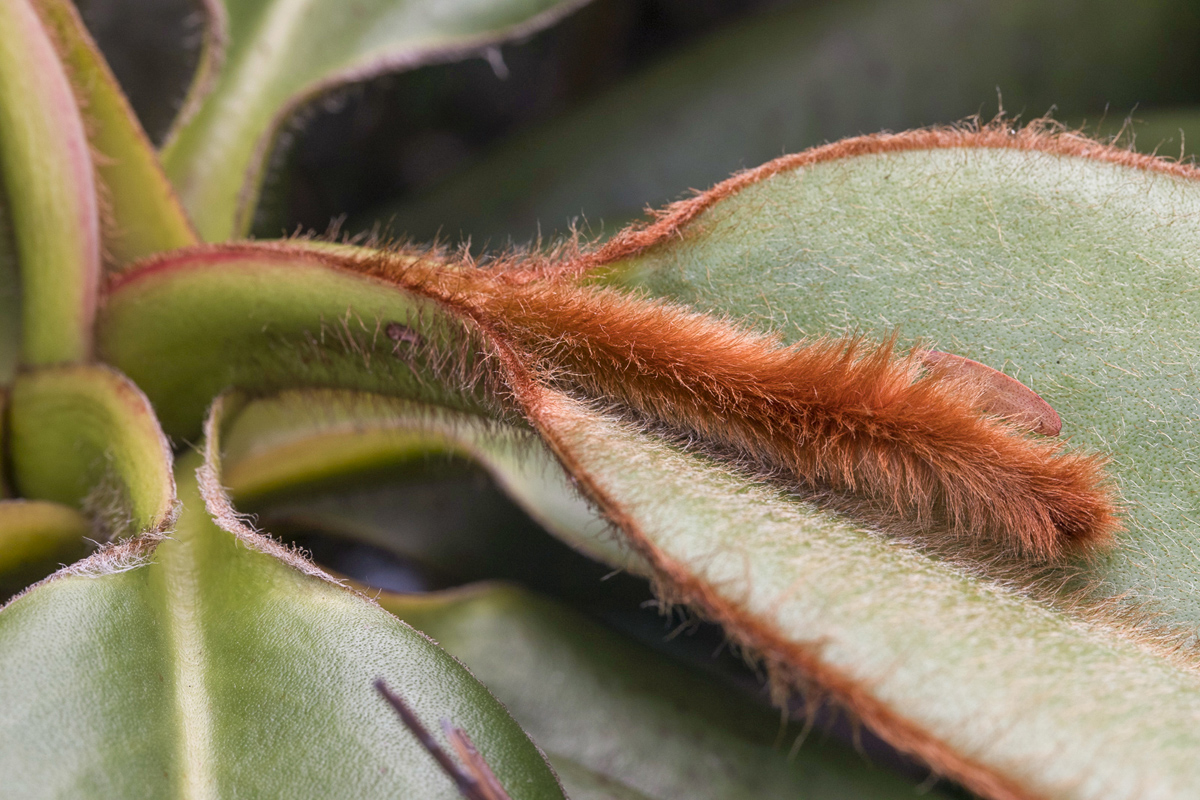
Caterpillar-like, the name means: the young leaves and tendrils of this pitcher plant are so densely hairy that they recall the woolly caterpillars of tiger moths. Nepenthes erucoides was described in 2019 by Alastair Robinson, Sarah Grace Zamudio and Rolly Caballero from a single peak on the island of Dinagat, off the north-eastern tip of Mindanao. It is a species of the most extreme ultramafic substrate on which a pitcher plant has ever been found: lateritic nickel ore and weathered chromite rubble.
Identification
A small, stiff pitcher plant with reduced, hard leaves. The authors call the combination of small stature, sclerophyllous leaves and strong hairiness characteristic. The most striking feature is the young foliage: according to the authors, the emerging leaves may have the densest indumentum of any Nepenthes, but those hairs are rapidly shed as the leaf expands, so mature leaves are much balder. The description also points to characters of the peristome and of the column behind the mouth, and to the structure of the inflorescence, which closely resemble those of the ultramafic mountain species of Palawan. The measurements in the description could not be consulted for this guide; the size fields are therefore left empty.
Similar species
On Mount Redondo Nepenthes erucoides grows together with Nepenthes mindanaoensis and Nepenthes bellii; lower down grow Nepenthes truncata (below 800 m) and Nepenthes merrilliana (below 600 m). Nepenthes mindanaoensis is a larger plant with thick, leathery leaves with inrolled petiole wings; Nepenthes bellii is a slender climber with small, rotund pitchers. The small stature, the hard, small leaves and above all the densely hairy young shoots make Nepenthes erucoides recognisable. The authors note a superficial resemblance to Nepenthes mantalingajanensis of Palawan, which they attribute to a similar environment rather than to relationship.
The trap and how it works
A pitfall on a plant living in an extremely hostile environment. On lateritic ore and chromite rubble almost no nitrogen or phosphorus is available, and the soil is rich in metals toxic to most plants; precisely there animal prey gives the pitcher plant an edge. Characteristic of the species is the structure of the peristome and of the column, the thickened part behind the mouth to which the lid is attached; the authors see that structure in the Palawan mountain species too, pointing to a shared adaptation to such soils. Specific data on nectar glands and prey were not available for this guide.
Habitat and ecology
Montane elfin forest at a strikingly low altitude, between about 800 m and the summit of Mount Redondo at 929 m (B1, R3). The soil is lateritic nickel ore, weathered chromite rubble and the clay derived from it: according to the authors the most extreme ultramafic substrate known for Nepenthes. The elfin forest on it is thin but very species-rich. That cloud-forest-like vegetation occurs below a thousand metres is a known phenomenon on isolated peaks near the sea, where cloud and wind act at low altitude.
Distribution and elevation
Endemic to Mount Redondo, the highest peak of Dinagat Island, in the municipality of Loreto, Dinagat Islands province. The authors call it a micro-endemic of a single peak. The label in our species list is correct.
- Recorded (one-degree cells)
Forms and variation
No varieties have been described. According to the authors the species hybridises with Nepenthes mindanaoensis, with which it grows on the summit; intermediates between the two are therefore to be expected and should not be mistaken for variation within Nepenthes erucoides itself. The dense hairiness is a feature of young growth and not of particular plants.
Where and when to see it
Mount Redondo is not a big mountain, but the Dinagat area is dominated by mining, and access to the summit goes through local communities and authorities. Those who get there should look at new growth: the young, densely hairy leaves and tendrils are the clearest character. Because the soil consists of loose rubble, the vegetation is vulnerable to trampling; keep to existing paths.
Conservation status
The species has not yet been assessed by the IUCN (Not Evaluated). The authors provisionally rated it Critically Endangered, on account of the very small range and declining habitat quality. The Dinagat Islands are among the most important nickel and chromite areas of the Philippines, and precisely the ore on which this species grows is the target of mining. Like all Nepenthes it is listed in CITES Appendix II.
Scientific name
Nepenthes erucoides | Robinson & Zamudio, 2019
Nepenthes erucoides was described on 31 October 2019 by Alastair Robinson, Alfredo Zamudio and Alberto Caballero, in Phytotaxa 423(1): 21-32. Mount Redondo, the highest peak on Dinagat Island in Dinagat Islands Province, northern Mindanao, Philippines, on an ultramafic substrate of lateritic nickel ore and decomposed chromite rubble, from around 800 m elevation to the summit at 929 m. The name combines the Latin "eruca" ("caterpillar") with the Greek suffix "-oides" ("resembling"), referring to the plant's distinctively hairy developing leaves and tendrils, which resemble the "exuberantly hairy caterpillars of certain erebid macromoths from the subfamily Arctiinae, such as those of the genus Arctia".
World Checklist of Vascular Plants (WCVP), via Plants of the World Online (POWO), Royal Botanic Gardens, Kew.