All species › Caryophyllales › Tropical pitcher plant family › Nepenthes dubia
Nepenthes dubia
A small pitcher plant with one of the strangest lids in the genus: on the upper pitchers it is narrow, wedge-shaped and thrown back so far that it points backwards beyond the vertical, away from the mouth. The species was collected on 29 May 1917 by H.A.B. Bünnemeijer on the Talakmau massif in West Sumatra, and described by B.H. Danser in 1928. Danser himself doubted whether it was a species at all and suspected a cross of N. inermis with another species; hence the name dubia, 'doubtful'. Later finds have shown that it is indeed an independent species.
Identification
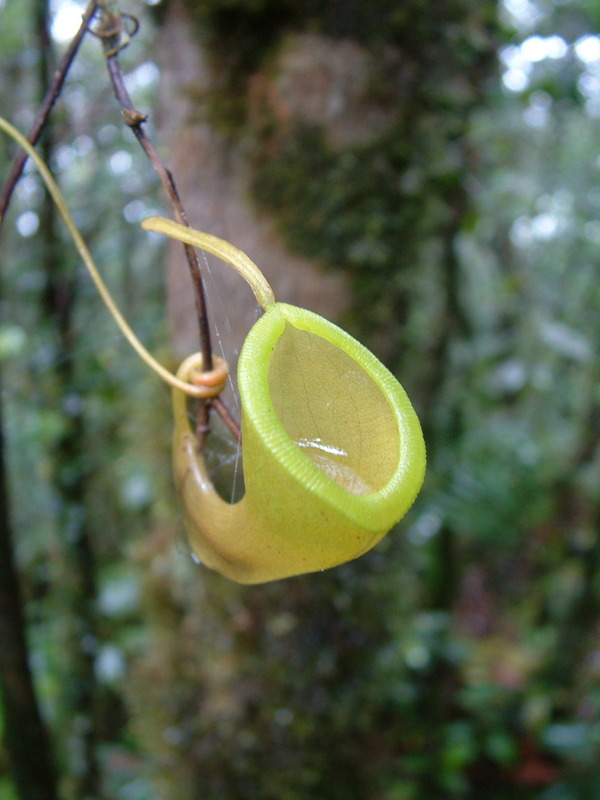
A small climber with a round stem to 3 m long and at most 4 mm thick; stem, tendrils and inflorescence are purplish red. The leaves are sessile, lanceolate to spathulate, to 10 cm long and 2 cm wide, with three longitudinal veins on each side and a base clasping half the stem. Lower pitchers are formed infrequently: they are to 5 cm tall, narrowly funnel-shaped below and ovoid above, with two short fringed wings and a rounded peristome to 3 mm. Upper pitchers are wholly different: to 8 cm tall and 4 cm wide, the lower part tubular but so compressed sideways that the walls almost touch, the upper part a wide funnel with a round, horizontal mouth and a rounded to involute peristome to 4 mm. The lid is narrowly cuneate, without appendages, and always reflexed beyond 180 degrees. Colour ranges from light green to yellow; orange and red forms are known.
Similar species
Nepenthes inermis has the same compressed funnel pitchers but almost wholly lacks a peristome, has fewer glands on the lid and is usually green. N. × pyriformis from Gunung Talang, long confused with N. dubia, has a broader lid reflexed no further than 90 degrees, a pitcher not compressed below, and a mouth rising towards the back. N. talangensis has a broadly ovate lid and a squat, often red pitcher. N. tenuis has been merged with N. dubia by some authors, but is again recognised as a separate species in recent reviews.
The trap and how it works
As in N. inermis, the catching power lies mainly in the fluid: the pitchers contain a thick, mucilaginous fluid that works as both pitfall and flypaper. Small flying insects that land in or fall into the wide funnel stick to the wall or in the liquid. The strongly reflexed lid leaves the mouth fully open, so rain has free access; the viscosity of the fluid prevents it from being heavily diluted. The compressed lower part keeps the fluid space small, and the glandular zone covers the lower two thirds of the inner wall.
Habitat and ecology
Montane cloud forest (B1): lower on the slope the species grows epiphytically in the montane forest; higher, above about 2400 m, also on the ground on moss cushions in low, stunted upper montane scrub (R5). The altitudinal range is 1600 to 2700 m. It shares these slopes with N. gymnamphora, N. izumiae, N. jamban and N. lingulata.
Distribution and elevation
Endemic to Sumatra, in the Barisan Mountains of West Sumatra. For a long time the species was known only from the Talakmau massif; it has since been found on one further mountain in the province. Because the species is critically endangered, this guide gives no more precise localities. The world checklist gives Sumatra as its only area.
- Recorded (one-degree cells)
Forms and variation
Pitchers vary from light green to yellow, and orange and red forms are known; no formal varieties have been described. Three natural hybrids have been reported: with N. izumiae, which forms small, yellowish-green funnel pitchers; probably with N. jamban (reported in 2009); and with N. jacquelineae, from a single plant. Plants from Gunung Talang that Jebb & Cheek (1997) included in N. dubia are now regarded as the hybrid N. inermis × N. talangensis (N. × pyriformis).
Where and when to see it
This species is critically endangered and its sites are small: do not go looking for it on your own. Anyone visiting the cloud forest of West Sumatra with a recognised local guide or a research group will know it at once by the narrow lid thrown far back and the compressed base of the upper pitcher. Leave plants, pitchers and seed where they are, and do not share location data from photographs: known sites of rare pitcher plants are quickly stripped.
Conservation status
Assessed on the Red List as Critically Endangered, on the basis of its very small range: two mountains, each with a limited area of suitable cloud forest. Over-collection is not seen as the main risk for this species, as its pitchers are less sought after than those of N. inermis; its vulnerability lies mainly in the small size of the populations and in threats to the habitat itself, such as fire and clearance of the lower slopes. As a member of the genus it is listed in CITES Appendix II.
Scientific name
Nepenthes dubia | Danser, 1928
Nepenthes dubia was described in 1928 by Benedictus Hubertus Danser in his monograph "The Nepenthaceae of the Netherlands Indies" (Bulletin du Jardin Botanique de Buitenzorg, series III, 9(3-4): 249-438). The lectotype (Bünnemeijer 938, a portion of a climbing stem with upper pitchers) was collected on 29 May 1917 by H.A.B. Bünnemeijer, and is held at the Bogor Botanical Gardens (Java) and the Herbarium Lugduno-Batavum (Leiden). Mount Talakmau on Sumatra, Indonesia, at approximately 1,900 m elevation. The name comes from the Latin word for "doubtful", reflecting the uncertainty Danser had at the time about this species' taxonomic status.
World Checklist of Vascular Plants (WCVP), via Plants of the World Online (POWO), Royal Botanic Gardens, Kew.