All species › Caryophyllales › Tropical pitcher plant family › Nepenthes gracilis
Nepenthes gracilis
Anyone walking past a roadside ditch or through a patch of peat forest in the lowlands of Malaysia, Singapore or Borneo stands a good chance of meeting this species as their first pitcher plant. Nepenthes gracilis is the commonest Nepenthes of Southeast Asia: a slender climber with small, narrow pitchers, found both in untouched peat-swamp forest and on bare road verges. Yet this everyday species turned out in 2012 to have a capture mechanism known from no other plant: in rain the lid works as a springboard that flicks insects into the pitcher.
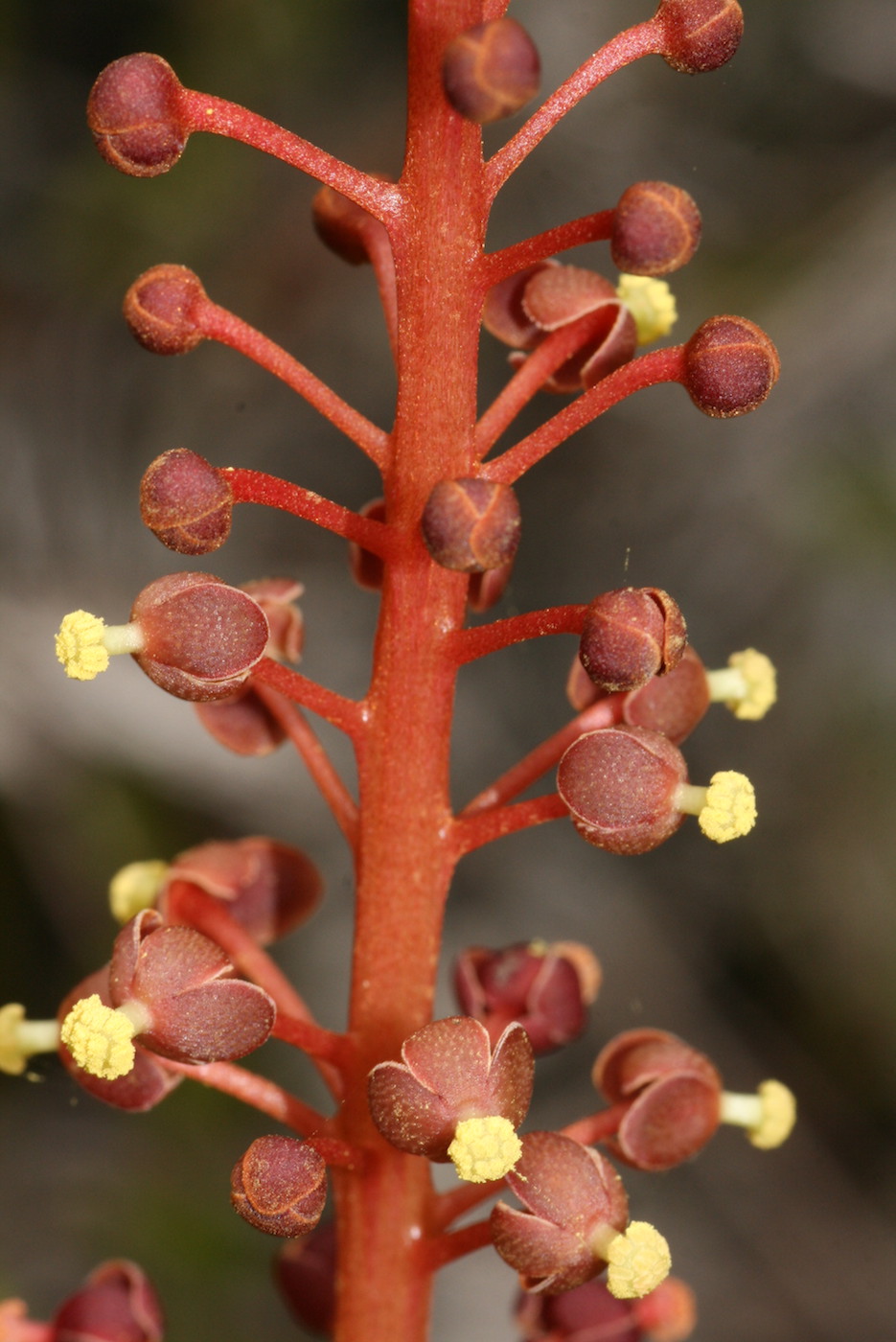
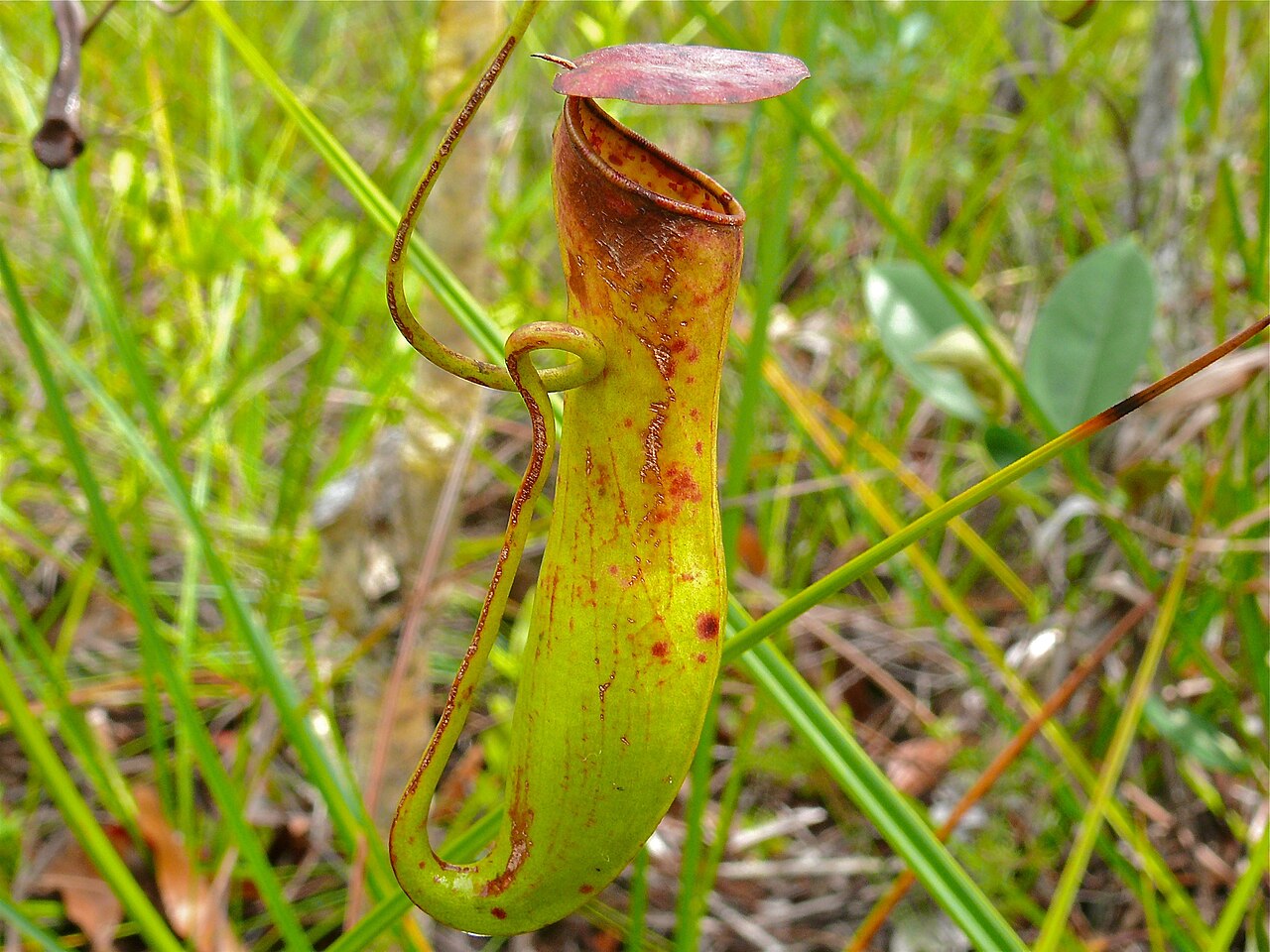
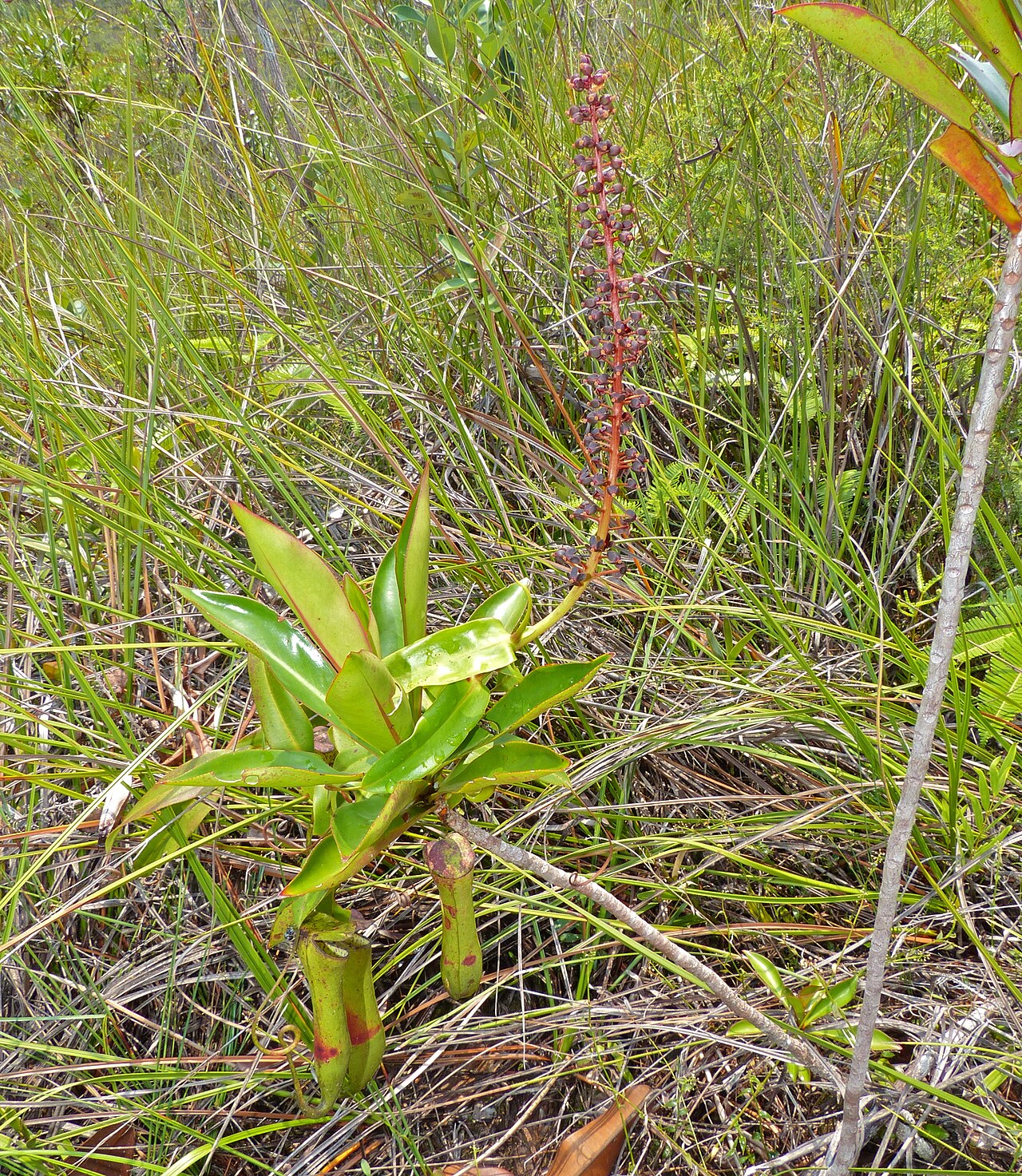
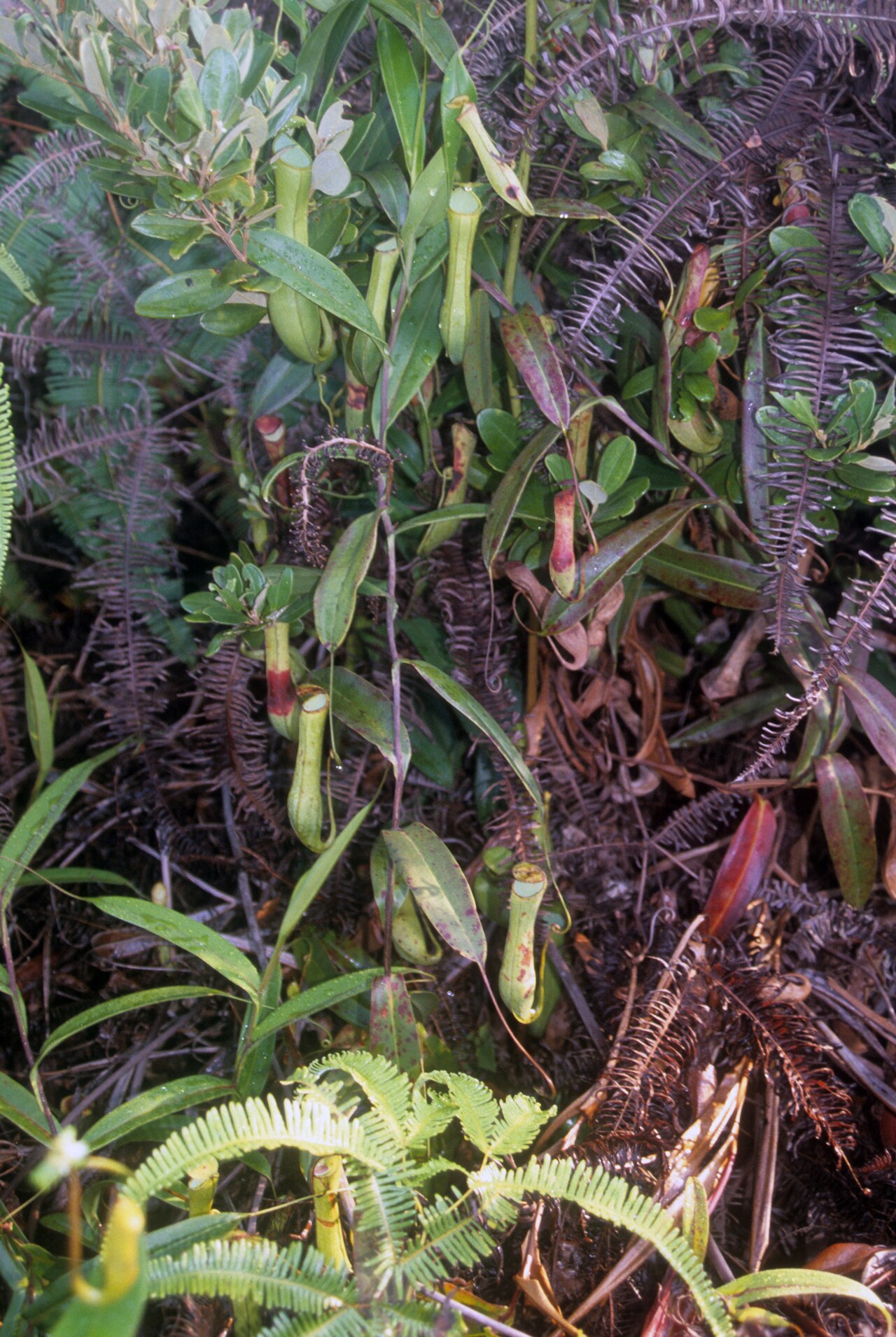
Identification
A slender climber, usually to 2 m and sometimes to 5 m tall, with triangular stems 2 to 4 mm thick. The leaves are narrowly lanceolate, mostly 12 to 19 cm long and 1.5 to 2.8 cm wide, sessile and running far down the stem at the base, with four to six longitudinal veins. Lower pitchers are ellipsoid in the basal half and slightly constricted and almost cylindrical above, usually 8 to 10.5 cm long, with two fringed wings 3 to 5 mm broad. Upper pitchers are nearly cylindrical, slightly constricted in the middle, usually 7 to 14.5 cm long and up to 4 cm wide, without wings. The peristome is very narrow in both, a rounded rim of about half a millimetre. Colour varies: green, red, green blotched with red, rarely black-purple.
Similar species
Several species often grow together in the lowlands. Nepenthes albomarginata also has narrow pitchers, but carries a conspicuous white band of hairs below the peristome. N. mirabilis has stalked leaves and larger pitchers with a broader, flattened peristome. N. rafflesiana and N. ampullaria are much more robust. The best field character of N. gracilis is the combination of triangular stem, narrow sessile leaves and hair-thin peristome. In mixed populations hybrids are frequent alongside the species itself, such as Nepenthes × trichocarpa with N. ampullaria.
The trap and how it works
A pitcher trap with a trick of its own. The peristome is so narrow that the usual slippery slide amounts to little here; the lid takes over part of the job. The underside of the lid carries an uneven layer of wax crystals, something found at that position in no other species studied, and structurally different from the wax inside the pitcher. In dry weather insects hold on well to that underside and lick at the few nectar glands — usually twenty to thirty. But when a raindrop hits the lid, it flicks down and back, and an insect sitting beneath is knocked loose and falls into the pitcher. Bauer and colleagues demonstrated this in 2012 with simulated rain and high-speed filming. Inside live, among others, ants of the species Polyrhachis pruinosa and mosquito larvae of Tripteroides.
Habitat and ecology
Poor, wet and open ground in the lowlands: peat-swamp forest, kerangas (heath forest on poor sand), heath-like scrub on podzol, swamp margins and disturbed places such as road verges (B4, B3, B5, H1). It usually grows on poor soils, sometimes on sandstone or ultramafic rock, from sea level to about 800 m. The species tolerates a lot of light and benefits from open ground, which makes it one of the few pitcher plants that stays common near people.
Distribution and elevation
Widespread in the western part of Malesia: southern Thailand, Cambodia, the Malay Peninsula and Singapore, Sumatra, Borneo and Sulawesi, from sea level to about 800 m. In Borneo and the peninsula it is locally very abundant in the lowlands. It is neither an endemic nor a rarity — which is precisely why it makes a good reference species against which to set other lowland species.
- Recorded (quarter-degree cells)
Forms and variation
Over time many varieties and forms of N. gracilis have been described, but most are no longer recognised; a series of former species names, such as N. teysmanniana and N. korthalsiana, are now synonyms as well. Variation is mostly in colour: green, red, green blotched with red and, rarely, dark blackish-purple plants. In the wild the species hybridises readily with other lowland species, including N. ampullaria, N. rafflesiana, N. mirabilis and N. albomarginata. DNA studies place it as sister to the N. mirabilis group.
Where and when to see it
Pick a patch of kerangas or peat forest in the lowlands of Borneo, the Malay Peninsula or Singapore; in Singapore itself it still grows in nature reserves and open ground. Walk forest edges and open, sandy stretches and look for slender green or red pitchers hanging among the shrubs. A chance to see the lid in action comes with a shower: stand by a group of upper pitchers and watch for insects sitting under the lid. Since the climate is wet year round, any season will do.
Conservation status
The Red List assesses the species as Least Concern. Its range is large, it is locally very abundant and it persists on disturbed ground. Local populations do vanish when peat-swamp forest is converted to oil-palm plantations and under large-scale drainage, but the species as a whole is not threatened. As a member of the genus it is listed in CITES Appendix II; international trade in wild plants requires a permit. In practice the trade runs on cultivated material.
Scientific name
Nepenthes gracilis | Korthals, 1840
Nepenthes gracilis was described in 1839 by Pieter Willem Korthals, in "Over het geslacht Nepenthes" (published 1839-1842 in Verhandelingen over de Natuurlijke Geschiedenis der Nederlandsche overzeesche bezittingen; Kruidkunde). The precise type locality could not be established with certainty from the accessible sources; the species has one of the broadest distributions in the genus, spanning much of Southeast Asia. The name is Latin for "slender", referring to the plant's fine, delicate build — the same root as the closely related N. gracillima (superlative form of the same word).
World Checklist of Vascular Plants (WCVP), via Plants of the World Online (POWO), Royal Botanic Gardens, Kew.