All species › Caryophyllales › Tropical pitcher plant family › Nepenthes gymnamphora
Nepenthes gymnamphora
The oldest name in this group of Sumatran and Javan mountain species, and one of the most awkward. Nepenthes gymnamphora was published in 1824 under Reinwardt's name by Nees von Esenbeck; the epithet comes from the Greek gymnos (naked) and amphoreus (jar). It is a slender climber of the mountain forests of Java and Sumatra, with small, often darkly spotted pitchers. There is no agreement on the limits of the species: some authors see one highly variable species on both islands, others restrict the name to Java and place the Sumatran plants in N. pectinata.
Identification
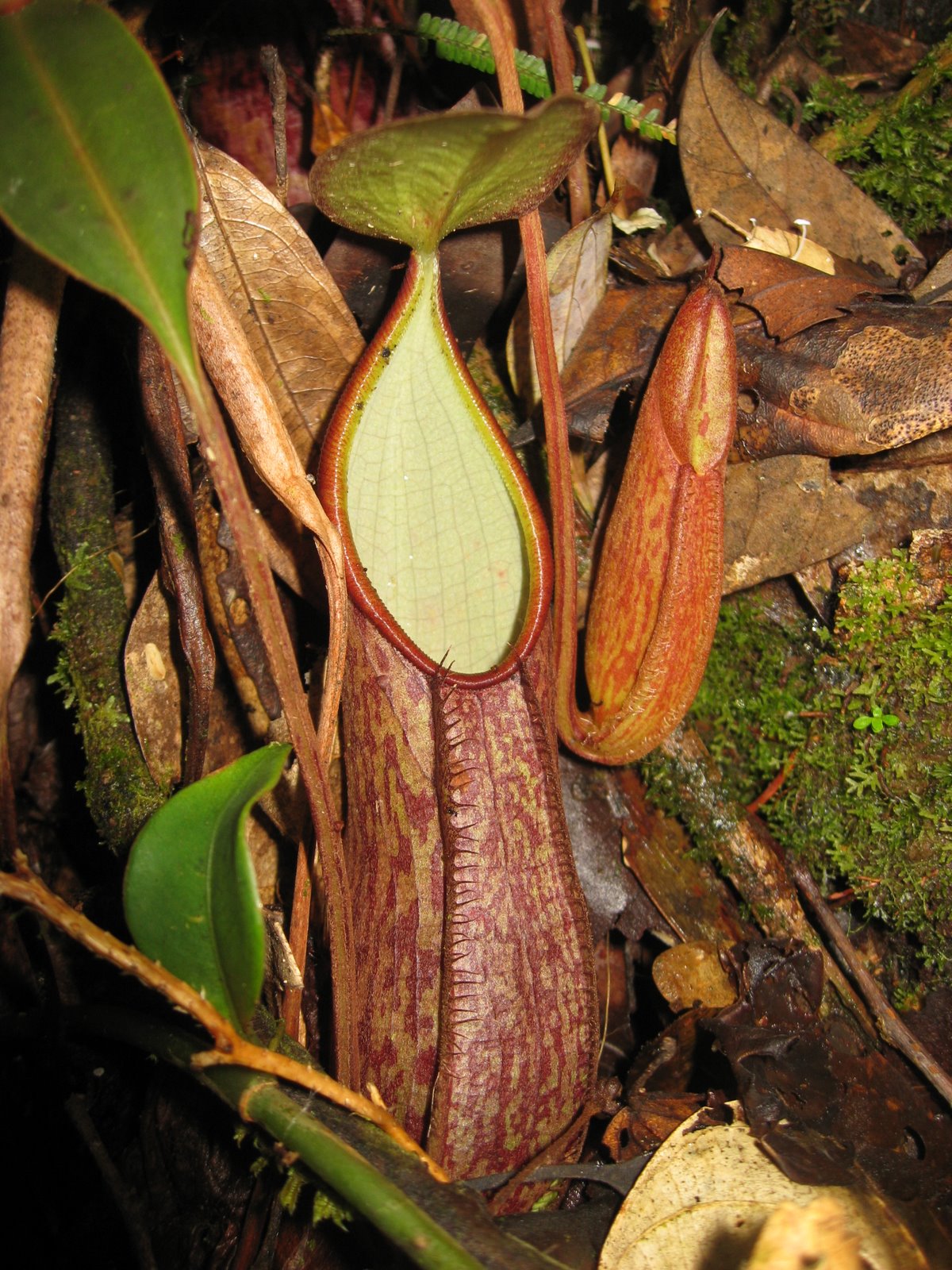
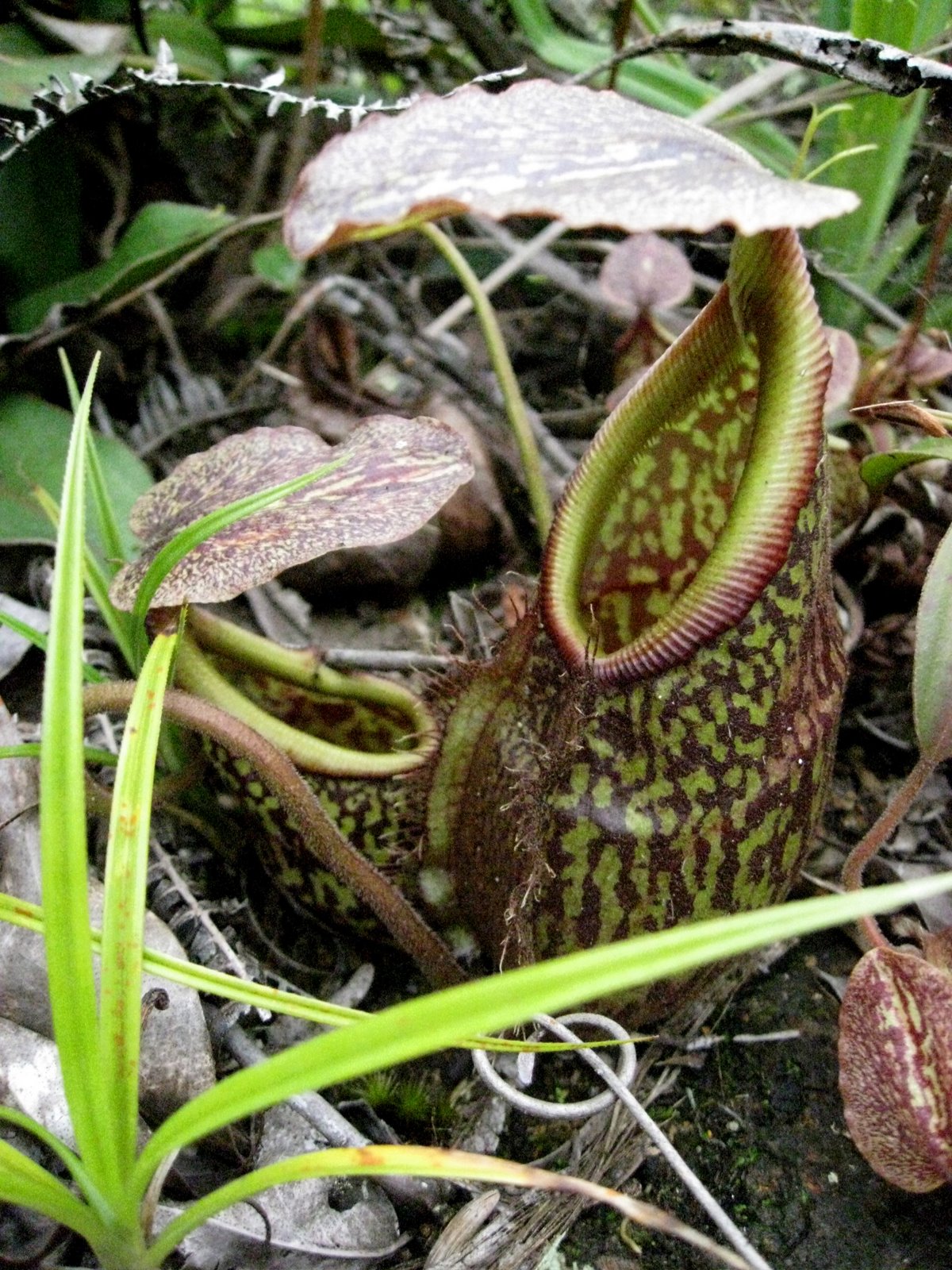
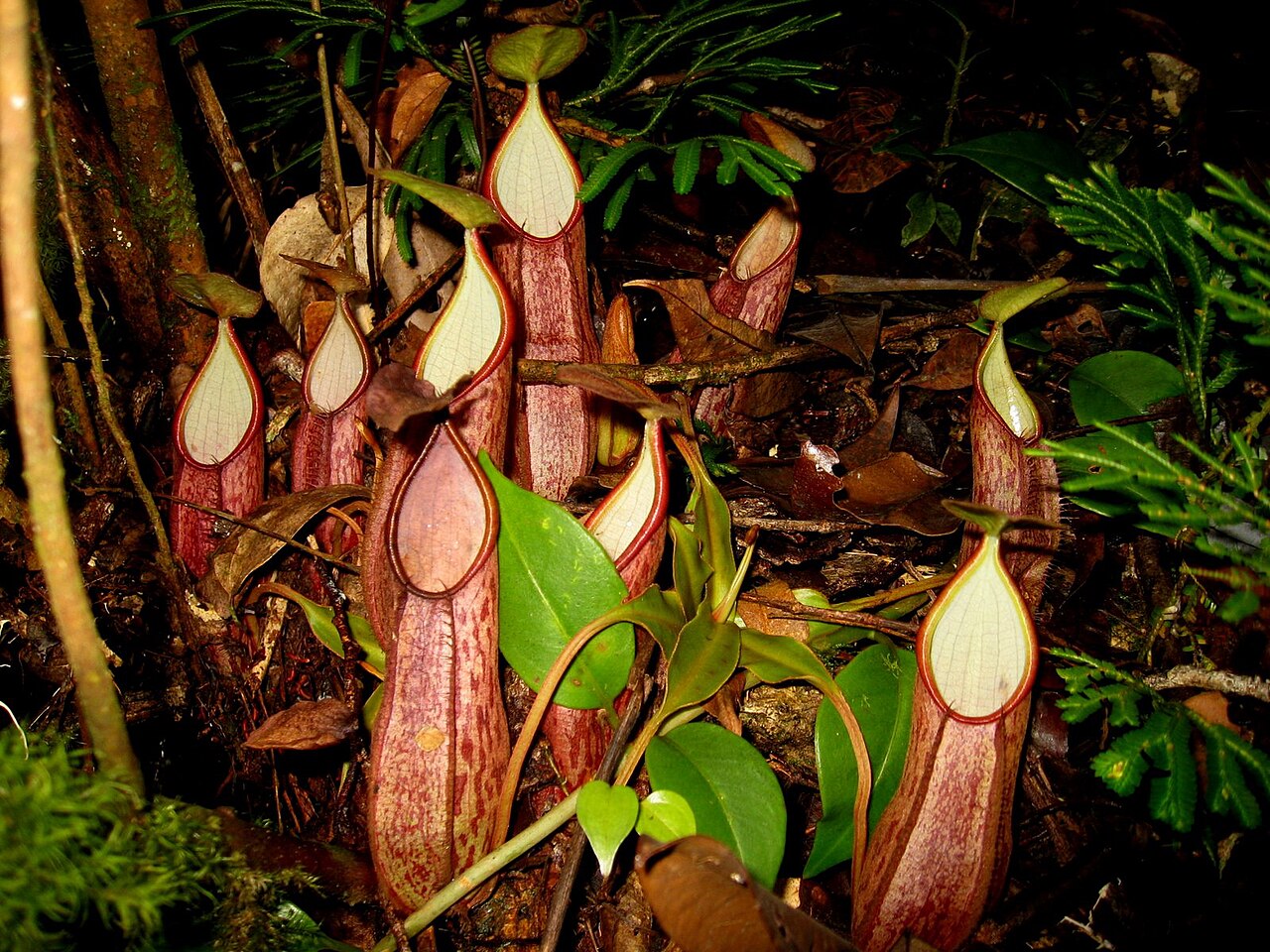
A climber that can reach several metres into the vegetation at forest edges, with round, rarely slightly angular stems 4 to 7 mm thick. Rosette leaves are small, 3 to 5 cm long; leaves of the climbing stem are narrowly elliptic, usually 23 to 26 cm long (10 to 30 cm), with a petiole of 4 to 5 cm and three or four longitudinal veins on each side. In Sumatran plants the leaf margin is often densely and shortly hairy. Lower pitchers are ellipsoid, 6 to 11.5 cm tall and to 4.5 cm wide, with two broad fringed wings of 5 to 7 mm, a flattened, ribbed peristome of 6 to 7 (to 9) mm with distinct teeth, an ovate lid of 3 to 4 cm and a filiform spur. Upper pitchers are narrower and almost cylindrical, 6 to 10 cm tall (rarely to 19 cm) and 1.7 to 2.8 cm wide, with wings reduced to ridges and a narrow, rounded peristome of 1.5 to 2 mm. Colour is reddish green to purple, often densely spotted dark.
Similar species
The closest relative is Nepenthes pectinata, used by Cheek & Jebb (2001) for the Sumatran plants: it has leaves that narrow more gradually to the base and run down the stem, a densely hairy leaf margin and an altogether more felted plant. N. xiphioides, described in 1995 from North Sumatra, is smaller in every way: rosette pitchers 4 to 5.5 cm against 8 to 12 cm, two or three leaf veins against three to six, glabrous leaf margins, much longer peristome teeth and no aerial pitchers. N. mikei and N. tobaica have a much narrower, thread-like peristome without distinct ribs.
The trap and how it works
A small pitfall trap with a well-developed peristome. The lower pitchers with their broad fringed wings stand in moss and mainly catch walking arthropods such as ants; the upper pitchers also take flying insects. The ribs of the peristome, with their teeth along the inner edge, turn slippery when wet, and nectar glands on the peristome and under the lid draw prey to that rim. The pitcher holds a digestive fluid. The small size of the pitchers is made up for by their number: a plant carries many at once.
Habitat and ecology
Mountain forest and cloud forest (B1) over a remarkably broad altitudinal zone, from about 600 to 2800 m according to Clarke (2001); the Javan plants in the narrow sense grow in forest between 1000 and 2750 m. The species climbs through forest edges and along openings, and grows in the moss layer of ridges. It tolerates some disturbance and is often found along trails and at the edges of opened-up forest.
Distribution and elevation
According to the world checklist on Java and Sumatra. In the broad sense of Clarke (2001) it is one of the most widespread mountain species of both islands. In the narrower sense of Cheek & Jebb (2001) the species is confined to West and Central Java, with one doubtful record from Borneo, and the Sumatran plants are called N. pectinata. This guide follows the world checklist, which accepts both names and places N. gymnamphora on both Java and Sumatra. An undescribed taxon on Gunung Sorik Marapi in Sumatra is mentioned in connection with this group.
- Recorded (quarter-degree cells)
Forms and variation
No formal varieties are recognised in the wild, but variation is great and partly geographic, which is precisely what makes the species limits so difficult. Many natural hybrids are reported from Sumatra: with N. bongso, N. mikei (informally named N. × pangulubauensis), N. ovata, N. reinwardtiana, N. rhombicaulis, N. singalana, N. spathulata, N. spectabilis and N. talangensis. That makes it one of the most freely hybridising species of the Sumatran highlands.
Where and when to see it
On Java the species can be seen on the accessible volcanoes of the west of the island; on Sumatra it occurs on many mountains along the Barisan chain. Look at the forest edge along the trail for small, spotted pitchers with two broad fringes; the lower pitchers often sit in moss at the foot of the plant. Anyone who wants to follow the debate on species limits should note the leaf margin (hairy or not), the number of leaf veins and the length of the peristome teeth, and photograph both lower and upper pitchers.
Conservation status
Assessed on the Red List as Least Concern: the species occurs over a large area and a broad altitudinal zone, and persists along forest edges and trails. As a member of the genus it is listed in CITES Appendix II. Because the species limits are still disputed, the assessment applies to the broad concept; if it were split, the separate parts would need reassessing. Threats are local: clearance of lower mountain slopes and fire.
Scientific name
Nepenthes gymnamphora | Reinwardt ex Nees, 1824
Nepenthes gymnamphora was described in 1824 by Caspar Georg Carl Reinwardt (published by Christian Gottfried Nees von Esenbeck). The precise type locality could not be established with certainty; the species occurs on the Indonesian islands of Java and Sumatra, at 600-2,800 m elevation. The specific epithet derives from the Greek words "gymnos" ("naked") and "amphoreus" ("pitcher"), "naked pitcher".
World Checklist of Vascular Plants (WCVP), via Plants of the World Online (POWO), Royal Botanic Gardens, Kew.