All species › Caryophyllales › Tropical pitcher plant family › Nepenthes hamiguitanensis
Nepenthes hamiguitanensis
A pitcher plant of the ridge of Mount Hamiguitan, an ultramafic mountain in the far south-east of Mindanao known for its bonsai forest and its wealth of endemic species. The first herbarium record dates from March 2007, by Victor Amoroso and R. Aspiras of Central Mindanao University. After fieldwork in 2008 and 2010 the species was described in July 2010 by Thomas Gronemeyer, Andreas Wistuba, Volker Heinrich, Stewart McPherson, François Mey and Victor Amoroso. At first it had been thought to be a natural hybrid between two other species of the mountain; the authors reached a different conclusion.
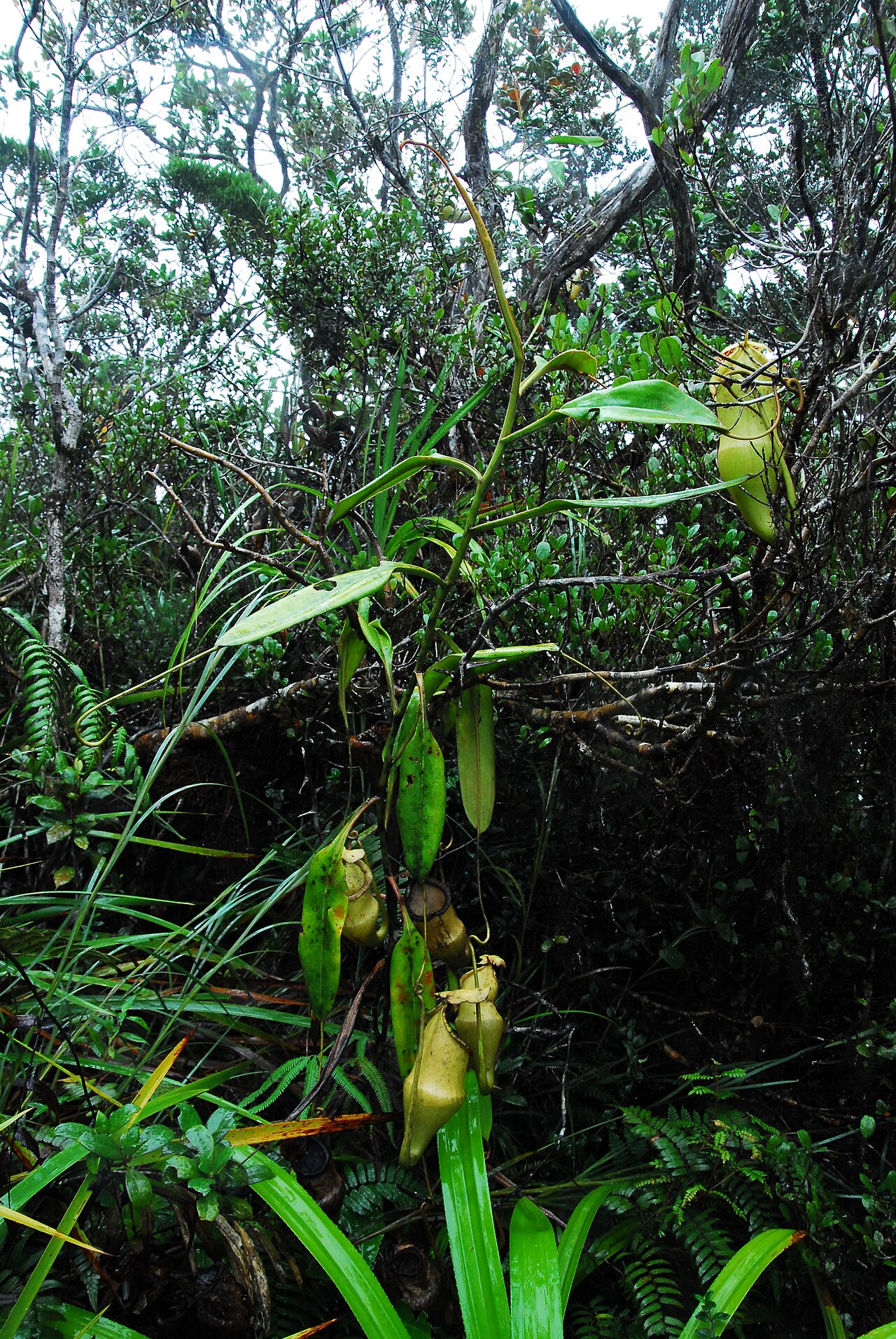
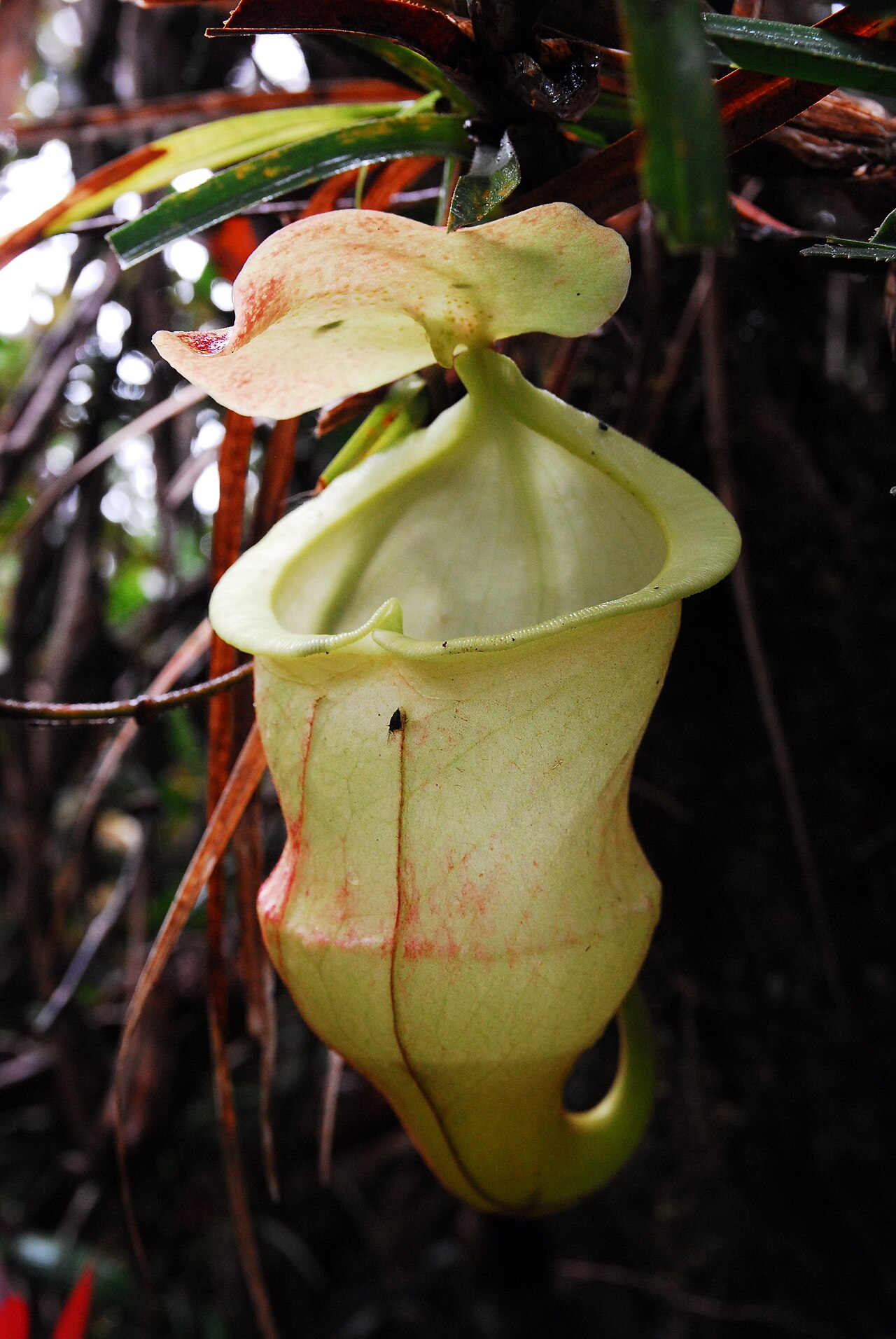
Identification
A climber up to four metres with terete stems nearly a centimetre thick. Leaves of the climbing stem are stalked, with an elliptic to oblong blade 20 to 25 cm long and 6 to 9 cm wide, an obtuse tip and three longitudinal nerves on each side of the midrib. Coarse, short, light brown to white hairs stand mainly along the leaf margins, and the blade is hairy on the upper surface too. Upper pitchers are stout: up to 20 cm tall and 9 cm wide, funnel-shaped below with a distinct hip and narrowing cylindrically towards the mouth, which is oblique and 6 to 8 cm wide. The peristome is about a centimetre wide, with very fine ribs. The lid is heart-shaped, about five centimetres wide, evenly set with glands. Pitchers are usually entirely creamy white, sometimes speckled red on a yellowish ground; the peristome is creamy white, red-striped or dark red.
Similar species
Three related species grow on the same mountain. Nepenthes micramphora is smaller in every respect, with pitchers of a few centimetres, and is nearly hairless except for the inflorescence. Nepenthes peltata has very different, large, bulbous lower pitchers, a tendril inserted peltately beneath the leaf tip, and forms no climbing stems or upper pitchers. Nepenthes mindanaoensis has more elongated upper pitchers and an acute rather than obtuse leaf tip. Cheek and Jebb cite the stout upper pitchers, with a length-to-breadth ratio of 2 to 2.5 to 1, and the hairy upper leaf surface as characters within the Nepenthes alata group.
The trap and how it works
A pitfall trap of the Nepenthes alata group, with stout, creamy white upper pitchers and a broad mouth. The finely ribbed peristome becomes slippery once wet, and the glands under the lid, evenly spread over the whole underside, lure insects to the rim. The hip-like swelling low on the pitcher, above which the wall narrows towards the mouth, hinders escape. Lower pitchers have been seen only on seedlings, so mature plants bear almost exclusively upper pitchers. The creamy white colour may stand out in the dim forest, but no prey study of this species has been published.
Habitat and ecology
Primary, intact montane forest and forest margins on the summit ridge of the mountain, between 1200 and 1600 m, especially above 1400 m (B1). The species prefers partial shade and heavy rainfall. Although the mountain is ultramafic, it does not necessarily grow on ultramafic soil, as the humus-rich litter layer in the forest forms a growing medium of its own. The open bonsai forest on the mountain's plateau is precisely not its habitat. Population density has been estimated at two to three plants per 50 square metres.
Distribution and elevation
Endemic to Mount Hamiguitan in the province of Davao Oriental, in the far south-east of Mindanao, Philippines, and confined there to the summit ridge. Our own species list gives 'Mount Hamiguitan, Mindanao', which matches the literature. The mountain is part of the Mount Hamiguitan Range Wildlife Sanctuary, inscribed as a UNESCO World Heritage Site in 2014. The species is far more localised than Nepenthes micramphora and Nepenthes peltata, which have a wider altitudinal range on the same mountain.
- Recorded (one-degree cells)
Forms and variation
No varieties or forms have been described. Opinions differ on the status of the species: the taxonomist Jan Schlauer treats it as the hybrid Nepenthes micramphora × Nepenthes peltata, whereas the authors consider a recent cross unlikely and speak of a species of possible hybridogenic origin. One argument for this is that no intermediate plants with lower pitchers were found in the field. No confirmed natural hybrids are known, although some plants on the mountain may be crosses; differing flowering times appear to limit crossing.
Where and when to see it
Mount Hamiguitan is a protected area with restricted access: visits are possible only with a permit and accompanied by accredited local guides. The trek to the summit ridge is long and wet. Search in the closed montane forest and along forest edges, not on the open bonsai plateau, and look for creamy white, stout pitchers in partial shade. On the same trek Nepenthes micramphora and Nepenthes peltata can often be seen too, which shows the differences between the species well. Follow the park rules strictly and take nothing away.
Conservation status
The species has not yet been assessed by the IUCN and therefore appears as 'Not Evaluated' (NE) in this guide. The authors themselves proposed an assessment as Vulnerable, because the species is known from a single ridge. That the mountain has been a World Heritage Site since 2014 and access is strictly regulated offers good protection. As a member of Nepenthes it is listed in CITES Appendix II, so international trade in wild plants requires a permit. Climate change is a long-term risk for a species found only in the summit zone of one mountain.
Scientific name
Nepenthes hamiguitanensis | Gronemeyer, Wistuba, Heinrich, McPherson, Mey & Amoroso, 2010
Nepenthes hamiguitanensis was described in July 2010 by Thomas Gronemeyer, Andreas Wistuba, Volker Heinrich, Stewart McPherson, François Sockhom Mey and Victor B. Amoroso, in volume 2 of McPherson's book Carnivorous Plants and their Habitats. The holotype (V. Amoroso & R. Aspiras CMUH00006494) was collected on 13 March 2007 at the forest margin along the trail to San Isidro on the summit ridge of Mount Hamiguitan, at 1,310 m elevation, and is held at the herbarium of Central Mindanao University, Musuan, Bukidnon, Mindanao, Philippines. The summit ridge of Mount Hamiguitan, along the trail to San Isidro, Mindanao, Philippines, at 1,310 m elevation. The specific epithet is derived from the name of Mount Hamiguitan, to which it is endemic, and the Latin ending "-ensis", meaning "from".
World Checklist of Vascular Plants (WCVP), via Plants of the World Online (POWO), Royal Botanic Gardens, Kew.