All species › Caryophyllales › Tropical pitcher plant family › Nepenthes peltata
Nepenthes peltata
A large pitcher plant of the slopes of Mount Hamiguitan in south-eastern Mindanao, with a peculiarity it shares with Nepenthes rajah of Borneo: the tendril is not attached at the tip of the leaf but some way below it on the blade, peltately. The species is named for this: peltata, 'shield-shaped'. It was described in January 2008 by the Japanese pitcher plant specialist Shigeo Kurata in the journal of the Japanese society for insectivorous plants. The type was based on a plant from Hamiguitan grown in a Japanese botanic garden.

Identification
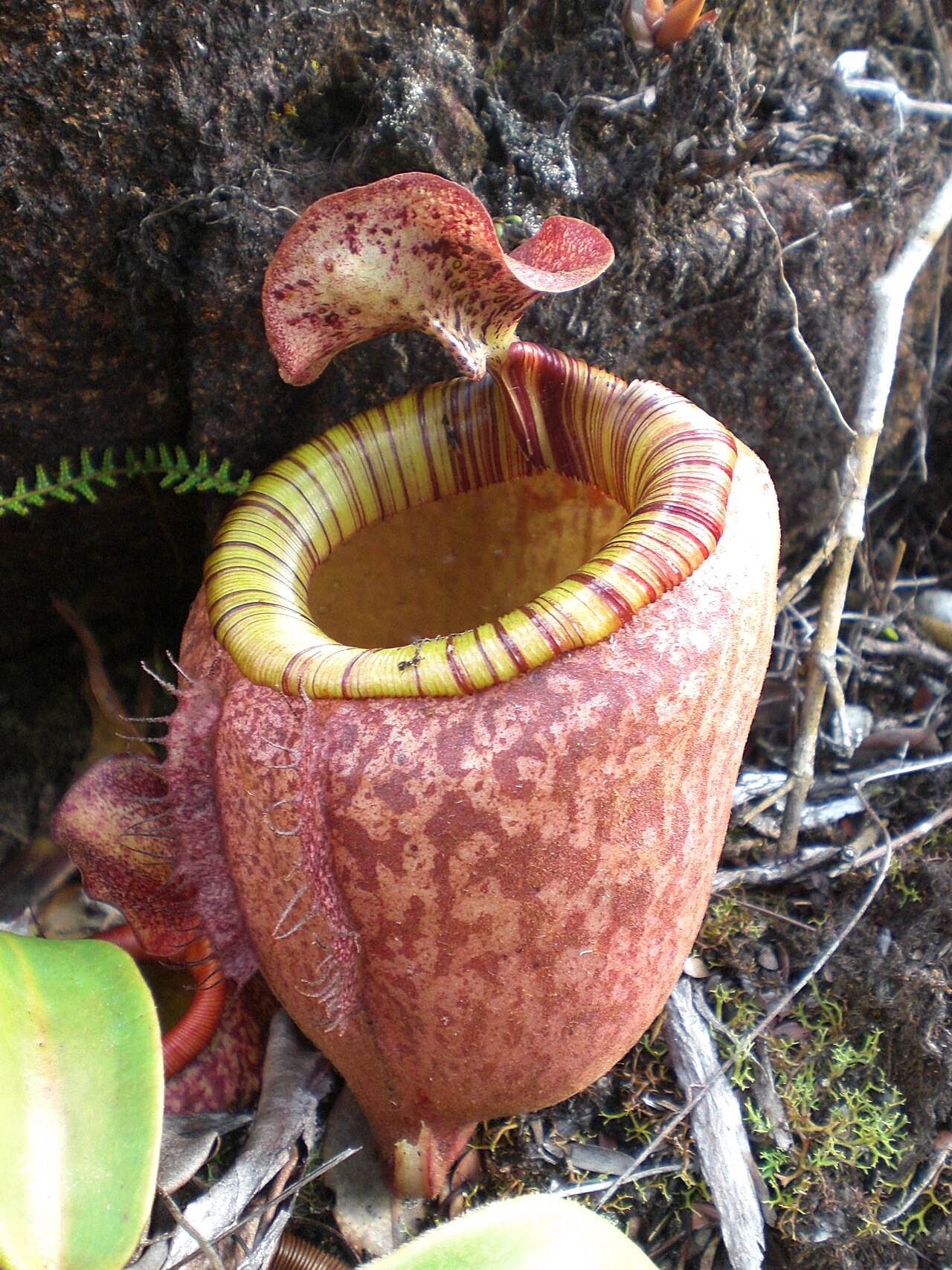
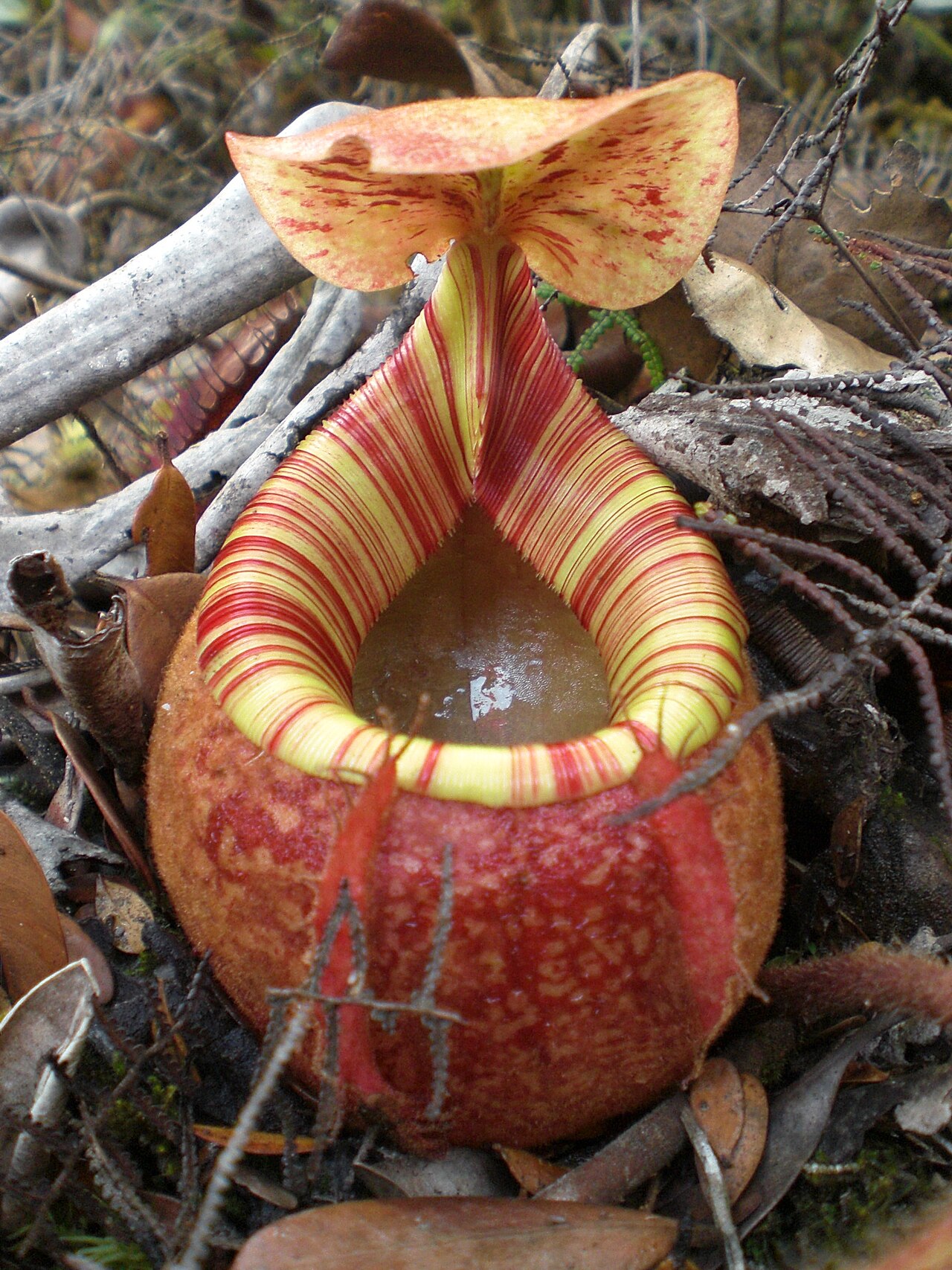
A plant with a short, rigid stem up to a metre, which sometimes reclines and then reaches three metres long. The leaves are oblong and large, up to 50 cm long, with a striking colour contrast: the upper surface dark green, the lower surface usually, but not always, dark red. The tendril is peltately inserted, a little below the leaf tip on the underside of the blade. Stem and leaf underside bear coarse, long, brown hairs. Lower pitchers are large, up to 28 cm tall and 16 cm wide, and variable in colour: yellow, orange, pink, red or purple, blotched dark purple or black. The peristome is loosely cylindrical and up to two centimetres wide; the lid is elliptic or ovate, up to 8 cm long and 6 cm wide. Upper pitchers have never been observed. The inflorescence is a raceme up to 75 cm.
Similar species
Its closest relatives are not on Mindanao but on Palawan: Nepenthes attenboroughii, Nepenthes deaniana, Nepenthes mantalingajanensis and Nepenthes mira, all large species with bulbous ground pitchers. Nepenthes peltata is distinguished by its unusual leaf colouring, the conspicuous hairiness of stem and leaf, and the peltate tendril insertion. On Hamiguitan itself Nepenthes hamiguitanensis is a climber with creamy white upper pitchers, and Nepenthes micramphora has pitchers of only a few centimetres; confusion is thus hardly possible. Plants formerly identified as Nepenthes mindanaoensis are partly Nepenthes justinae.
The trap and how it works
A large ground trap. Because the plant almost never climbs, it forms only lower pitchers, which are large and bulbous and stand on the ground or in low vegetation. The broad, loosely cylindrical peristome offers a large slippery surface on which insects lose their footing, and the large lid bears nectar glands. Upper pitchers have never been seen; they may form only in deep shade or when the plant finds support to climb, or be absent altogether. Pitchers nearly 30 cm tall could in principle also hold larger prey, but no published prey study of this species was found.
Habitat and ecology
Upper montane mossy forest, secondary vegetation, ridge tops, cliffs and landslides, exclusively on ultramafic rock, from 865 m to the summit at 1635 m (R3, B1, B5). The plant tolerates shade but clearly prefers direct sunlight, and so often grows in open places: ridges, rocky slopes and sites where a landslide has removed the vegetation. The mountain's ultramafic rock yields a nutrient-poor soil rich in heavy metals, which keeps the vegetation low and open.
Distribution and elevation
Endemic to Mount Hamiguitan in the province of Davao Oriental, in the far south-east of Mindanao, Philippines, where it occurs on the upper slopes. Our own species list gives 'Mindanao', which is correct, but the actual range is limited to this one mountain. The mountain is part of the Mount Hamiguitan Range Wildlife Sanctuary, inscribed as a UNESCO World Heritage Site in 2014. Nepenthes hamiguitanensis, Nepenthes micramphora and Nepenthes justinae also grow on the same mountain.
- Recorded (one-degree cells)
Forms and variation
No varieties or forms have been described. Pitcher colour is highly variable, from yellow and orange to pink, red and purple, with dark blotches, and the leaf underside is not always red either. Despite growing alongside three other species, no natural hybrids have been established with certainty, although some plants on the mountain may be undetermined crosses. Plants once thought to be a hybrid with Nepenthes micramphora are now regarded as Nepenthes hamiguitanensis, although not every taxonomist follows that view.
Where and when to see it
Mount Hamiguitan is protected and accessible only with a permit and accredited local guides. The large, colourful ground pitchers of this species are easy to see on open ridges and rocky slopes above about 900 m, often in full sun. Look for the red leaf underside and the tendril emerging from the blade below the leaf tip: that is the quickest recognition point. Stay on the trails; the open, rocky places where the species grows are sensitive to trampling.
Conservation status
The species has not yet been assessed by the IUCN and therefore appears as 'Not Evaluated' (NE) in this guide. In 2009 Stewart McPherson regarded it as not threatened, because of its extensive populations on the mountain and the access restrictions. The mountain's inscription as a World Heritage Site in 2014 has strengthened its protection further. As a member of Nepenthes it is listed in CITES Appendix II, so international trade in wild plants requires a permit. Because its whole range comprises one mountain, collecting, fire and climate change remain potential risks.
Scientific name
Nepenthes peltata | Kurata, 2008
Nepenthes peltata was described in January 2008 by Shigeo Kurata, in the Journal of Insectivorous Plant Society 59(1): 12-17. The holotype (Koshikawa 44) originated from the Mount Hamiguitan Range, Mindanao, Philippines, and was subsequently cultivated at Nanso Botanic Gardens; the preserved specimen is held at Kyoto University's herbarium. The Mount Hamiguitan Range, Mindanao, Philippines — the same mountain as several earlier species in this series, including N. hamiguitanensis (golf 23), N. justinae (golf 24) and N. micramphora (golf 27). The specific epithet derives from the Latin "peltata", referring to the characteristic peltate (shield-shaped) tendril insertion, attached away from the apex rather than at the tip.
World Checklist of Vascular Plants (WCVP), via Plants of the World Online (POWO), Royal Botanic Gardens, Kew.