All species › Caryophyllales › Tropical pitcher plant family › Nepenthes micramphora
Nepenthes micramphora
One of the smallest pitcher plants in the world, from Mount Hamiguitan in the far south-east of Mindanao. The name says it all: micramphora comes from the Greek mikros, small, and the Latin amphora, jar. The type material was collected in January 2005 by Victor Amoroso and R. Aspiras of Central Mindanao University; in 2009 Volker Heinrich, Stewart McPherson, Thomas Gronemeyer and Victor Amoroso described the species in McPherson's Pitcher Plants of the Old World. Before that the plants on the mountain were taken for Nepenthes bellii.


Identification
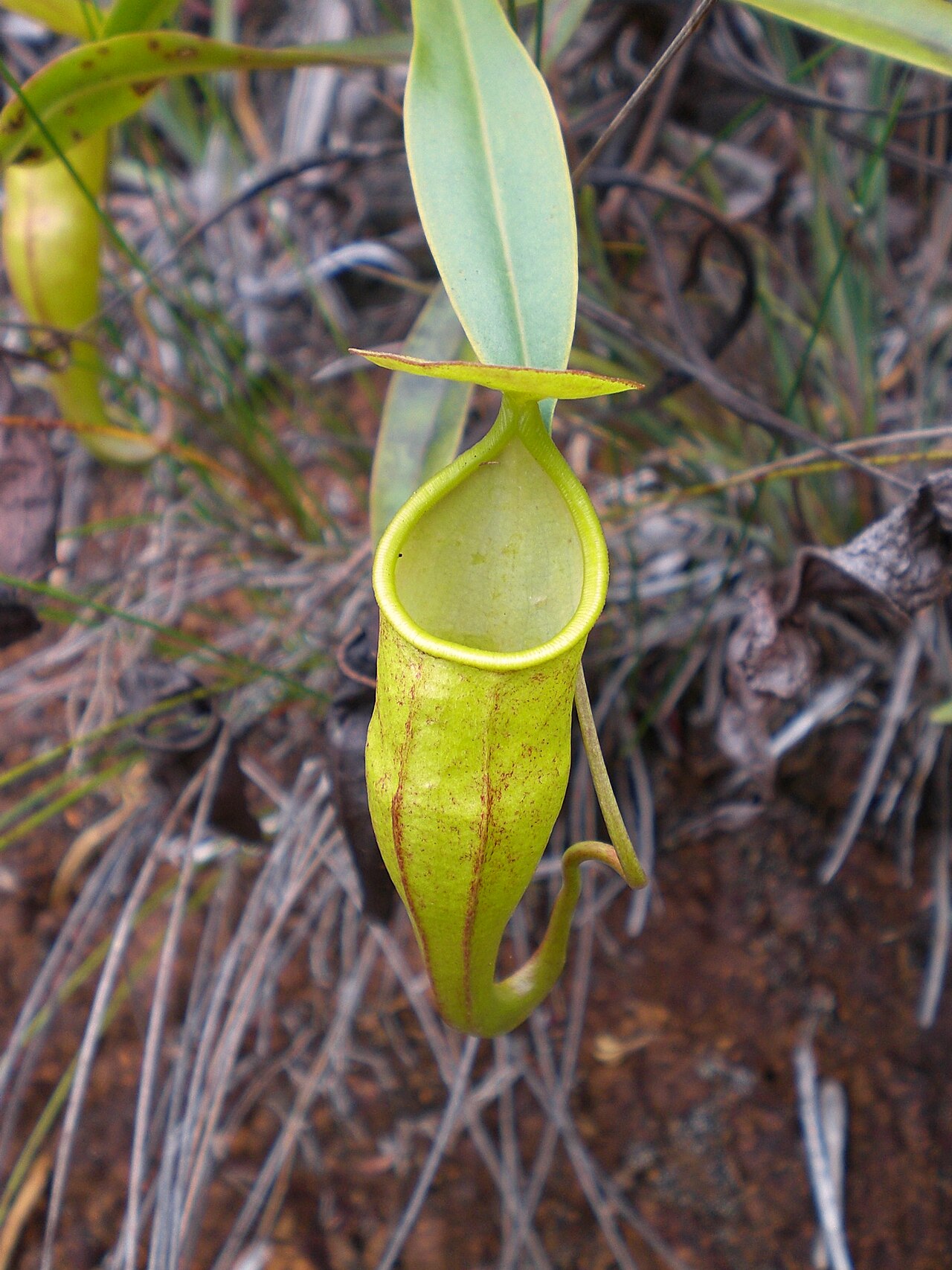
A small climber up to two metres, with terete stems and strikingly small leaves: sessile, leathery and hairless, lanceolate-elliptic, only 4 to 8 cm long and 7 to 10 mm wide. Lower pitchers are almost cylindrical and funnel-shaped towards the tendril, only 2.5 to 4 cm tall and 1.2 to 1.6 cm wide, with fringed wings, a very narrow terete peristome of less than a millimetre and a kidney-shaped lid slightly wider than the mouth. A rosette can carry up to seven live pitchers at once. Upper pitchers are funnel-shaped, with a waist below the peristome, 3.7 to 6.7 cm tall and usually about 4 cm. The pitchers are yellowish green and densely speckled red, with a yellow, sometimes red-flushed peristome. The female inflorescence is 25 to 35 cm long, rusty-felted, with twenty to forty one-flowered pedicels.
Similar species
Until 2009 the species was taken for Nepenthes bellii from north-eastern Mindanao and Dinagat. That species is larger in every respect, with lower pitchers up to 9 cm, a peristome of 5 to 8 mm and much longer tendrils. On Mount Hamiguitan itself confusion with the other pitcher plants is unlikely: Nepenthes hamiguitanensis has creamy white upper pitchers up to 20 cm, Nepenthes peltata large, bulbous ground pitchers up to 28 cm, and Nepenthes justinae also much larger pitchers. The tiny, red-speckled pitchers and the small, narrow leaves make Nepenthes micramphora unmistakable on the mountain.
The trap and how it works
A miniature trap. Lower pitchers are barely larger than a finger joint, with a peristome less than a millimetre wide, and stand in rosettes carrying up to seven pitchers at once: the plant invests in number rather than size. The fringed wings guide ants and other small crawling animals to the mouth. Upper pitchers have a waist below the peristome that hinders climbing back out. With such small pitchers the prey presumably consists mainly of ants and other small arthropods, but no targeted prey study has been published.
Habitat and ecology
Exposed places on ultramafic substrate, from 1100 m to the summit at 1635 m: upper montane mossy forest, secondary vegetation, ridge tops, cliffs and landslides (R3, B1). The species is confined to ultramafic soils and grows terrestrially, in places where the vegetation is low and open and light reaches the ground. The climate on the mountain is cool and wet, with much rain and fog.
Distribution and elevation
Endemic to Mount Hamiguitan in the province of Davao Oriental, in the far south-east of Mindanao, Philippines. Our own species list gives 'Mindanao', which is correct, but the actual range is limited to this one mountain. The mountain is part of the Mount Hamiguitan Range Wildlife Sanctuary, a UNESCO World Heritage Site since 2014. Older records of Nepenthes bellii from this mountain concern this species.
- Recorded (one-degree cells)
Forms and variation
No varieties or forms have been described, and no confirmed natural hybrids are known, although some plants on the mountain may be crosses with related species. The taxonomist Jan Schlauer regards Nepenthes hamiguitanensis as the hybrid Nepenthes micramphora × Nepenthes peltata; the authors of that species disagree. Pitcher colour is fairly constant, yellowish green with dense red speckles; the peristome is yellow and sometimes flushed red.
Where and when to see it
Mount Hamiguitan is protected and can be visited only with a permit and accredited local guides. According to McPherson the species is plentiful there in open places above about 1100 m, but you must look carefully: the pitchers are barely bigger than a thumb and blend into moss and scrub. Search ridges, rocky slopes and landslides for rosettes of narrow leaves ringed by small, red-speckled jars. Stay on the trails and take nothing away.
Conservation status
The species has not yet been assessed by the IUCN and therefore appears as 'Not Evaluated' (NE) in this guide. In 2009 Stewart McPherson regarded it as not threatened, because of its extensive populations on the mountain and the access restrictions. Inscription as a World Heritage Site in 2014 has strengthened its protection further. As a member of Nepenthes it is listed in CITES Appendix II, so international trade in wild plants requires a permit. Because its whole range comprises one mountain, disturbance of the open summit vegetation, fire and climate change remain risks.
Scientific name
Nepenthes micramphora | Heinrich, McPherson, Gronemeyer & Amoroso, 2009
Nepenthes micramphora was described in 2009 by Volker Heinrich, Stewart McPherson, Thomas Gronemeyer and Victor Amoroso, in volume 2 of McPherson's Pitcher Plants of the Old World (pp. 1314-1319). The holotype was collected on 31 January 2005 on Mount Hamiguitan, on the trail from San Isidro, at 1,300-1,600 m elevation, and is held at the herbarium of Central Mindanao University, Musuan, Bukidnon, Philippines. Mount Hamiguitan, on the trail from San Isidro, Mindanao, Philippines, at 1,300-1,600 m elevation — the same mountain as previously covered N. hamiguitanensis (golf 23) and N. justinae (golf 24). The specific epithet derives from the Greek "mikros" ("small") and the Latin "amphora" ("amphora, urn"), referencing the tiny pitchers of this species.
World Checklist of Vascular Plants (WCVP), via Plants of the World Online (POWO), Royal Botanic Gardens, Kew.