All species › Caryophyllales › Tropical pitcher plant family › Nepenthes justinae
Nepenthes justinae
Mount Hamiguitan in the far south-east of Mindanao is one of the richest pitcher-plant mountains in the Philippines: five species of the genus grow on this one massif, and some of them occur nowhere else. Nepenthes justinae is one of them. It was published in 2016 by a German-Filipino team, together with Nepenthes aenigma from northern Luzon, and is named for Justina Yu, mayor of San Isidro, who worked for the protection of the mountain.


Identification
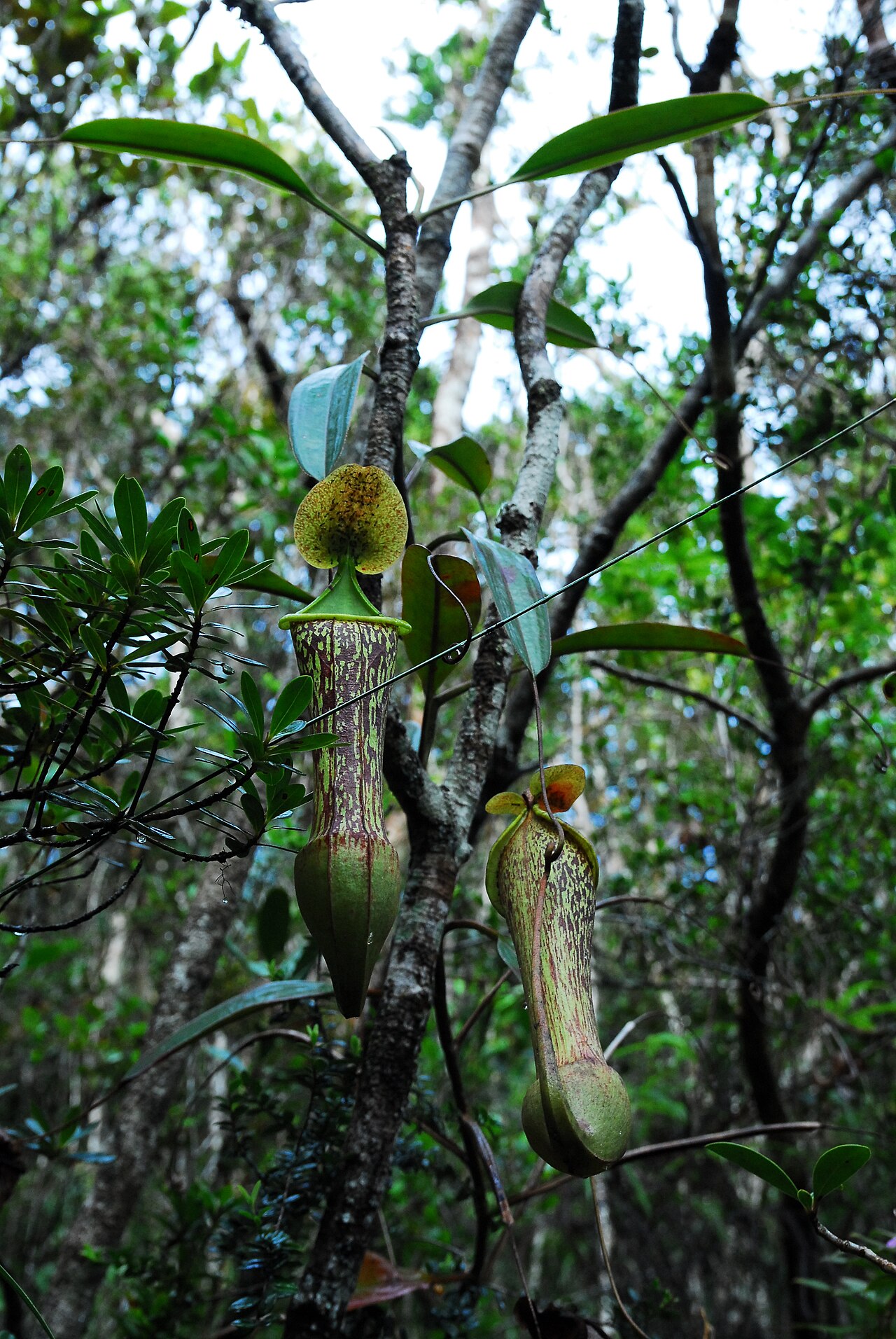
A climber with a round stem to four metres long and five to eight millimetres thick. Leaves on the climbing stem are elliptic to ovate, to about 18 cm long and 11 cm wide, with three longitudinal nerves on each side of the midrib and oblique side veins between them; the base narrows into a sessile, narrowly winged petiole of some six centimetres. Lower pitchers are small, around 9 cm tall: the lower two-thirds is bulbous, the upper third slightly funnel-shaped, with two fringed wings down the front. They are creamy yellow with narrow purple blotches, greenish white inside, and the peristome is dark red with irregular yellow stripes. Upper pitchers are much longer, 17 cm in the description but up to 25 cm on the mountain, with a distinct rim or 'hip' separating the lower third from the rest; above it the pitcher narrows and widens again towards the oblique mouth. The lid of the upper pitchers carries a rounded appendage of about three millimetres on the keel beneath.
Similar species
The authors compared the species chiefly with Nepenthes mindanaoensis, which has slender, wholly cylindrical pitchers and no appendage under the lid. It differs from Nepenthes talaandig of Bukidnon in the uncrenellated peristome of the lower pitchers, the distinct rim in the upper pitchers and an unbranched spur. On Hamiguitan itself the other species are easier to tell apart: Nepenthes peltata has a petiole inserted beneath the middle of the blade and a hairy, squat pitcher; Nepenthes micramphora makes tiny pitchers; Nepenthes hamiguitanensis has large, swollen pitchers with a broad peristome. The species belongs to the group around Nepenthes alata, with winged petioles and a ridge beneath the lid.
The trap and how it works
A pitfall trap that, as in most pitcher plants, comes in two versions. Lower pitchers stand in the litter and on rocky ground; their fringed wings form a route to the mouth for ants and other walking animals. Upper pitchers hang on coiled tendrils up to 21 cm long in the vegetation and target flying and climbing insects. The peristome works as a slide: its fine ribs are covered by a water film from condensation and rain, and an insect walking on it slips into the pitcher. The underside of the lid is set with large nectar glands, especially towards the tip, drawing prey to the rim. The upper part of the inner wall is smooth and waxy, the lower part carries the glands that secrete digestive fluid. Nothing has yet been published on the prey of this species in particular.
Habitat and ecology
The montane forest on the summit of Hamiguitan, between about 1200 and 1620 m, is the main habitat (B1). The species has also been found in the mountain's famous pygmy forest at around 1000 m: a vegetation of ancient trees knee- to head-high on ultramafic soil, poor in nutrients and rich in heavy metals (R3). The plant grows both on the ground and epiphytically high in trees; the latter makes it hard to say how large the population is. In the pygmy forest it grows with Nepenthes peltata and Nepenthes micramphora, higher up with Nepenthes hamiguitanensis.
Distribution and elevation
Endemic to Mount Hamiguitan in Davao Oriental province, south-eastern Mindanao, and as far as is known nowhere else. The coarse label 'Mindanao' in our species list can therefore be narrowed to this one mountain. The altitudinal limits given in the description run from about 1000 m in the pygmy forest to the summit at 1620 m. No records outside Hamiguitan have been published, but the mountains of eastern Mindanao are still poorly explored botanically: Nepenthes candalaga, which resembles this species, was found on another mountain in eastern Mindanao only in 2022.
- Recorded (one-degree cells)
Forms and variation
No varieties have been described. Colour varies, as in most montane pitcher plants, with the amount of light: plants in full sun are more strongly marked with red and purple than plants in the shade of the forest. The authors mention plants of presumed hybrid origin in which this species is one parent, probably with Nepenthes peltata; confirmed natural hybrids do not yet exist. Anyone seeing a plant on Hamiguitan with characters of two species should keep that possibility in mind.
Where and when to see it
Mount Hamiguitan is a protected area and since 2014 a World Heritage Site; access is through the sanctuary's management, with a permit and a local guide, and the pygmy forest is strictly protected for good reason. Those who get there see the species most easily along the trails in the summit forest. Look both at the ground, where the small lower pitchers sit among the moss, and upwards: the long upper pitchers often hang high in the trees. The lid with its rounded appendage and the striped rim distinguish it from Nepenthes hamiguitanensis, which grows in the same forest.
Conservation status
The species has not yet been assessed by the IUCN (Not Evaluated). The authors proposed the category Vulnerable: it is confined to one mountain, but that mountain has been nationally protected since 2003 and a World Heritage Site since 2014, so mining and agriculture pose no threat for as long as protection is enforced. Numbers cannot be estimated, because many plants grow high in the trees. Like all Nepenthes the species is listed in CITES Appendix II.
Scientific name
Nepenthes justinae | Gronemeyer, Wistuba, Mey & Amoroso, 2016
Nepenthes justinae was described in 2016 by Thomas Gronemeyer, William Suarez, Hannes Nuytemans, Mark Calaramo, Andreas Wistuba, François Sockhom Mey and Victor B. Amoroso, in Plants 5(2), article 23. Mount Hamiguitan, Mindanao, Philippines, at 1,000-1,620 m elevation — the only known habitat of this endemic species, within the Mount Hamiguitan Range Wildlife Sanctuary. The specific epithet honours Justina Yu, mayor of San Isidro in Davao Oriental, Mindanao, whose efforts helped get the Mount Hamiguitan Range Wildlife Sanctuary inscribed as a UNESCO World Heritage Site in 2014.
World Checklist of Vascular Plants (WCVP), via Plants of the World Online (POWO), Royal Botanic Gardens, Kew.