All species › Caryophyllales › Tropical pitcher plant family › Nepenthes kitanglad
Nepenthes kitanglad
Mount Kitanglad, in the heart of Bukidnon province, is at almost 2900 m one of the highest mountains in the Philippines, an extinct volcano with extensive cloud forest. In July 1991 botanists of the Philippine Plant Inventory collected an epiphytic pitcher plant with strongly four-angled stems there, above Impasug-ong. Martin Cheek and Matthew Jebb recognised it in 2013 as a new species in their revision of the alata group, and named it after the mountain.
Identification
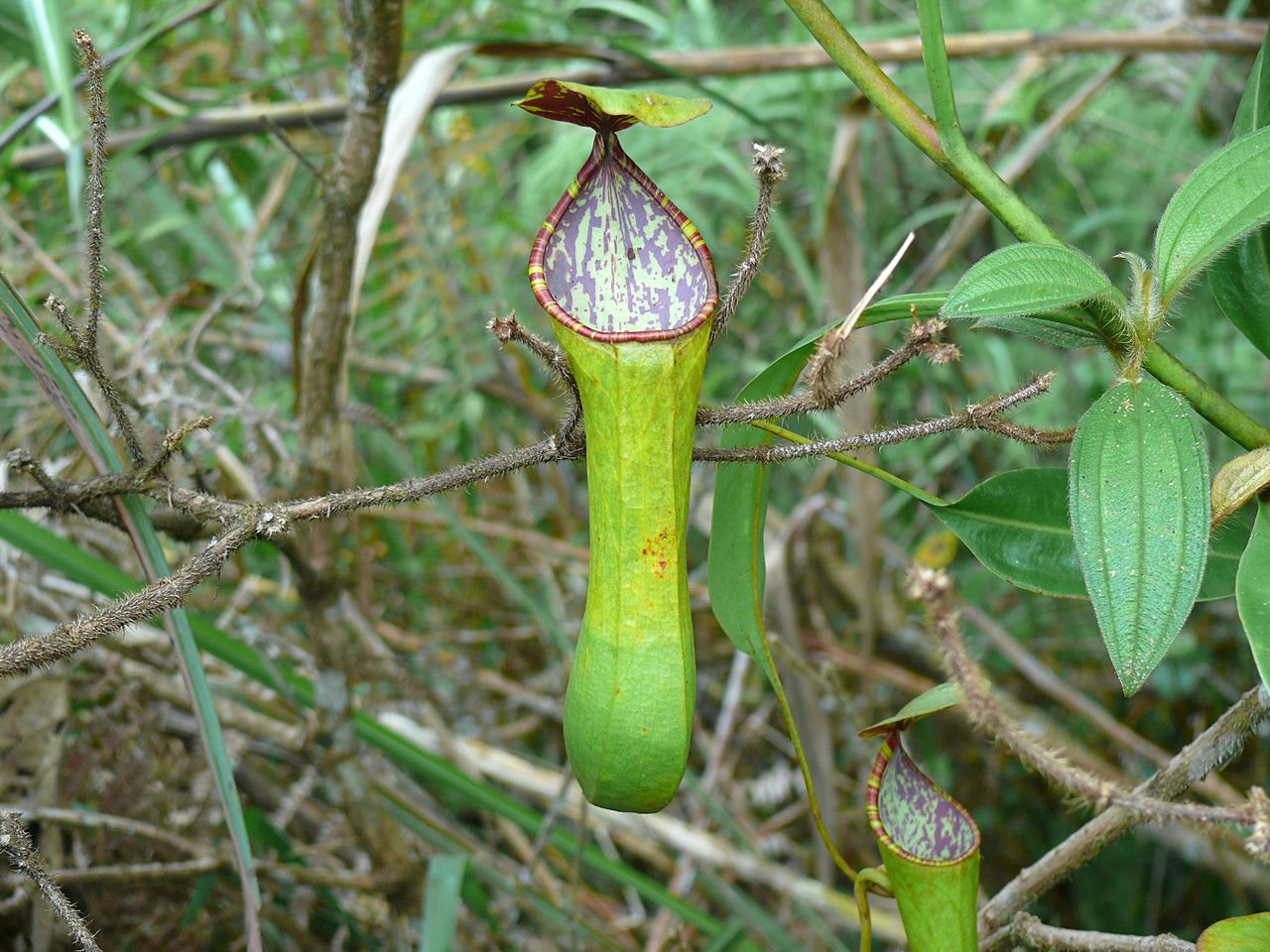
An epiphytic climber of a metre or more. The short stems are round and four to five millimetres thick, but the climbing stems are strikingly four-angled, seven to nine millimetres thick, with long internodes of eleven to twelve centimetres. The leaves are thickly papery, oblong-elliptic, 15.5 to 33 cm long and 4.3 to 7 cm wide, with three or four pairs of longitudinal nerves, on an evenly winged petiole of four to five centimetres. Lower and upper pitchers differ greatly. Lower pitchers are narrowly ovoid-cylindrical, about 12.5 cm tall and 5 cm wide, with a highly oblique, concave mouth and a peristome only a millimetre wide at the front and up to three millimetres at the sides; the lid is narrowly ovate to rhombic. Upper pitchers are much larger, about 21.5 cm tall and 6.5 cm wide, ovoid-cylindrical, green and slightly maroon above, with a mouth seven by four centimetres and a rounded-flattened peristome up to five and a half millimetres. The lid is ovate-triangular, five centimetres long, with a weakly developed convex appendage, and the spur is strikingly long, 17 mm.
Similar species
The authors compared the species with Nepenthes saranganiensis from southern Mindanao, a terrestrial shrub with winged stems and little difference between lower and upper pitchers. Nepenthes kitanglad has angled rather than winged stems, strongly dimorphic lower and upper pitchers, and is a climbing epiphyte of forest. From Nepenthes kurata and Nepenthes mindanaoensis, relatives in the same group, it differs among other things in the strongly four-angled climbing stem and the long internodes.
The trap and how it works
A pitfall in two very different forms. Lower pitchers are narrow, with a strongly oblique, concave mouth and a peristome almost absent at the front and widening only at the sides; upper pitchers are large, broad and ovoid with a wide mouth. Such a difference usually indicates that the two pitcher types serve different prey: below, crawling animals of the forest floor or the moss cover of trunks; above, flying insects. The long spur of seventeen millimetres behind the lid is notable for the group; its function has not been studied. Data on prey for this species are lacking.
Habitat and ecology
Epiphytic in mossy cloud forest on volcanic substrate, between 1800 and 2100 m (B1). At this altitude the forest on Kitanglad is densely draped in moss, ferns and orchids, and often wrapped in cloud for days. The plant grows on the trunks and branches of trees, where moss and humus form the substrate.
Distribution and elevation
Endemic to Mindanao, and known only from Mount Kitanglad in Bukidnon province, with the type collection from Intavas, Impasug-ong. The label in our species list is correct. No other sites have been published; the Kitanglad range is large, however, with several peaks, and the species may be more widespread there than is now known.
- Recorded (one-degree cells)
Forms and variation
No varieties have been described, and there is little material. The upper pitchers are green with a maroon flush towards the top, but how much the colour varies is unknown. No natural hybrids have been reported.
Where and when to see it
Mount Kitanglad is a protected natural park and one of the best-known mountains of Mindanao, not least for the Philippine eagle. Climbs are regulated and go through the park management and the mountain's indigenous communities. Above 1800 m, in the mossy cloud forest, look along trunks and in the branches for large green pitchers with a dark red flush and a long spur behind the lid.
Conservation status
The species has not yet been assessed by the IUCN (Not Evaluated). The authors rated it Critically Endangered, because it is known from one mountain where forest has been cleared on a large scale for timber and agricultural expansion. The higher cloud forest lies within Mount Kitanglad Range Natural Park, but the lower margins of the park are under pressure. Like all Nepenthes it is listed in CITES Appendix II.
Scientific name
Nepenthes kitanglad | Jebb & Cheek, 2013
Nepenthes kitanglad was described in 2013 by Martin Cheek and Matthew Jebb, in "Recircumscription of the Nepenthes alata group (Caryophyllales: Nepenthaceae), in the Philippines, with four new species" (European Journal of Taxonomy 69: 1-23). Mount Kitanglad, Bukidnon Province, Mindanao, Philippines — the only known locality, where the species grows epiphytically in mossy forest at 1,800-2,100 m elevation. The specific epithet refers to Mount Kitanglad, the only known locality of this species.
World Checklist of Vascular Plants (WCVP), via Plants of the World Online (POWO), Royal Botanic Gardens, Kew.