All species › Caryophyllales › Tropical pitcher plant family › Nepenthes jamban
Nepenthes jamban
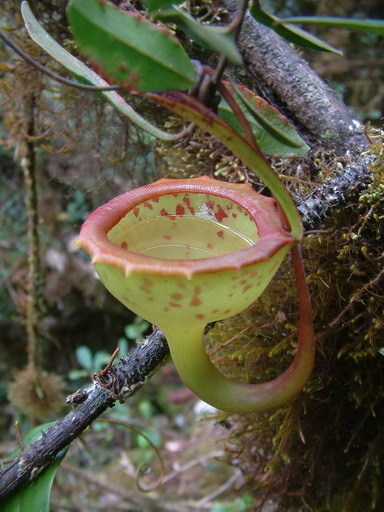
A small montane species of the Barisan range in North Sumatra, discovered in 2005 and described in 2006, with a name that raises a smile in every account: jamban is the Indonesian word for toilet, after the shape of the upper pitchers, a wide funnel on a narrow base. Behind the joke lies a botanically interesting plant, with viscous pitcher fluid and a narrow lid bearing twenty to thirty large, crater-like nectar glands, a character it shares with only one related species.
Identification
A climber with a thin stem under 5 mm thick and up to 4 m long, with short internodes to 5 cm; the stem is characteristically purplish red. The leaves are stalkless and leathery, narrowly obovate to elliptic or slightly spathulate, to 11 cm long and 3.3 cm wide; the tendril reaches 24 cm. Lower pitchers are cylindrical to narrowly funnel-shaped below and widely funnel-shaped above, rarely more than 5.8 cm tall, with narrow fringed wings, an almost horizontal mouth and a flattened peristome to 8 mm; they are yellowish orange to bright red. Upper pitchers are widely funnel-shaped in the upper half, to 12 cm tall and 5.2 cm wide, with a round, horizontal mouth and a peristome to 6 mm; they are bright yellow with a yellow to orange peristome. The lid is narrow, to 4.8 cm long and less than a centimetre wide, and held at an angle over the mouth.
Similar species
The species belongs to a group of Sumatran highland species with funnel-shaped, wholly glandular pitchers, stalkless leaves and viscous fluid: Nepenthes dubia, N. inermis, N. jacquelineae and N. tenuis. Its closest relative is N. jacquelineae, which shares the narrow lid and large nectar glands. N. jamban is, however, less robust, lacks the greatly expanded peristome of N. jacquelineae, has longer one-flowered pedicels and an even narrower lid, and grows only on the ground, whereas N. jacquelineae also lives as an epiphyte. N. dubia and N. inermis lack a real peristome or have a reflexed lid.
The trap and how it works
A trap between pitfall and flypaper. The fluid in the pitchers is thick and mucilaginous, as in related species, so an insect that falls in not only cannot climb out along the wall but also sticks to the fluid itself. The narrow lid carries twenty to thirty crater-like nectar glands up to half a millimetre wide on its underside, in the upper quarter, visible as bumps on the upper surface: a strong lure above the mouth. The upper pitchers catch strikingly many large prey, such as wasps and crickets, and relatively few small animals, and host large numbers of mosquito larvae.
Habitat and ecology
Upper montane mossy forest and summit scrub, between 1800 and 2100 m (B1). The plant grows only on the ground, among moss and the low shrubs of the ridge, and climbs through the vegetation with its thin stems. N. bongso, N. dubia, N. gymnamphora and N. lingulata grow at the same site; such a rich pitcher-plant community on a single summit is typical of the Barisan range. The climate is cool, wet and almost always misty.
Distribution and elevation
Endemic to Sumatra, Indonesia, and known only from the type locality in the Barisan range south of Padang Sidempuan, in the province of North Sumatra. The species was first collected there in April 2005. Altitude: 1800 to 2100 m. Our species list gives the Barisan range as its area, which is correct; it is worth knowing that the site lies in the northern part of the chain, in North Sumatra.
- Recorded (one-degree cells)
Forms and variation
No varieties or forms have been described. The difference between lower and upper pitchers is mainly one of colour and size: small yellowish-orange to red lower pitchers near the ground, larger bright yellow upper pitchers higher in the vegetation, sometimes with a speckled inner wall. A natural hybrid with N. lingulata has been reported, and in 2009 a putative cross with N. dubia was found at a site where both grow together with N. lingulata and N. rhombicaulis.
Where and when to see it
The site lies high in the Barisan range and can be reached only on foot, with a local guide and with permission from the villages at the foot of the mountain. Above 1800 m, in the scrub on the ridge, the yellow funnels of the upper pitchers are the first thing you see; the lower pitchers sit low in the moss and, at a few centimetres, are easily missed. Since five pitcher-plant species grow intermixed, it pays to check the narrow lid and the purplish-red stem. Collect nothing: this is a single known population.
Conservation status
The Red List data used by this guide hold no assessment for the species (Not Evaluated). What is known: it has been found on only one summit, in an area without formal protection, and as a striking new species it is sought after by collectors. The upper montane forest itself lies above the zone of farming and logging, which gives the site some protection. Like the whole genus, N. jamban is listed in CITES Appendix II.
Scientific name
Nepenthes jamban | Lee, Hernawati & Akhriadi, 2006
Nepenthes jamban was described in 2006 by Ch'ien C. Lee, Hernawati and Praseno Akhriadi, in Blumea 51(3): 561-568. The holotype (Lee, Hernawati, Akhriadi NP 433) was collected on 22 April 2005, during field expeditions in the Barisan Mountains, Sumatra, in 2004-2005, and is held at the Herbarium Universitas Andalas (ANDA). South of Padang Sidempuan, North Sumatra, Indonesia, in the Barisan Mountains. The specific epithet is the Indonesian word for "toilet", referring to the shape of the pitchers.
World Checklist of Vascular Plants (WCVP), via Plants of the World Online (POWO), Royal Botanic Gardens, Kew.