All species › Caryophyllales › Tropical pitcher plant family › Nepenthes hurrelliana
Nepenthes hurrelliana
One of the hairiest pitcher plants of Borneo, with a coat of coarse, rusty-brown hairs covering even the upper side of the leaf and the lid. Martin Cheek and Anthony Lamb described the plant in 2003 from Mount Lumarku in south-western Sabah. An important caveat: in 2019 Robinson and colleagues, after an expedition to the type locality of Nepenthes mollis, unseen since 1925, concluded that N. hurrelliana and N. mollis are the same species. As mollis is the older name, on that view the plant is called N. mollis. This guide still keeps both names separate; the text below describes the plants that became known as hurrelliana.


Identification
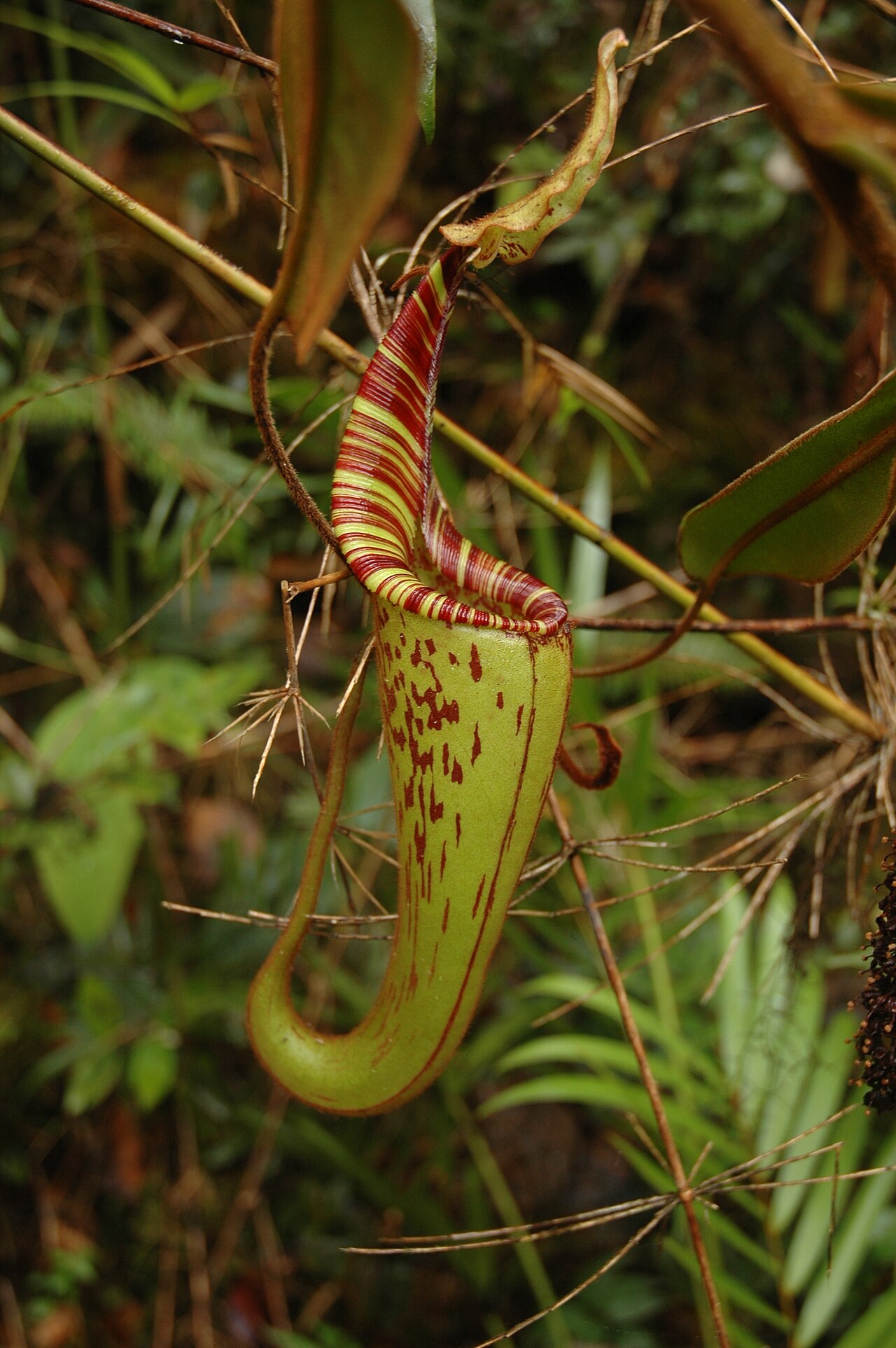
A branched climber to seven metres, with leaves to 35 cm that are hairy on the upper surface, which is unusual in the genus. Stem, midrib and tendril are yellow-green, and nearly all parts bear coarse orange to brown hairs up to 5 mm long. The lower pitchers are narrowly funnel-shaped, to 28 cm tall, with a peristome greatly expanded at the sides and rear, to about 6 cm, and a horizontal mouth. The inside is olive green or yellowish, blotched dark red, purple or black. The upper pitchers are similar but narrower, especially below, to 30 cm long, with a paler wall and brighter markings. Under the narrow lid sits a triangular, slightly hooked appendage, often hairy.
Similar species
At the description Cheek and Lamb suspected that the plant might have arisen from an old cross between Nepenthes fusca and Nepenthes veitchii: the upper pitchers recall N. fusca, the expanded peristome N. veitchii. It differs from both in its dense rusty indumentum, its broad peristome with a long neck and its blotched interior. Whether it stands apart from N. mollis, known from a single pitcherless specimen of 1925, could only be answered when that species was refound in the field; Robinson and colleagues saw no difference.
The trap and how it works
A pitfall with an exceptionally broad peristome collar drawn out towards the back. The peristome carries nectar glands and turns slippery when wet; a broad collar enlarges the area on which insects land and slip. The lid bears nectar glands on its underside. In epiphytic pitchers on Lumarku a golden tree frog of the genus Philautus has been found, using the pitcher as shelter or breeding site, as several frogs in Borneo do. Little has been published on the prey.
Habitat and ecology
Tall mossy mountain forest and upper montane forest between about 1500 and 2400 m, where the plant usually grows as an epiphyte up to ten metres up in the trees (B1). It also occurs in low, mossy heath vegetation on ridges, and only rarely grows on the ground. Notably, it is never found together with its presumed parents N. fusca and N. veitchii, which was an argument for treating it as a species rather than a hybrid. For a pitcher plant such a habitat is favourable: the constant humidity keeps the pitchers filled and the peristome slippery, while the poor soil supplies little nitrogen and phosphorus, so that the extra nutrition from prey is a real advantage.
Distribution and elevation
Endemic to Borneo, known from mountains in northern Sarawak, including Mulu, Murud and the Meligan range, from Lumarku in south-western Sabah, and from Brunei. This agrees with 'Borneo, Brunei, Sabah' in the guide's own species list, although a large share of the known sites lies in Sarawak, which is missing there. If the plants are included in N. mollis, the species also extends to the Kemul Massif in East Kalimantan.
- Recorded (one-degree cells)
Forms and variation
No varieties or wild colour forms have been described. The degree of blotching inside the pitchers varies greatly. Rare natural hybrids have been reported with Nepenthes lowii and with N. veitchii. Note the naming: this guide holds N. hurrelliana and N. mollis as two records, whereas the most recent revision merges them.
Where and when to see it
The most accessible site is Gunung Mulu National Park in Sarawak, where climbing Mulu is a trek of several days with nights in simple camps. Above about 1500 m, in the mossy forest, you have to look up: most plants grow as epiphytes, their pitchers hanging among moss and branches. The rusty indumentum stands out well in the half-light of the cloud forest.
Conservation status
The IUCN Red List assesses the plants under the name N. hurrelliana as Least Concern. The species occurs on several mountains, grows largely in hard-to-reach high country, and part of it lies in protected areas such as Gunung Mulu National Park. Since the plant is now often included in N. mollis, the assessment may be merged in future. As a member of Nepenthes it is listed in CITES Appendix II.
Scientific name
Nepenthes hurrelliana | Cheek & Lamb, 2003
Nepenthes hurrelliana was described in 2003 by Martin Cheek, Matthew Jebb, Ch'ien C. Lee, Anthony Lamb and Anthea Phillipps, in "Nepenthes hurrelliana (Nepenthaceae), a new species of pitcher plant from Borneo" (Sabah Parks Nature Journal 6: 117-124). The type material (A. Lamb & Surat 145/99) is held at the Forest Department herbarium in Sandakan (SAN), originating from Mount Lumarku, Sabah. Mount Lumarku, Sabah, Borneo. The species is named after Andrew Hurrell, who studied the plant on Mount Murud in 1995 and whose field observations showed that it grew in self-sustaining populations independent of its putative parent species, and could thus be considered a distinct species.
World Checklist of Vascular Plants (WCVP), via Plants of the World Online (POWO), Royal Botanic Gardens, Kew.