All species › Caryophyllales › Tropical pitcher plant family › Nepenthes hemsleyana
Nepenthes hemsleyana
The pitcher plant that gets its nitrogen from bats. Nepenthes hemsleyana is a lowland species of the peat swamps and heath forests of north-western Borneo, and its upper pitchers serve as roosts for the small bat Kerivoula hardwickii. The bat finds a dry, safe resting place; the plant collects its droppings and derives much of its nitrogen from them. The species was described by Macfarlane in 1908 but disappeared from view twenty years later as a synonym of Nepenthes rafflesiana. Only in 2013 was the old name restored, after the plant had been described anew in 2011 under a new name, N. baramensis.

Identification
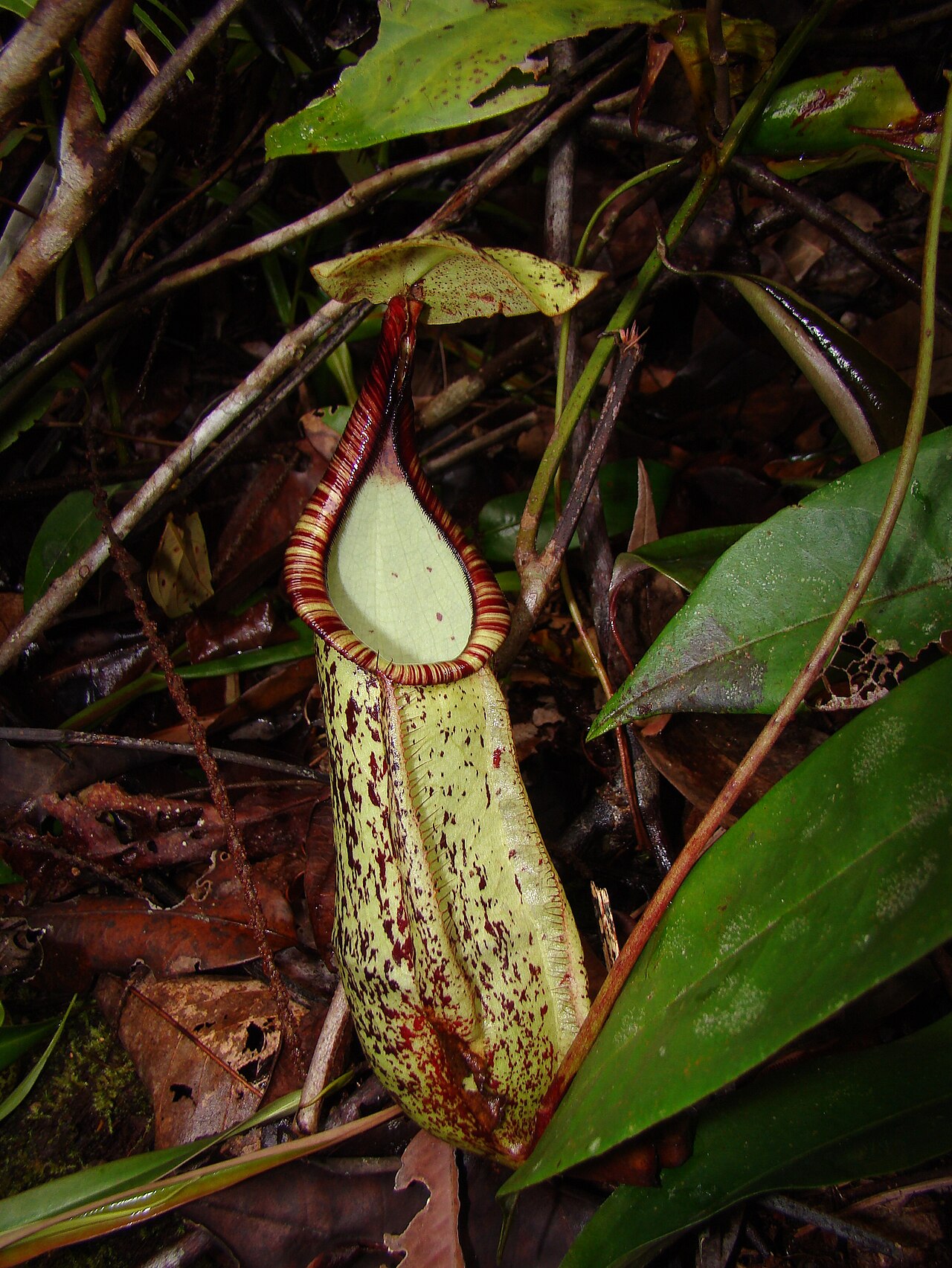
A climber to six metres, much like N. rafflesiana but 'elongated in all respects'. The upper leaves have proportionally longer blades and shorter petioles than in N. rafflesiana. The lower pitchers reach 20 cm, are thin-walled and have two wings down the front. The upper pitchers are long, narrow funnels 18 to 25 cm tall and 3 to 5 cm wide, with a glandular zone below the 'hip' and a waxy layer above it. The peristome is subcylindrical, to 8 mm wide at the front, and ends in teeth on the inner side; the lid is broadly ovate and carries no appendages. The upper pitchers are usually green to yellowish green.
Similar species
The confusion with Nepenthes rafflesiana is understandable: both grow in the same lowlands and look alike. The upper pitchers of N. hemsleyana, however, are longer and slimmer, lack the UV patterns that attract insects to N. rafflesiana, produce less nectar and scent, and hold a more watery, less viscoelastic fluid. The key difference lies in the back wall of the upper pitcher: in N. hemsleyana it bears a dish-shaped structure that reflects sound far more strongly. In 2011 Clarke, Moran and Lee described the plant as N. baramensis; in 2013 Scharmann and Grafe showed that Macfarlane's name has priority.
The trap and how it works
Here the upper pitcher is more bedroom than trap. Work by Ulmar Grafe, Michael and Caroline Schöner and colleagues showed that the woolly bat Kerivoula hardwickii regularly roosts in the upper pitchers, and that the plant derives on average about 34 per cent of its foliar nitrogen from the bats' droppings. The pitcher is adapted accordingly: the fluid level stays low, so the bat can hang above it, and the back wall acts as a sound reflector that strongly returns the bat's echolocation call, helping it find the pitcher in dense forest. Bats roosting in these pitchers are in better condition and carry fewer parasites than those using other roosts. Insects are still caught, but to a lesser degree.
Habitat and ecology
Lowlands below 200 m, in peat swamp forest and heath forest on poor white sand (B4, B3), the kerangas and its waterlogged variant, kerapah. Both forest types are nutrient-poor, acid and wet, with a relatively open canopy. The bats that visit the plant belong to the same forest; where the forest goes, so do the bats, and with them the plant's main source of nitrogen.
Distribution and elevation
Endemic to Borneo, known from the Baram district and the areas of Bintulu and Miri in Sarawak, from Gunung Mulu National Park, and from the Belait and Tutong districts of Brunei. An occurrence in the Kapuas area of West Kalimantan has been mentioned but is unconfirmed. This agrees with the guide's own species list. The type locality lay by a rocky hill near a Kedayan settlement; the area has since been heavily degraded by deforestation and oil palm plantations.
- Recorded (one-degree cells)
Forms and variation
No varieties or wild colour forms have been described. Natural hybrids are known with N. ampullaria and N. rafflesiana, in Brunei mainly in disturbed places. Since N. rafflesiana is itself highly variable and the two species grow side by side, careful identification of the upper pitchers is needed; lower pitchers alone are hard to assign. Like all pitcher plants the species is dioecious: there are male and female plants, and both must be in flower for seed to set. The small, inconspicuous flowers are borne in racemes or panicles and are pollinated by insects; the seeds are light and dispersed by wind.
Where and when to see it
In Brunei and around Miri and Bintulu in Sarawak the species grows in heath and peat forest often reachable by existing trails, for instance in protected forests and national parks. Look for long, slender upper pitchers hanging a metre or two up in the scrub; do not disturb bats resting in them by peering into or moving the pitchers. Bear in mind the presence of N. rafflesiana and compare pitcher shape.
Conservation status
There is no IUCN assessment under this name (Not Evaluated), partly because of the species' late reinstatement. What is known: peat swamp and heath forest in Sarawak and Brunei have been cleared on a large scale in recent decades for oil palm and other agriculture, and the type locality has been degraded too. The species does occur in protected areas such as Gunung Mulu. As a member of Nepenthes it is listed in CITES Appendix II.
Scientific name
Nepenthes hemsleyana | Macfarlane, 1908
Nepenthes hemsleyana was described in 1908 by John Muirhead Macfarlane, in his monograph "Nepenthaceae" (in A. Engler's Das Pflanzenreich); Macfarlane distinguished the species from the closely related N. rafflesiana based on, among other things, the leaf venation, the long and slender tendril, and the slim, elongated pitchers. The type material had already been collected in 1877 by Frederick William Burbidge, on a rocky hill about 150 m high, roughly 3 km from the Kedayan settlement of Meringit, near the Meropok branch of the Lawas River, Sarawak, Borneo; three of Burbidge's specimens are held at the Royal Botanic Gardens, Kew, with K000651485 designated as the lectotype. A rocky hill near the Meropok branch of the Lawas River, near Meringit, Sarawak, Borneo, at approximately 150 m elevation. The specific epithet honours the English botanist William Botting Hemsley, who had previously described other Nepenthes species, including N. macfarlanei and N. smilesii.
World Checklist of Vascular Plants (WCVP), via Plants of the World Online (POWO), Royal Botanic Gardens, Kew.