All species › Caryophyllales › Tropical pitcher plant family › Nepenthes macrovulgaris
Nepenthes macrovulgaris
A specialist of the ultramafic soils of Sabah, where serpentinite and peridotite rock comes to the surface. Nepenthes macrovulgaris was described in 1988 by J.R. Turnbull and A.T. Middleton, who in the 1980s also described a series of new species from Sulawesi. The plant grows on open, poor ground where few other plants survive: scrub, landslides and cliffs on soil that is naturally toxic to most crops. In such places it often forms large sprawling mats with numerous stout lower pitchers.
Identification
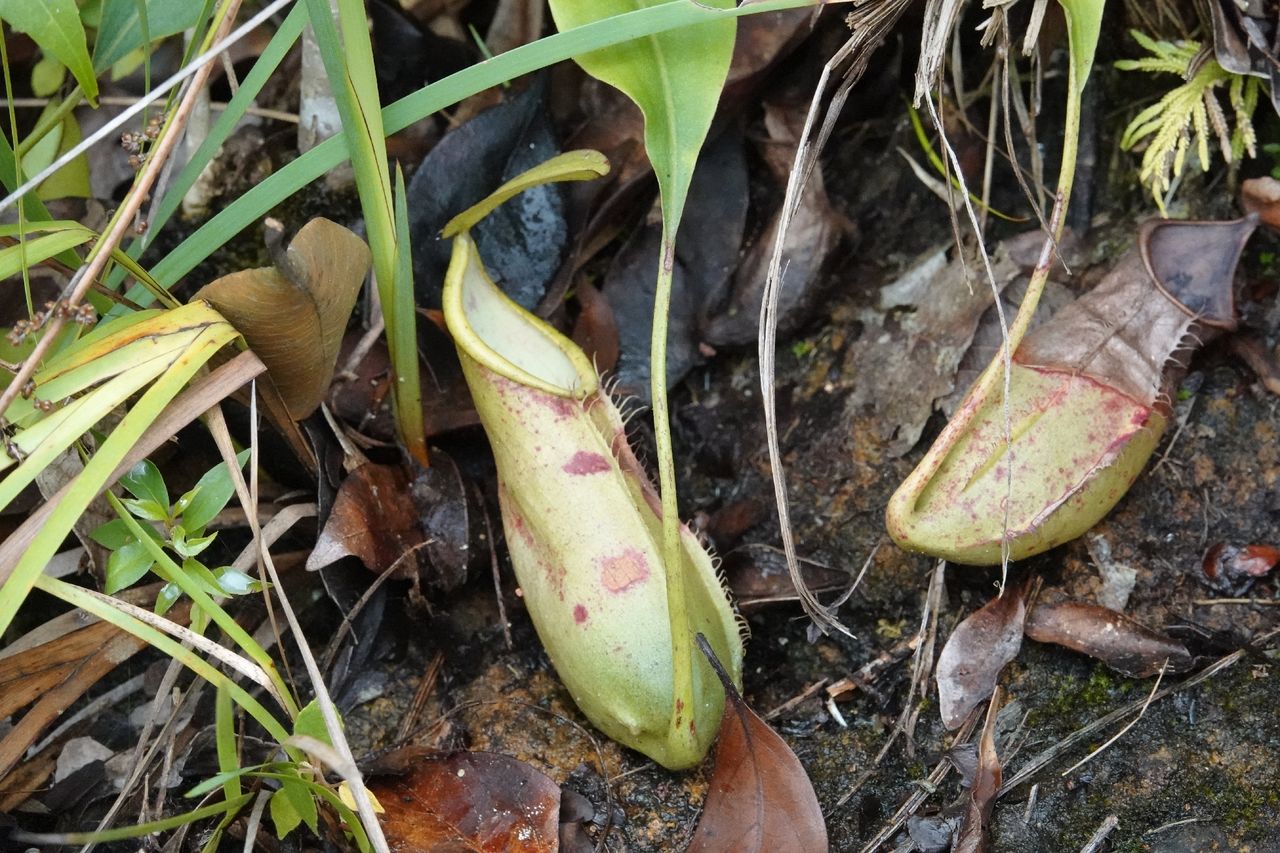
A climber that can reach six metres, but often sprawls over the ground. The stems are 5 to 9 mm thick and glabrous in adult plants; young pitchers bear short, fine hairs. The leaves are chartaceous, to about 30 cm long, oblong to linear, with two to three longitudinal veins on each side. The lower pitchers are what one sees most: stout, inflated to cylindrical, 9 to 23 cm long and up to 9 cm wide, with a cylindrical to flattened peristome. They are green to brown, and the speckled form is the commonest. Upper pitchers are produced much less often, are less inflated and 12 to 16 cm tall. The lid is ovate to elliptic, to just over 5 cm. The difference between lower and upper pitchers is linked to growth stage: young plants and rosettes form lower pitchers, and only when the stem begins to climb do upper pitchers appear, their tendrils often coiling around a support.
Similar species
In appearance N. macrovulgaris resembles Nepenthes hirsuta, Nepenthes hispida and Nepenthes philippinensis, but molecular work shows the likeness to be deceptive: its closest relative is Nepenthes reinwardtiana, a species with two characteristic 'eye spots' on the inner pitcher wall. From the hairy species N. macrovulgaris differs in its glabrous adult stems and its ultramafic habitat. In the field it may grow beside Nepenthes rajah and Nepenthes tentaculata, which look little like it.
The trap and how it works
A pitfall that works mostly on the ground: since the plant often sprawls and forms few upper pitchers, most pitchers lie on or just above the soil and catch mainly walking animals such as ants. Nectar on the peristome and under the lid lures the prey; on the wet peristome the animals lose their grip. Digestive fluid stands at the bottom. On nutrient-poor ultramafic soil, where nitrogen and phosphorus are scarce, the catch supplies an important share of nutrients. No prey study specific to this species was found for this guide.
Habitat and ecology
Scrub, landslides and cliffs on ultramafic soil, often with Casuarina, between about 300 and 1200 m (R3, B5). It also grows in openings in submontane and mossy forest. Ultramafic rock gives a soil rich in magnesium, nickel and chromium and poor in calcium and phosphorus; the forest stays low and open, and that is precisely where this light-loving pitcher plant finds room.
Distribution and elevation
Endemic to Borneo and confined to Sabah, where it occurs on ultramafic sites such as around Kinabalu and Tambuyukon, in the Tawai and Meliau ranges, and around Mount Silam near Lahad Datu. This agrees with 'Borneo, Sabah', but the addition of 'Kinabalu' in the guide's own species list gives too narrow a picture: Kinabalu is only one of many sites.
- Recorded (one-degree cells)
Forms and variation
No varieties have been described. There is colour variation, however: from plain green to brown, with the speckled form as the commonest. Natural hybrids have been reported with N. albomarginata, N. rajah, N. reinwardtiana and N. tentaculata; the cross with N. rajah is a rarity found only on shared ultramafic sites. Like all pitcher plants the species is dioecious: there are male and female plants, and both must be in flower for seed to set. The small, inconspicuous flowers are borne in racemes or panicles and are pollinated by insects; the seeds are light and dispersed by wind.
Where and when to see it
Ultramafic sites can often be recognised in the field by their low, open vegetation and reddish-brown soil. Mount Silam near Lahad Datu has a road and trails to the summit, and around Kinabalu ultramafic slopes are partly visible from the trails. Look in open places and along landslides for large mats with stout, speckled lower pitchers on the ground.
Conservation status
The IUCN Red List assesses the species as Least Concern. It occurs on a series of ultramafic sites in Sabah, several of them in protected areas, and tolerates disturbance such as landslides well. Ultramafic soils are, however, sensitive to mining and fire. As a member of Nepenthes it is listed in CITES Appendix II, so international trade requires a permit. For enthusiasts it is worth knowing that almost all species of the genus are now available through tissue culture; anyone wishing to grow a plant has no need of wild ones.
Scientific name
Nepenthes macrovulgaris | Turnbull & Middleton, 1988
Nepenthes macrovulgaris was described in 1988 by John R. Turnbull and Anne T. Middleton, in the Botanical Journal of the Linnean Society 96(4): 351-358. The precise type locality could not be established with certainty; the species is restricted to ultramafic habitats in Sabah, Malaysian Borneo, with records including Mount Kinabalu and Mount Tambuyukon, Danum Valley, and the Tawai and Meliau ranges and Mount Silam, at 300-1,200 m elevation. The name combines Greek and Latin elements: the describers chose it to indicate a relatively large plant and to indicate that no single characteristic uniquely distinguishes this taxon from all others. The element "vulgaris" does not mean the species is common, but reflects informal field usage among plant collectors and growers.
World Checklist of Vascular Plants (WCVP), via Plants of the World Online (POWO), Royal Botanic Gardens, Kew.