All species › Caryophyllales › Tropical pitcher plant family › Nepenthes paniculata
Nepenthes paniculata
A pitcher plant known for almost a century from a single herbarium sheet. Nepenthes paniculata was described in 1928 by B. H. Danser from material the Dutch botanist H. J. Lam had collected in 1920 during the Van Overeem expedition in the central uplands of what was then Dutch New Guinea. The name refers to the panicle (Latin panicula): the male inflorescence is branched, which is unusual in the genus. Only in August 2013 did an international team of eight researchers find the species again, and the lower pitchers were then seen for the first time.

Identification
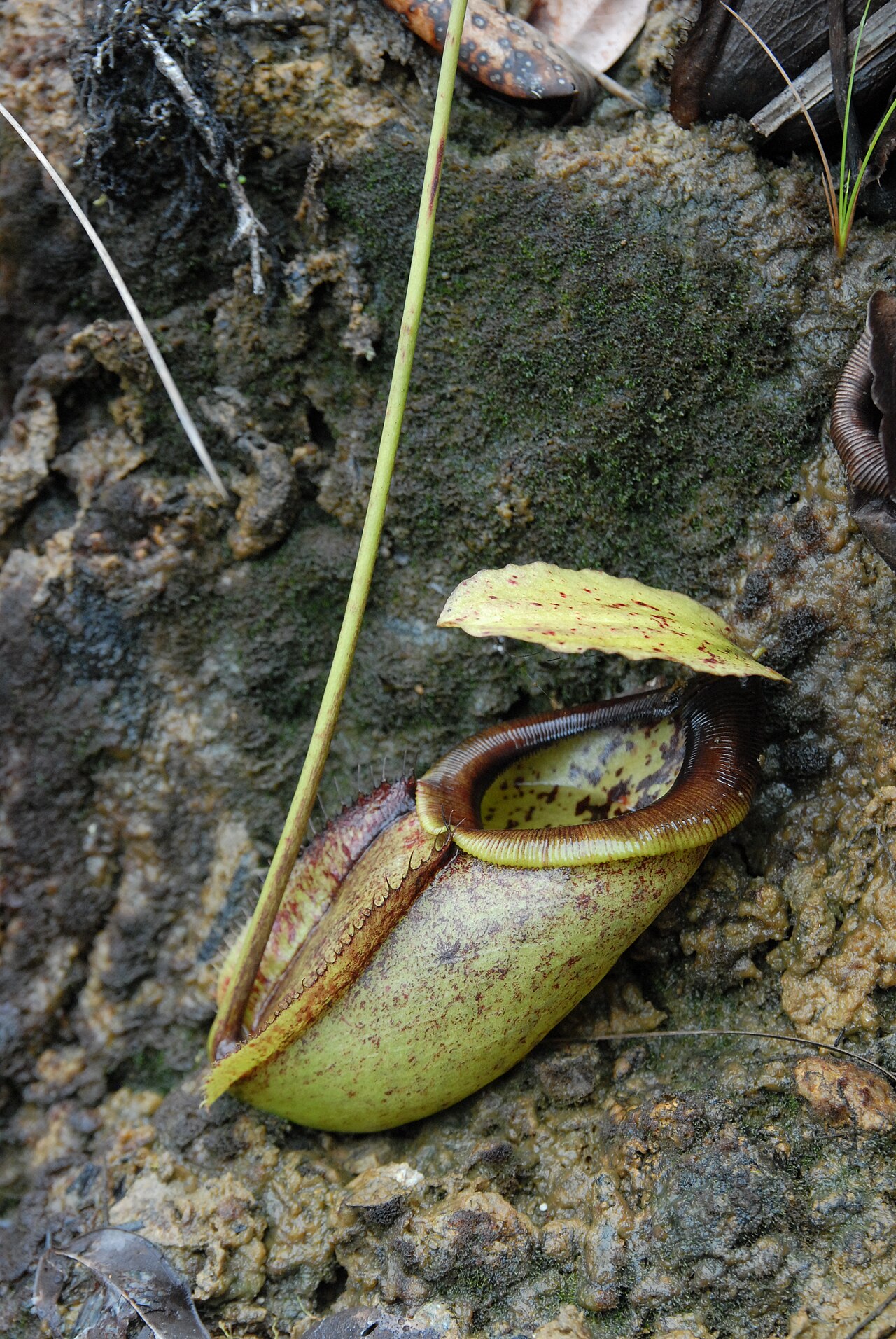
A climber to about seven metres, with terete stems half a centimetre to a centimetre thick. The leaves are leathery and stalked, narrowly elliptic to lanceolate, 20 to 30 cm long and 4 to 7 cm wide, with an acuminate tip and a narrowed base. Upper pitchers are wholly funnel-shaped, 8 to 11 cm tall and 3 to 5 cm wide, with two prominent ribs down the front that sometimes develop into narrow wings in the upper part. The peristome is 4 to 10 mm wide, with ribs half a millimetre to a millimetre apart and conspicuous teeth on the inner edge. The lid is nearly round, about four by five centimetres, with a rounded tip and heart-shaped base. The pitchers are yellowish green, spotted violet inside, with a reddish lid. Young pitchers bear a sparse brown felt that later disappears.
Similar species
According to Flora Malesiana its closest relative is Nepenthes neoguineensis, a widespread lowland species that also has a branched inflorescence. Nepenthes paniculata differs in the shape of its pitchers and peristome: the upper pitchers are wholly funnel-shaped and short, not long and curved, and the peristome bears distinct teeth. The lower pitchers, first seen in 2013, superficially recall those of Nepenthes merrilliana and related species from the Philippines. In its own area Nepenthes papuana is a possible source of confusion; hybrids with that species are also suspected.
The trap and how it works
Little is known about capture in this species, since until 2013 there was only herbarium material. The upper pitchers follow the usual plan of the genus: a slippery, ribbed peristome on which insects lose their grip, nectar glands on the rim and under the lid, and digestive fluid at the bottom. The teeth on the inner edge of the peristome make it harder for prey to clamber back out. The funnel shape and the ribs down the front fit a pitcher that hangs free in the vegetation and mainly catches flying insects. The lower pitchers are larger and more bulbous and presumably catch mainly walking animals, but no published observations on this were found.
Habitat and ecology
Mossy montane forest on a ridge, at about 1460 m, according to the data of the type collection (B1). Cloud forest of this kind is almost constantly damp, with a thick cover of moss on trees and ground, low temperatures and few available nutrients. Nothing more precise about the soil and light conditions at the site was found in the literature consulted. That the species stayed unfindable for so long is partly because later expeditions climbed a different slope of the mountain from the one where Lam had collected in 1920.
Distribution and elevation
Probably endemic to a single mountain in the west-central uplands of the Indonesian province of Papua, on New Guinea. Our own species list gives the broader 'New Guinea'; that is correct, but the area actually known is far smaller. Because the species is listed as Endangered, this guide gives no closer indication of the site. The known altitude is about 1460 m. Whether the species also occurs on neighbouring ridges is unknown: the region is vast, inaccessible and poorly explored botanically.
- Recorded (one-degree cells)
Forms and variation
No varieties or forms have been described. Natural hybrids with Nepenthes papuana are suspected but poorly documented. As the species was known until 2013 from one herbarium sheet only, almost nothing can yet be said about variation within it. The Flora Malesiana description covers only upper pitchers and a male inflorescence; the lower pitchers were first photographed at the rediscovery and are not fully described with measurements in the sources consulted.
Where and when to see it
There is no responsible way to give a site tip for this species. It is extremely local, endangered and reachable only by a long expedition into remote mountains, with permits and local guidance. Anyone who sees in the montane forest of Papua a climbing pitcher plant with short, yellowish-green funnels, toothed peristomes and a reddish lid would do well to share photographs and a description with a herbarium or with specialists, but not to publish an exact location, and not to collect plants or seed.
Conservation status
Listed on the Red List as Endangered. The reason is the tiny known range: probably one mountain, with a population of unknown size. In 2001 Flora Malesiana still described the species as poorly known and known only from the type. No specific threats are named in the sources consulted; the area is remote, but so small a population is sensitive to any disturbance, including the collection of plants after the rediscovery. As a member of Nepenthes it is listed in CITES Appendix II, so international trade in wild plants requires a permit.
Scientific name
Nepenthes paniculata | Danser, 1928
Nepenthes paniculata was described in 1928 by Benedictus Hubertus Danser, in the Bulletin du Jardin Botanique de Buitenzorg. Doorman Top, a mountain in New Guinea (03°28'01"S, 138°26'59"E) — the same mountain as N. lamii (golf 25); more recent finds come from mossy forest on a ridge top at 1,460 m elevation. The specific epithet derives from the Latin "panicula" ("panicle"), a botanical term referring to a type of branched flower cluster.
World Checklist of Vascular Plants (WCVP), via Plants of the World Online (POWO), Royal Botanic Gardens, Kew.