All species › Caryophyllales › Tropical pitcher plant family › Nepenthes pantaronensis
Nepenthes pantaronensis
The Pantaron Range in the heart of Mindanao is one of the largest more or less continuous forest areas of the southern Philippines, and it has only recently been surveyed specifically for pitcher plants. Fieldwork in 2012 yielded material from which four new species from the mountains of central Mindanao were described in 2014, described by a German-Filipino team around Thomas Gronemeyer and Victor Amoroso of Central Mindanao University. Nepenthes pantaronensis is named after the range itself. It is a species that lives high in the trees, and so escaped attention for a long time.
Identification
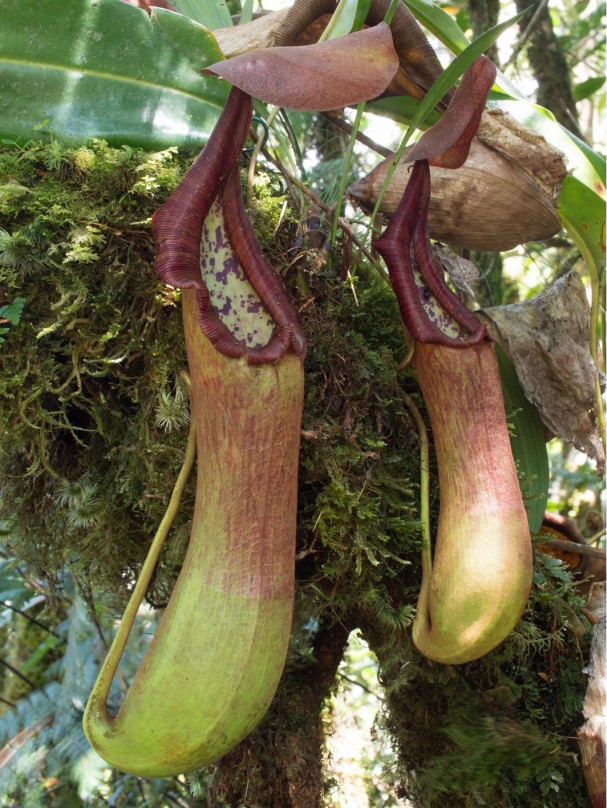
An epiphytic climber with stems up to three metres long and almost a centimetre thick. The leaves are linear to oblong, to 28 cm long and 5 cm wide, with only two longitudinal veins on each side of the midrib; at the base of the plant they have a channelled petiole, on climbing stems a broadly winged one. The tendrils reach 34 cm. Lower pitchers are up to 35 cm tall, with a basal quarter to third that is more or less inflated, sometimes bulbous; the wings are usually reduced to ribs. The peristome is flattened and up to 2.5 cm wide, red with yellow, orange or purple bands; the lid is ovate, up to seven centimetres long and bright red on both sides. Upper pitchers reach 40 cm, with a bulbous basal fifth to quarter and a peristome of one to two centimetres; sometimes they are entirely green.
Similar species
The describers compare the species with Nepenthes pulchra, which occurs in the same part of Mindanao. That species has three to four longitudinal veins on each side of the midrib instead of two, lower pitchers with distinctly fringed wings rather than reduced ones, and a broadly winged petiole even at the base of the plant. The habit differs too: Nepenthes pulchra grows strictly on the ground in open scrub, Nepenthes pantaronensis high in the trees of montane forest. A bulbous base on both lower and upper pitchers, combined with a broad striped peristome, is characteristic of this species.
The trap and how it works
A pitfall trap with an exceptionally broad peristome. In lower pitchers the flattened rim is up to 2.5 cm wide and so forms a generous, slippery 'landing strip' on which insects coming for nectar lose their grip. The bulbous base of the pitcher holds much fluid, in which prey drowns and is digested; the inner surface is white to pale yellowish green with purple-red blotches. Because the plant lives as an epiphyte, even the 'lower' pitchers often hang high above the ground, catching climbing as well as flying animals. Nothing has been published on the composition of the prey.
Habitat and ecology
Epiphytic on tall trees in lower montane forest (B1). The type collection comes from 1390 m; on a second mountain the species grows at middle elevations. Because it sits high in the crowns it is hard to see from the ground, and it may well be commoner in the range than the few records suggest. No altitudinal range has been published; the elevation field is therefore left empty.
Distribution and elevation
Endemic to Mindanao, in Bukidnon Province: the Pantaron Range and adjacent mountains. The describers cite the type locality on Mount Gaka and a second population on Mount Sumagaya, somewhat further north. The Pantaron Range is the ancestral domain of indigenous peoples such as the Talaandig, Manobo and Higaonon, and part of the forest is of cultural importance to them.
- Native
Forms and variation
No varieties have been described. Colour varies: the outside of the lower pitchers is greenish or blotched orange-red, the upper pitchers are similarly coloured but sometimes entirely green. The peristome is usually red with yellow, orange or purple bands. The description mentions no natural hybrids.
Where and when to see it
Binoculars are the main tool: search the montane forest of central Mindanao along trunks and in the crowns for hanging pitchers with a bulbous base and a broad striped peristome. Fallen trees and ridge trails sometimes give a view of plants otherwise out of reach. The area is the land of indigenous communities; access runs through local government and tribal organisations, and respecting their rules is not a formality.
Conservation status
The Red List assesses the species as Least Concern. In 2014 the describers still proposed Near Threatened, but already noted that it occurs on more than one mountain. The Pantaron Range suffers from logging and mining, and protection of the area is a cause taken up by local and indigenous groups. As a member of Nepenthes it is listed in CITES Appendix II, so international trade in wild plants requires a permit.
Scientific name
Nepenthes pantaronensis | Gieray, Gronemeyer, Wistuba, Marwinski, Micheler, Coritico & Amoroso, 2014
Nepenthes pantaronensis was described in 2014 by Angelika Gieray, Thomas Gronemeyer, Andreas Wistuba, Wolfram Marwinski, Volker Micheler, Franco Coritico and Victor B. Amoroso, in Plants 3(2): 284-303 — the same article as N. cornuta (golf 20). The discovery had already been announced online in September 2012 under a provisional name. The Pantaron Mountain Range and Mount Sumagaya, central Mindanao, Philippines, in lower and upper montane forest. The specific epithet refers to the Pantaron Mountain Range, where the species was discovered — the same range as N. cornuta (golf 20).
World Checklist of Vascular Plants (WCVP), via Plants of the World Online (POWO), Royal Botanic Gardens, Kew.