All species › Caryophyllales › Tropical pitcher plant family › Nepenthes sibuyanensis
Nepenthes sibuyanensis
Sibuyan is a small, rugged island in the middle of the Philippines, and the ridge of Mount Guiting-Guiting on it is one of the most remarkable botanical places in the country. Nepenthes sibuyanensis was found there in September 1996 by a group of pitcher-plant enthusiasts, Thomas Alt, Phill Mann, Trent Smith and Alfred Öhm, and described in 1998 by Joachim Nerz in the Carnivorous Plant Newsletter. It is one of the squattest, most heavily built pitcher plants of the Philippines, with pitchers that can be almost as broad as they are tall.
Identification
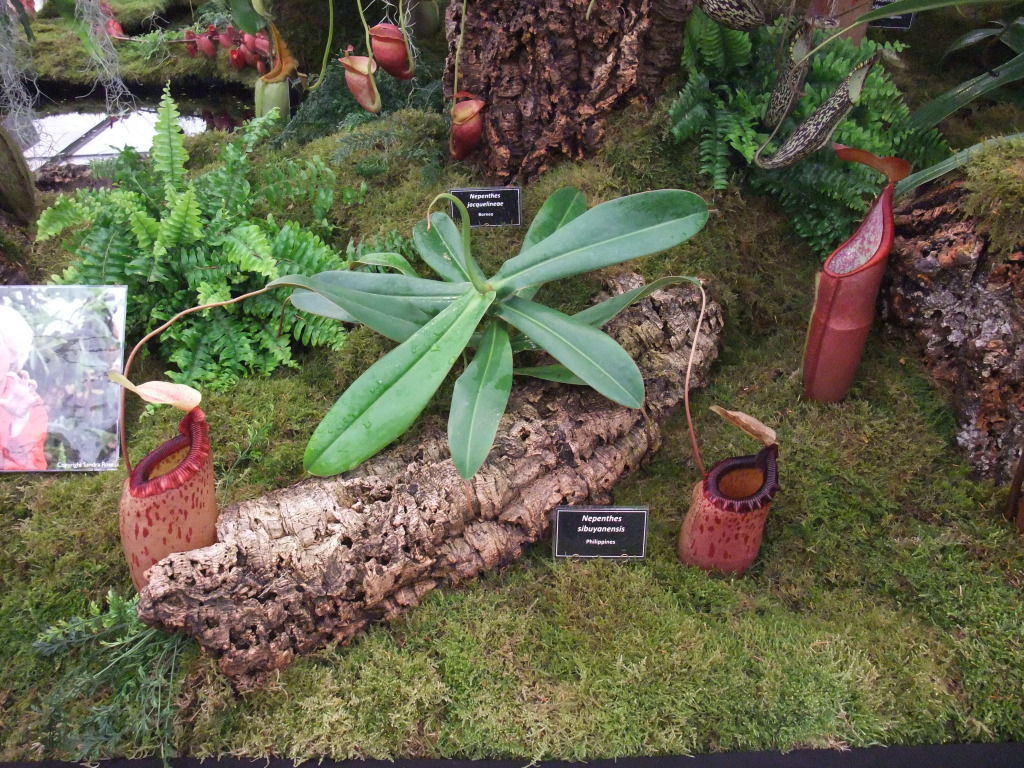
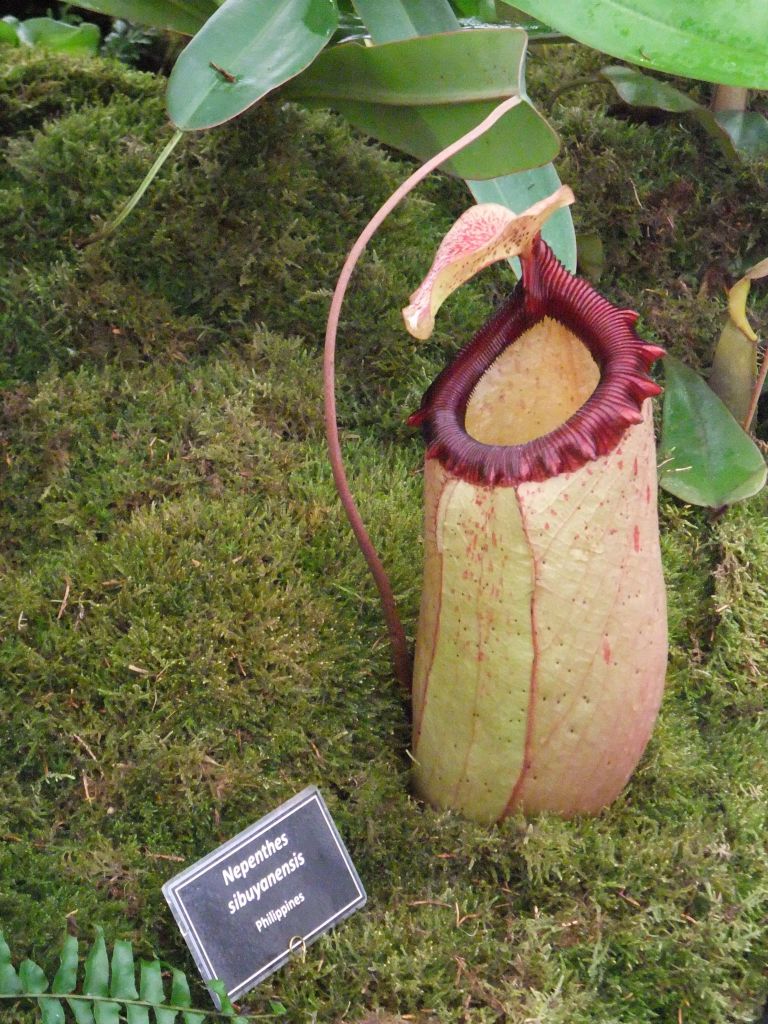
A shrub or short climber 0.7 to 2 m tall, with a sturdy stem almost a centimetre thick. The leaves are sessile, linear-lanceolate to slightly spathulate, 10 to 21 cm long, and run down the stem in narrow wings. The most striking point is that lower and upper pitchers are nearly alike: shortly ovoid-cylindrical, to 20 cm (sometimes 25 cm) tall and to 12 cm (sometimes 15 cm) wide, without a waist. Only the lower pitchers bear fringed wings, and then only over the upper two-thirds. The mouth is ovate to almost circular and rises steeply at the back into a short, broad neck. The peristome is very broad, 2 to 3 cm, with ribs a millimetre high, six to eight shallow lobes on the outer margin and teeth three to five millimetres long on the inner margin. The lid is ovate, 8 to 10.5 cm long, without appendages. Pitchers are green or yellowish to dull orange or pink with a few red blotches in the upper third; the peristome is glossy bright red to purplish black.
Similar species
The species belongs to the group around Nepenthes ventricosa of Luzon and Nepenthes burkei of Mindoro. Both have pitchers clearly waisted in the middle, like an hourglass; Nepenthes sibuyanensis lacks that waist and has larger, broader pitchers. On Sibuyan itself confusion is hardly possible. Nepenthes argentii is a dwarf at most thirty centimetres tall with pitchers of four to five centimetres; Nepenthes graciliflora and Nepenthes armin grow lower on the mountain and have narrow, slender pitchers with a thin peristome.
The trap and how it works
A pitfall that nearly always lies on or in the ground. The pitchers usually develop half-embedded in the substrate, among grass and ferns, and are rarely in full light; as a result even the upper pitchers work largely as ground traps for walking animals. The broad peristome with its high ribs and long inner teeth forms a wide, smooth rim that turns treacherously slippery when wet; the teeth project over the inner wall and presumably make it hard for an insect to climb back out. There are relatively few nectar glands under the lid, 35 to 60, but they are large, up to two millimetres. Nothing has been published on the composition of the prey.
Habitat and ecology
Open, grassy slopes among tall grass, small shrubs and the fern Dipteris conjugata, probably on ultramafic soil (R3), between about 1300 and 1800 m. These are the open ridges and slopes of Sibuyan's high country, where forest gives way to low vegetation in wind and mist (R5). The plant grows rather scattered. Other notable endemics grow on the mountain, such as Lobelia proctorii and Rhododendron rousei.
Distribution and elevation
Endemic to Sibuyan, in Romblon province. The species is known from Mount Guiting-Guiting, neighbouring Mount Mayo and the ridge linking the two. Published altitudinal limits vary, from 1250–1500 m to 1500–1800 m; the Flora Malesiana treatment gives 1350–1800 m, and the holotype comes from 1300 m. The elevation field follows Flora Malesiana, extended by the altitude of the holotype.
- Recorded (one-degree cells)
Forms and variation
No varieties have been described. Pitcher colour varies considerably, from green and yellowish to dull orange and pink, and the peristome from bright red to almost black; that variation follows the light in part. No natural hybrids are known with certainty. Because Nepenthes argentii grows on the same slopes between about 1600 and 1770 m, a cross between the two has been suggested as a possibility.
Where and when to see it
The pitchers sit in the grass and among the ferns, not in the shrubs: search low, and look for the glossy red rim showing among the green. Mount Guiting-Guiting is a protected natural park and a hard, steep climb; the high country requires a climb of several days with a permit and a local guide, and the weather up top is often wet and cold. The same route passes through the altitudinal zones of the island's other pitcher plants: Nepenthes graciliflora and Nepenthes armin lower down, Nepenthes argentii higher up.
Conservation status
The Red List assesses the species as Vulnerable, on account of its very small range on a single mountain massif. The massif lies within Mount Guiting-Guiting Natural Park, but logging and above all mining proposals on Sibuyan are a recurring threat to the park and its surroundings. The species is listed in CITES Appendix II, like the whole genus.
Scientific name
Nepenthes sibuyanensis | Nerz, 1998
Nepenthes sibuyanensis was described in March 1998 by Joachim Nerz, in Carnivorous Plant Newsletter 27(1): 18-23. The holotype (sheet 051001) was collected on 5 October 1996 by Phill Mann and Trent Smith, on Mount Guiting-Guiting — the same mountain as N. argentii and N. armin (golf 18) — at 1,300 m elevation, on an open slope amongst high grasses and ferns of the genus Dipteris. Mount Guiting-Guiting, Sibuyan island, Philippines, at 1,300 m elevation. The specific epithet derives from Sibuyan Island, Philippines, to which the species is endemic, with the Latin suffix "-ensis" denoting geographical origin.
World Checklist of Vascular Plants (WCVP), via Plants of the World Online (POWO), Royal Botanic Gardens, Kew.