All species › Caryophyllales › Tropical pitcher plant family › Nepenthes neoguineensis
Nepenthes neoguineensis
The pitcher plant of New Guinea's rivers: a tall climber of gravel bars, banks and ridges, distributed along the whole length of the island. Nepenthes neoguineensis was collected as early as 1828 by Alexander Zipelius at Triton Bay on the south-west coast. A herbarium name from 1900, Nepenthes leptoptera, was never validly published; the species was only described in 1911 by John Muirhead Macfarlane, based on female material Gerard Versteeg had collected in 1907. It is regarded as one of the more primitive members of the genus because of its branched inflorescence.

Identification
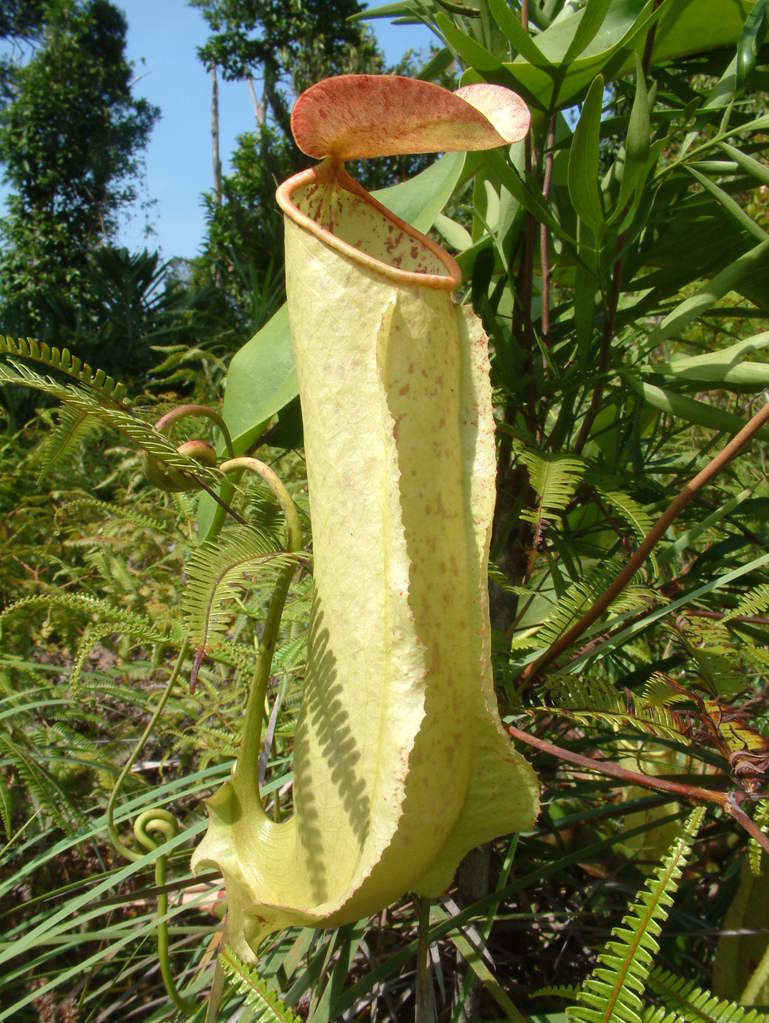
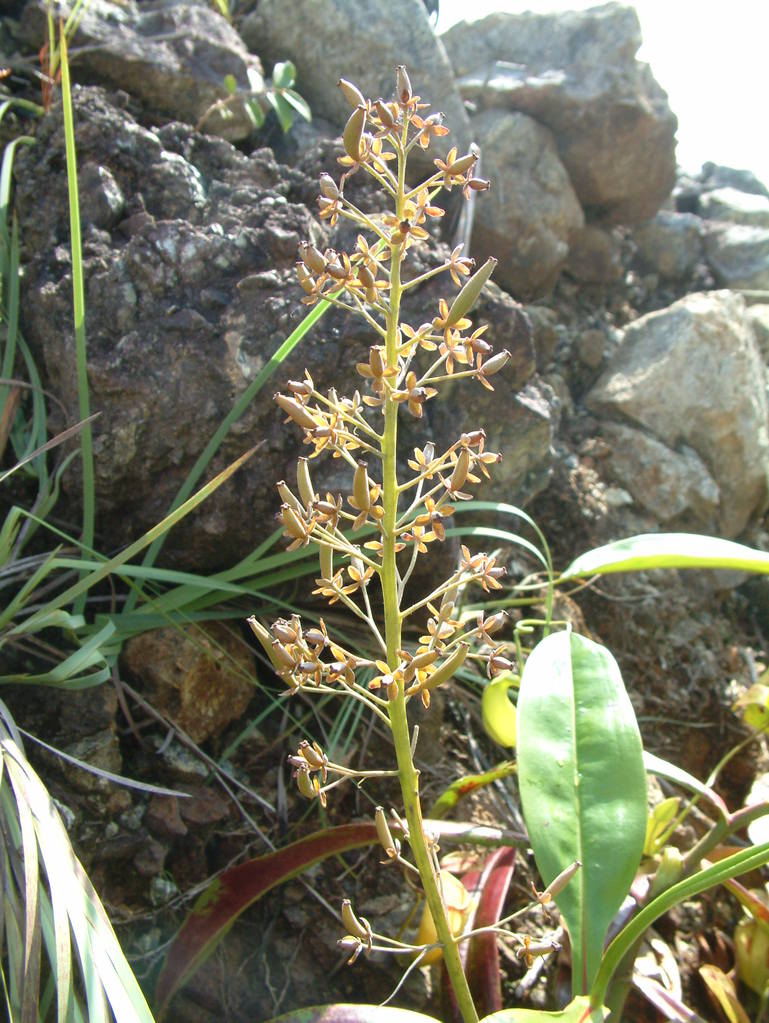
A vigorous climber that can reach ten metres or more into the vegetation, with quadrangular stems. The leaves are papery and stalked, narrowly oblanceolate, 15 to 35 cm long and usually 2.5 to 5 cm wide. The plant is almost hairless, brown-felted only in the leaf axils. Lower pitchers are ovoid and cylindrical towards the mouth, to 14 cm tall and 4.5 cm wide, with prominent fringed wings up to a centimetre broad. Upper pitchers are almost cylindrical and curved over most of their length, to 24 cm tall and 5 cm wide, with fringed wings that are widest at the base of the pitcher. The lid is nearly round, to 6 cm. The inflorescence is 35 to 50 cm long and carries pedicels that branch in a corymb into several flowers.
Similar species
According to Flora Malesiana, the curved upper pitchers with broad fringed wings widest at the base, together with the corymbose partial peduncles, are diagnostic. Its closest relatives in New Guinea are Nepenthes papuana, very similar vegetatively but with a racemose inflorescence of mostly one-flowered pedicels and more densely hairy leaf margins, and Nepenthes paniculata, with short, wholly funnel-shaped upper pitchers and a toothed peristome. Danser saw affinity with Nepenthes tomoriana from Sulawesi and Nepenthes distillatoria from Sri Lanka. In the field Nepenthes mirabilis is the usual source of confusion; it has straighter upper pitchers without broad wings.
The trap and how it works
Two clearly different pitchers. Lower pitchers are squat and sit on or just above the ground, with broad fringed wings that serve as a ramp for ants and other walking animals. Upper pitchers hang from long tendrils and have a peculiar curved shape; they too keep their wings, widest at the base. As throughout the genus, the peristome works as a slide once wet, and nectar glands on the rim and under the lid draw insects to the mouth. The inner wall carries several hundred digestive glands per square centimetre. No specific prey study was found in the literature consulted.
Habitat and ecology
River banks and gravel bars, ridge crests, rarely open grassland or disturbed forest, from sea level to 900 m and occasionally to 1400 m (W7, B5, B2). The preference for river banks and gravel bars is characteristic: these are open, light, repeatedly disturbed places with a thin, free-draining soil, where a tall climber can grow up through the scrub to the light. On ridge crests the species finds similar open conditions. In closed lowland forest it grows mainly at the edges.
Distribution and elevation
Distributed along the whole length of New Guinea, in both the Indonesian west and Papua New Guinea, and on the D'Entrecasteaux Islands off the eastern tip; it may also occur on Misool. Our own species list gives 'New Guinea', which matches the literature. It is one of the more widespread species of the genus on the island, especially in the lowlands and hills. It is not known from the Moluccas or Australia.
- Recorded (one-degree cells)
Forms and variation
No varieties or forms have been described. Where ranges overlap, the species forms natural hybrids with Nepenthes ampullaria and Nepenthes maxima; these hybrids are generally intermediate between the parents. Colour varies mainly between pitcher types: lower pitchers from light green to entirely dark purple, upper pitchers usually yellowish green, often with a darker peristome and a bright red lid. That colour combination of the upper pitchers, together with their curved shape, makes the species easy to recognise in the field.
Where and when to see it
Follow the rivers. In the lowlands of Papua New Guinea and western New Guinea the species is easiest to find on gravel bars and banks, where scrub grows and the plant's tendrils hang free. Look for curved, yellowish-green pitchers with a red lid, and search the ground beneath the shrubs for the squat, winged lower pitchers. Ridge crests with low scrub are a second good place to look. As the species can cross with Nepenthes ampullaria and Nepenthes maxima, it is worth noting intermediate forms.
Conservation status
Assessed on the Red List as Least Concern. The species has a large range across the whole island, grows in naturally dynamic places such as river banks and gravel bars, and tolerates some disturbance. As a member of Nepenthes it is listed in CITES Appendix II, so international trade in wild plants requires a permit. No specific threats are named in the sources consulted; locally, gravel extraction, mining and deforestation along rivers may affect populations.
Scientific name
Nepenthes neoguineensis | Macfarlane, 1910
Nepenthes neoguineensis was described in 1911 by John Muirhead Macfarlane, based on the specimen Versteeg 1746 (female plant material), in Nova Guinea 8(1): 339-341. The type material was collected on 25 September 1907 on a "Nepenthes hill" in New Guinea. A "Nepenthes hill" in New Guinea; the species occurs more broadly across both Papua New Guinea and Western New Guinea, from sea level to 900 m, occasionally up to 1,400 m. The specific epithet derives from its native location, meaning "of New Guinea", the island after which the plant is named.
World Checklist of Vascular Plants (WCVP), via Plants of the World Online (POWO), Royal Botanic Gardens, Kew.