All species › Caryophyllales › Tropical pitcher plant family › Nepenthes tenax
Nepenthes tenax
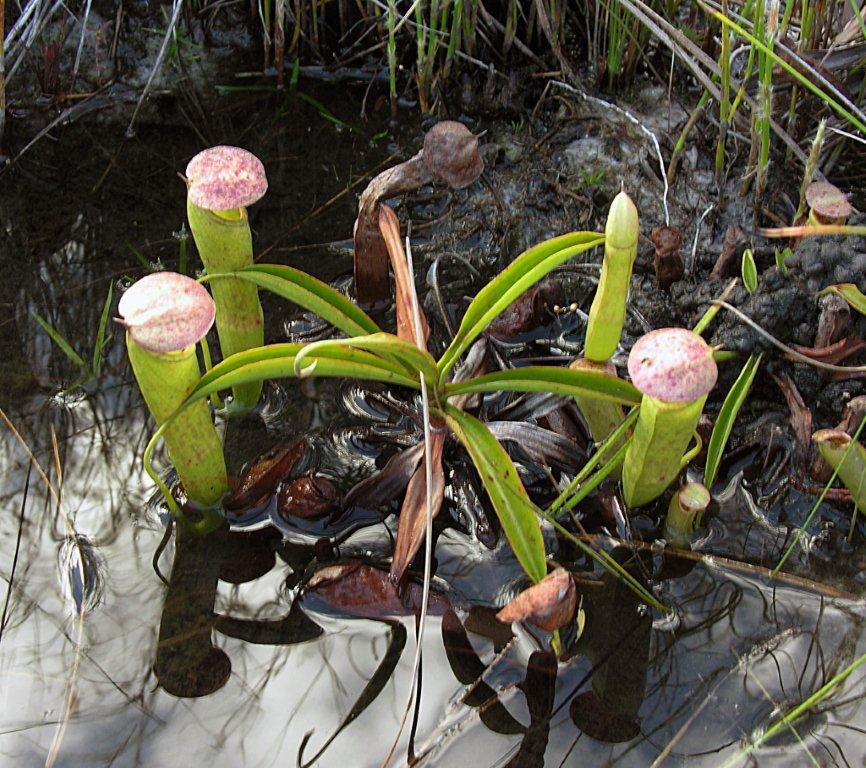
For a long time Australia officially had just one pitcher plant, the widespread Nepenthes mirabilis. Fieldwork at the northern tip of Cape York early this century changed that. Charles Clarke and Rob Kruger showed that a small, upright species that did not fit N. mirabilis grew in the swamps along the Jardine River, and described it in 2006 as Nepenthes tenax. It is a little shrub that does not climb but stays upright on stiff stems in the open swamp vegetation — with pitchers hardly longer than a finger.
Identification
A shrubby plant at most a metre tall, with stems up to 0.5 m and sometimes 1 m long, 2 to 6 mm thick. It grows monopodially: when the main stem dies, new stems sprout from the rootstock. The rosette leaves are very narrowly linear, to 60 mm long and 8 mm wide; the stem leaves are lanceolate, to 110 mm long and 25 mm wide, and strikingly V-shaped in cross-section. Young parts carry simple and star-shaped hairs that later fall away. Lower pitchers are up to 55 mm tall and 10 mm wide, ovoid to funnel-shaped; upper pitchers reach 110 mm tall and 20 mm wide and are wholly funnel-shaped. Both have a round, oblique mouth with a rigid, finely ribbed peristome with minute teeth. The inflorescence is a raceme to 16 cm; the fruits are about 12 mm long.
Similar species
Four species grow on Cape York, and confusion is real. Nepenthes mirabilis is a climber with much larger, thinner leaves and bigger pitchers. N. rowaniae has robust, leathery blades running far down the stem and pitchers with flattened wings. N. parvula, described in 2016, is most like N. tenax but smaller in every part, has a deep red lid underside and grows only in permanently wet swamps. N. tenax is recognised by the combination of upright, non-climbing growth, V-shaped stem leaves and narrow, funnel-shaped upper pitchers. Hybrids with N. mirabilis are frequent and sometimes muddy the picture.
The trap and how it works
A small pitcher trap which, because of its size, mainly catches small prey: ants, small flies and other creatures from the swamp vegetation. The lower pitchers sit close to the ground in the rosette and catch walking animals; the upper pitchers stand on the stems in open air and also catch flying insects. The rigid, finely ribbed peristome with its minute teeth works as in other species: once wet it is slippery and lets insects slide inside. Digestive fluid stands at the bottom. Its size does not make it a minor catcher; the density of plants in a good swamp is high.
Habitat and ecology
Open, wet vegetation on the floodplains along the Jardine River: open sandy ground or saturated peat in the lower parts of swamps, in vegetation described as open heath (W4, W6). It grows at practically sea level, in permanently wet swamps and peaty hollows. The surrounding savanna burns regularly; the rootstock lets the plant resprout after fire. The species stands in full sun and depends on open vegetation.
Distribution and elevation
Endemic to Australia, in Queensland, on the northern part of the Cape York Peninsula around the Jardine River. Most subpopulations lie within Apudthama National Park. It grows at practically sea level. With N. mirabilis, N. rowaniae and N. parvula it is one of the four species of Cape York, the only place in Australia where pitcher plants occur; three of them are endemic to Australia.
- Recorded (one-degree cells)
Forms and variation
No varieties or forms are recognised. Before 2006 the species was included in N. mirabilis, like the other Australian pitcher plants. Two natural hybrids have been documented: N. tenax × N. mirabilis, which is fairly common and can form large hybrid swarms, and the rarer N. tenax × N. rowaniae. In such swarms every intermediate occurs between the upright N. tenax and the climbing N. mirabilis, which can make field identification difficult.
Where and when to see it
Northern Cape York is only reachable overland in the dry season, roughly June to October; in the wet season roads and rivers flood. The Jardine River area and Apudthama National Park are the region; follow the roads that cross the swamps and heath flats and look for small, upright plants with narrow pitchers among the sedges and low shrubs. The area is remote and calls for a four-wheel drive, ample supplies and respect for the rights of the traditional owners of the land.
Conservation status
The Red List assesses the species as Least Concern, because of its abundance, stable population and protection: most subpopulations lie in a national park. The original description still rated it ‘lower risk, conservation dependent’, precisely because all known populations lie in protected areas. Possible threats are a changed fire regime, feral pigs rooting in swamps and illegal collection. As a member of the genus it is listed in CITES Appendix II.
Scientific name
Nepenthes tenax | Clarke & Kruger, 2006
Described by Charles Clarke & Rodney Kruger in 2006, in Austrobaileya, volume 7, no. 2, p. 319-324. Holotype from the head of Cowal Creek near Cape York, Queensland, Australia; the species is found around swamp and floodplain margins of the Jardine River, northern Cape York Peninsula, on open sandy or saturated substrates, near sea level. From the Latin tenax ("tenacious, steadfast") — refers to the upright stems and pitchers that, uniquely among pitcher plants, remain erect in open, windy terrain without support from surrounding vegetation.
World Checklist of Vascular Plants (WCVP), via Plants of the World Online (POWO), Royal Botanic Gardens, Kew.