All species › Caryophyllales › Tropical pitcher plant family › Nepenthes ventricosa
Nepenthes ventricosa
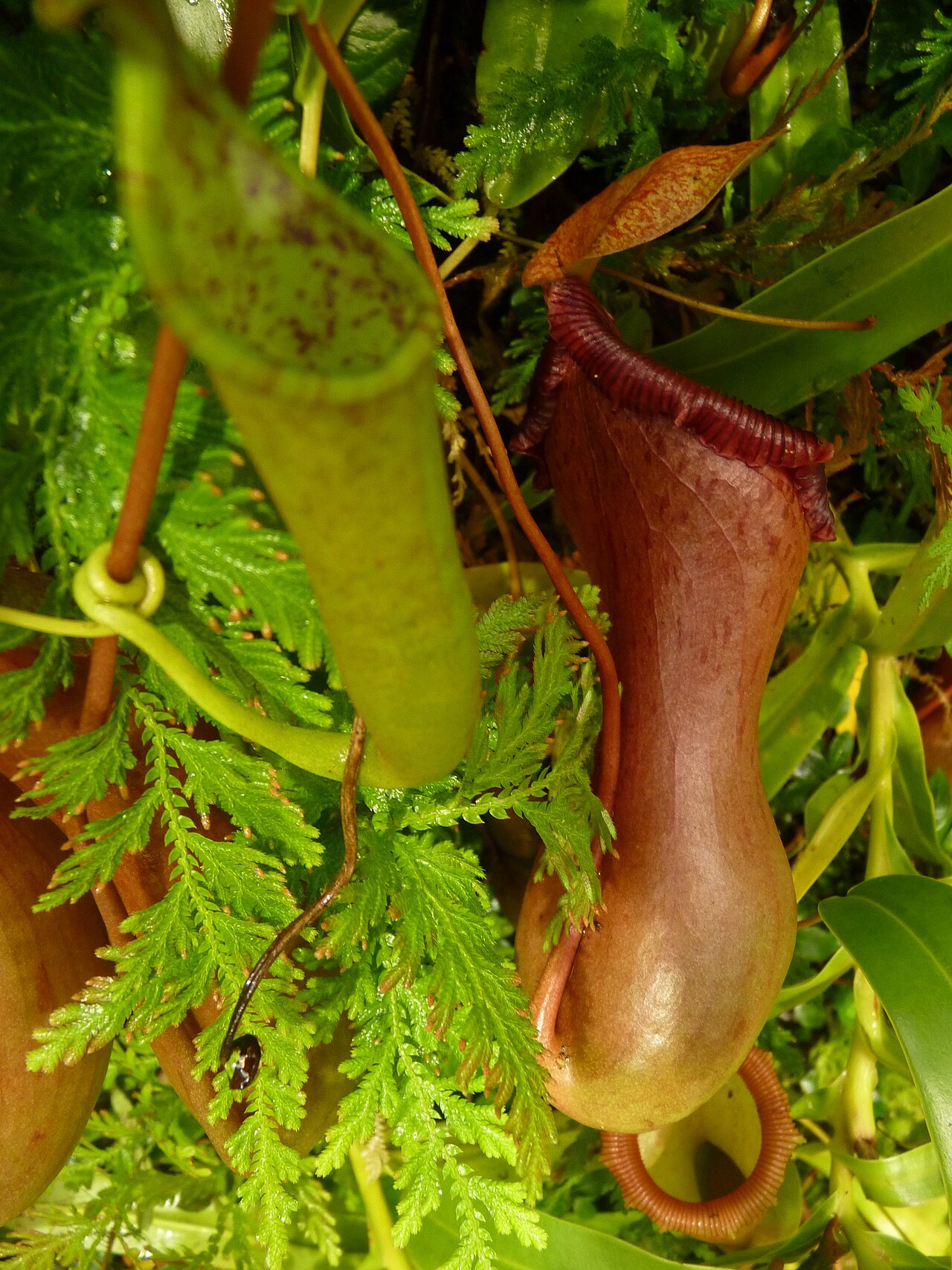
The pitcher plant with hourglass pitchers. Nepenthes ventricosa — Latin for 'swollen on one side' — has pitchers strongly constricted in the middle, with a bulbous base and a wide, red-rimmed mouth. It was described in 1837 by the Spanish Augustinian friar and botanist Francisco Manuel Blanco in his Flora de Filipinas, the same flora in which he described Nepenthes alata. It is a mountain species of northern Luzon, of low, mossy oak forest. It is widespread in cultivation, but in the wild it is far less well known than its popularity suggests.

Identification
A climber of at least two metres, sometimes epiphytic, with winged to sharply three-angled stems 3.5 to 9 mm thick. The leaves are papery to thinly leathery and sessile, oblanceolate or narrowly oblong, 15 to 25 cm long and only 2 to 3 cm wide. The plant is almost hairless, with here and there inconspicuous appressed reddish hairs half a millimetre long. The upper pitchers are unmistakable: hourglass-shaped, 9 to 16 cm tall, with a waist exactly in the middle only a half to a third as wide as the base or mouth. They are uniformly creamy white. The peristome is broad and almost round, 10 to 25 mm, with coarse ribs one to two millimetres apart, and bright red. The interior is yellowish. The lid is narrowly elliptic, 4 to 6 cm long and about 2 cm wide.
Similar species
According to Flora Malesiana the species is easily distinguished from Nepenthes alata by its angular stems and white, hourglass-shaped upper pitchers. Closely related are Nepenthes burkei from Mindoro and Nepenthes sibuyanensis from Sibuyan; Nepenthes ventricosa differs from these in the stronger constriction in the middle, the smaller mouth and usually the narrower peristome. Anyone who sees an hourglass-shaped pitcher with a creamy white wall and a red peristome on a climber in the montane forest of northern Luzon is almost certainly looking at this species.
The trap and how it works
A trap in which shape does the work. The broad red peristome with coarse ribs is the lure zone: nectar glands lie there, and once the surface is wet, insects lose their grip. Below the mouth sits the bulbous upper part, then the narrow waist, and below that the bulbous base holding the digestive fluid. The constriction makes it hard for a fallen insect to climb back: it must pass a narrow neck over a slippery wall. The creamy white of the pitcher against the red peristome gives a strong contrast that may be conspicuous to flying insects; no study of the prey of this species was found in the literature consulted, however.
Habitat and ecology
Low, mossy oak forest in the mountains, at 1200 to 1500 m according to Flora Malesiana; other overviews give an altitudinal range of 1000 to 2000 m (B1). This is cloud forest: cool, almost always damp, with trees covered in moss and epiphytes, and an acid, humus-rich soil. The plant climbs through the low vegetation or grows epiphytically on mossy branches. Like many montane species of the genus it does not tolerate prolonged heat or drought.
Distribution and elevation
Endemic to the Philippines. Flora Malesiana gives only Luzon; other overviews also report the species from Panay and Sibuyan. Our own species list gives Luzon, which matches the core record. On Luzon its centre lies in the northern uplands, the Cordillera Central. Records from other islands warrant caution, as related species such as Nepenthes sibuyanensis also occur there and the species is widely cultivated, so the origin of plants is not always clear.
- Recorded (one-degree cells)
Forms and variation
No wild varieties or forms have been described. Pitchers vary in colour from ivory white to red, with a peristome that is usually bright red. Hybrids with Nepenthes alata are mentioned in the literature, but it is not always clear whether wild or cultivated plants are meant; this guide covers only what has been established in the wild. Differences between lower and upper pitchers are not separately described in the sources consulted; the flora bases its description on the upper pitchers.
Where and when to see it
The uplands of northern Luzon, with their rice terraces and pine forests, are easy to travel from Baguio and the other mountain towns. Search not in the pine forest but in remnants of low, mossy oak forest on higher slopes and ridges, between about 1200 and 1500 m. The white hourglasses stand out well against the green. Ask locally about trails through cloud forest and respect the rules of protected areas and the rights of the indigenous communities on whose land you walk.
Conservation status
Assessed on the Red List as Least Concern. The species has a fairly large range in the uplands of Luzon and is not regarded as seriously threatened in the sources consulted. As a member of Nepenthes it is listed in CITES Appendix II, so international trade in wild plants requires a permit; the extensive trade in this species rests on cultivated material. The cloud forest of northern Luzon is under pressure from conversion to vegetable farming, logging and road building, which may affect populations locally.
Scientific name
Nepenthes ventricosa | Blanco, 1837
Described by Francisco Manuel Blanco in 1837, in "Flora de Filipinas. Segun el Sistema sexual de Linneo" (Manila, Sto. Thomas por D. Candido Lopez, p. 805-809) — one of the oldest Nepenthes descriptions in this guide. The precise type locality could not be established with certainty. The species is endemic to the Philippines (Luzon, Panay, Sibuyan), a highland species at 1000-2000 m elevation. From the Neo-Latin ventricosus ("having a swelling on one side") — refers to the characteristic bulging shape of the pitchers.
World Checklist of Vascular Plants (WCVP), via Plants of the World Online (POWO), Royal Botanic Gardens, Kew.