All species › Caryophyllales › Tropical pitcher plant family › Nepenthes hamata
Nepenthes hamata
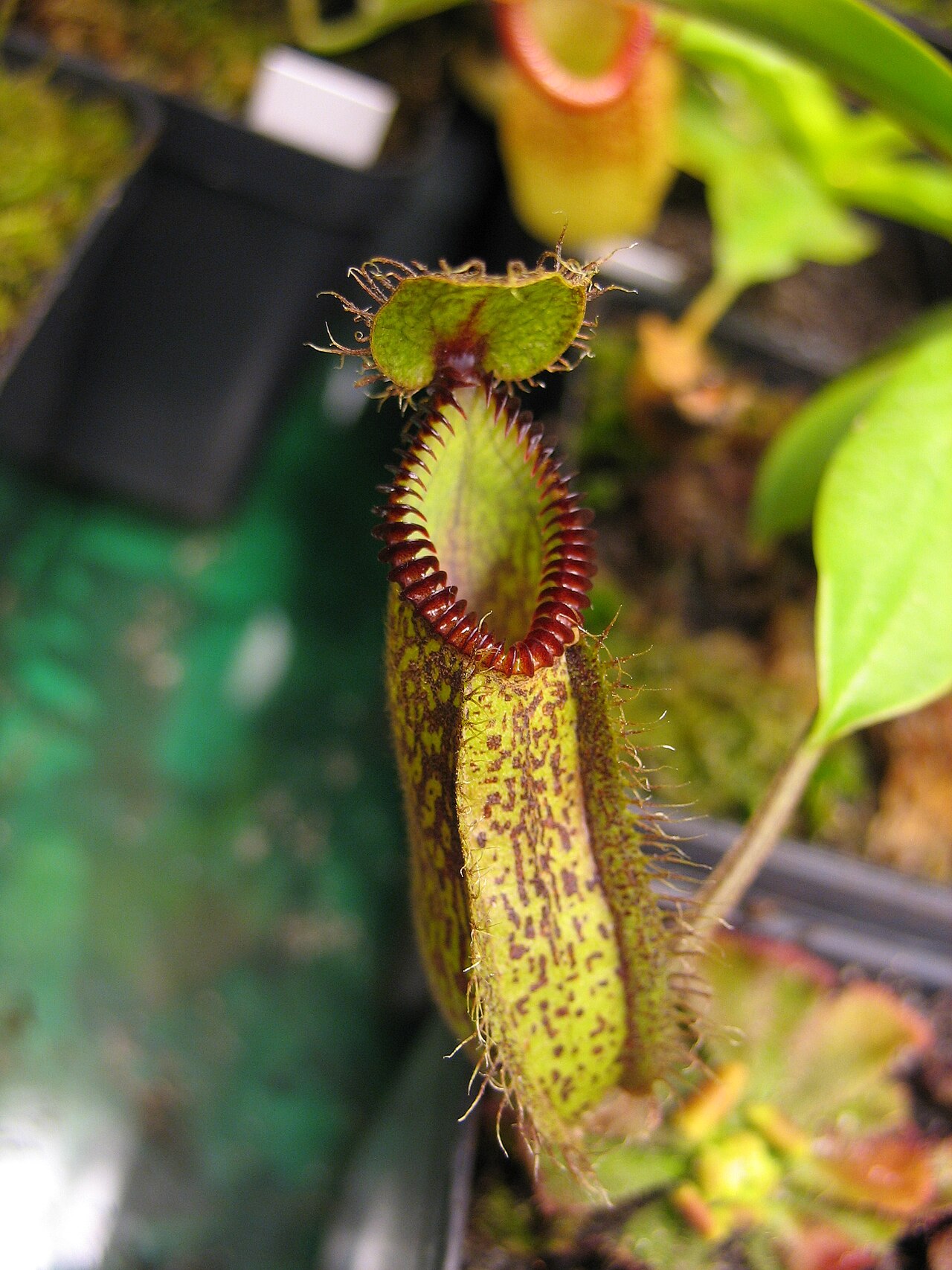
One of the most bizarrely built pitcher plants in the world. The peristome of Nepenthes hamata bears not ordinary ribs but a ring of long, curved teeth projecting inward over the mouth of the pitcher like hooks; the name means 'hooked'. The species was described twice, almost simultaneously, in 1984: by J.R. Turnbull and A.T. Middleton in the Indonesian journal Reinwardtia, and by the Japanese pitcher plant specialist Shigeo Kurata as N. dentata. Turnbull and Middleton's name took priority. It is a mountain species of Central Sulawesi, long a rarity known only from a few expeditions.

Identification
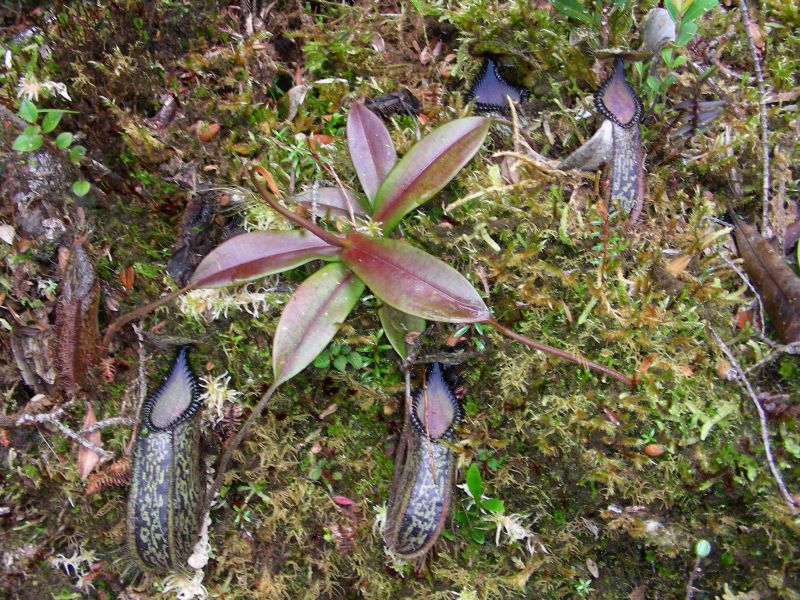
A climber to about seven metres, with thin stems of 4 to 5 mm and small, chartaceous leaves, usually only 5 to 7 cm long on the climbing stems. The lower pitchers are small and narrowly ovoid, 7 to 11.5 cm tall, with two fringed wings. The upper pitchers are slightly ovoid below and cylindrical above, 7 to 20 cm tall. Both carry the famous peristome: a narrow rim whose ribs are drawn out into falcate teeth about five millimetres long, overhanging the inner edge. The lid is ovate, to almost 4 cm, and its underside bears up to 45 multicellular, filiform processes on each side. Many plants are heavily blotched dark red to almost black.
Similar species
The closest relative is Nepenthes tentaculata, a smaller species of Borneo and Sulawesi that also has filiform processes on the lid but no conspicuous teeth on the peristome. Within Sulawesi N. hamata is most like Nepenthes diabolica, described in 2020, which also has a strongly toothed peristome; that species is more densely and woollier haired, and its teeth are even more developed. Nepenthes nigra and Nepenthes glabrata belong to the same group, but have a peristome with at most fine teeth.
The trap and how it works
What the hooks actually do has long been a puzzle. The teeth on the peristome are extended ribs; nectar glands lie between their bases, so an insect after nectar must walk over the rim and work its way between the teeth towards the mouth. Once on the wet peristome it slides inward. The explanation most often given is that the teeth hinder captured animals from climbing out, or nectar thieves from feeding without stepping onto the peristome; this has never been shown experimentally, however. The filiform processes under the lid probably also serve as a lure. No prey study has been published.
Habitat and ecology
Open mountain ridges and summits between about 1400 and 2500 m, where the plant grows rooted in thick moss and climbs into the low trees (B1, R5). This is mossy upper montane forest and dwarf forest on the ridges, with high humidity and a cool climate. The plant grows terrestrially or as an epiphyte and tolerates partial shade. For a pitcher plant such a habitat is favourable: the constant humidity keeps the pitchers filled and the peristome slippery, while the poor soil supplies little nitrogen and phosphorus, so that the extra nutrition from prey is a real advantage.
Distribution and elevation
Endemic to Sulawesi and known there from the province of Central Sulawesi, including Mount Lumut (the type locality), Sojol, Tambusisi and the Tomongkobae mountains, and also from the eastern peninsula. This agrees with 'Sulawesi' in the guide's own species list. Some populations lie within Lore Lindu National Park and Morowali Nature Reserve. Sulawesi lies east of Wallace's Line, in the transition zone between the Asian and Australian floras and faunas, and holds far fewer pitcher plants than Borneo; all the more striking, then, that a large share of the island's species is endemic.
- Recorded (one-degree cells)
Forms and variation
No varieties or wild forms have been formally described. Colour ranges from green with red blotches to almost entirely dark red or black. Natural hybrids have been reported with N. glabrata and N. tentaculata. What was once offered in the trade as 'red hairy hamata' later proved to be a species of its own, N. diabolica.
Where and when to see it
The mountains of Central Sulawesi can only be climbed on treks of several days, usually from villages at their foot with local guides. On the open ridges above about 1400 m, search the moss and the low trees for the small, toothed pitchers; their dark colouring does not always make them easy to spot in the moss. Lore Lindu National Park has rangers and trails, but the summits with N. hamata lie far off the beaten track.
Conservation status
The IUCN Red List assesses the species as Least Concern (assessed 2018): it is spread over several mountains, most populations are remote and not directly threatened, and some lie in protected areas. Collecting for the trade was once a concern, but since tissue culture made the species widely available in the 1990s, the incentive to collect wild plants has much diminished. As a member of Nepenthes it is listed in CITES Appendix II.
Scientific name
Nepenthes hamata | Turnbull & Middleton, 1984
Nepenthes hamata received two names almost simultaneously in 1984: Shigeo Kurata published the species as "N. dentata" in The Gardens' Bulletin Singapore, while John R. Turnbull and Anne T. Middleton described it in Reinwardtia as "N. hamatus" — the latter name gained priority and is retained in the major reference works. The type material (J.R. Turnbull & A.T. Middleton 83121a) was collected on 19 September 1983 on the west ridge of Mount Lumut, Central Sulawesi (1°07'S, 121°39'E), at 1,850-1,900 m elevation; it was reportedly deposited at Herbarium Bogoriense, though researchers later had difficulty locating it there. The west ridge of Mount Lumut, Central Sulawesi, Indonesia, at 1,850-1,900 m elevation. The specific epithet derives from the Latin "hamatus" ("hooked"), describing the appearance of this species' highly developed peristome teeth.
World Checklist of Vascular Plants (WCVP), via Plants of the World Online (POWO), Royal Botanic Gardens, Kew.